Newsletter
Newsletter Support JNS

Israeli entrepreneur urges African Abraham Accords

The Jewish state’s “success in overcoming national challenges offers practical solutions” to many of the continent’s needs, Haim Taib tells the JNS Policy Conference.

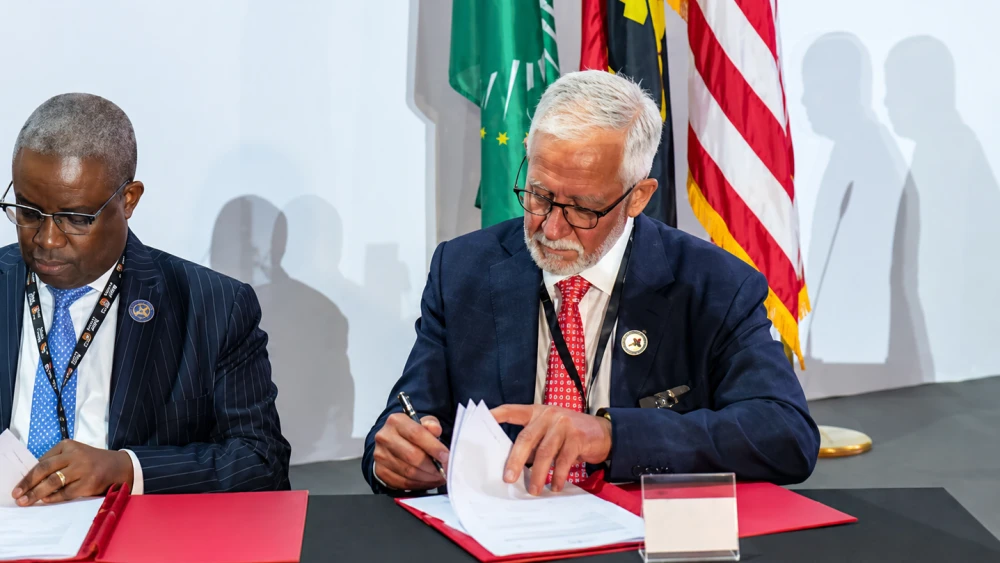
Haim Taib and Armando Manuel, chairman of Angola’s Sovereign Wealth Fund, at the signing of a $1 billion Lobito Corridor development initiative during the U.S.-Africa Business Summit in Luanda, Angola, in June 2025. Credit: Mitrelli.
Armando Manuel, chairman of Angola’s Sovereign Wealth Fund, and Haim Taib, founder and president of the Menomadin Group, at the signing of a $1 billion Lobito Corridor development initiative during the U.S.-Africa Business Summit in Luanda, Angola, June 23, 2025. Credit: Mitrelli.

Israel, the United States, and its Gulf allies should work to create an Abraham Accords partnership with Africa, an Israeli entrepreneur and philanthropist said on Monday.

The comments come amid a growing diplomatic push over the last couple of years to strengthen Israeli ties with the continent, fueled by a mix of religious faith and economic benefits.

“Israel has both the capabilities and the experience to become a meaningful partner in Africa’s next chapter,” Haim Taib, founder and president of the Israel-Africa Relations Institute, told the JNS International Policy Conference in Jerusalem. “Its success in overcoming national challenges offers practical solutions to many of Africa’s most pressing needs.”

The 66-year-old has built a business empire in Angola, where he created more than 100 national-scale development projects over the last three-and-a-half decades.

“The Abraham Accords showed what is possible when countries choose cooperation and opportunity over division,” he said, referring to the landmark 2020 agreement between Israel and four Arab nations led by the United Arab Emirates. “The next chapter of that success story can extend beyond the Middle East and into Africa.”

The current war with Iran has only strengthened these ties.

Taib, who launched a private investment platform last year with a target of $1 billion, proposed a strategic framework connecting Israel, the United States, the Abraham Accords nation, and African countries focused on investment and development.

“Israel brings innovation and technology, the United States brings leadership, financing and strategic influence, the Abraham Accords nations bring investment, connectivity and regional reach. Africa brings young talent, resources and scale,” he said. “Together, they can create one of the most important growth and stability platforms of the 21st century.”

Etgar Lefkovits, an award-winning international journalist, is an Israel correspondent and a feature news writer for JNS. A native of Chicago, he has two decades of experience in journalism, having served as Jerusalem correspondent in one of the world’s most demanding positions. He is currently based in Tel Aviv.
The Qatar-owned news organization “should not be treated as an impartial or authoritative arbiter,” Kurt Schwartz, CEO of the Committee for Accuracy in Middle East Reporting and Analysis, told JNS.
Of Monday’s shooting in Montreal, in which a policeman and a Jewish civilian were killed, Amichai Chikli said he had warned Canada’s government it was heading down the same path as Australia.
The debriefing of the airman has propelled a debate over whether Tehran has advanced Chinese and Russian capabilities.
“The unhinged rants, dehumanizing rhetoric and irrational antisemitism I was spreading were poisoning my own life and terrifying innocent people,” Lucas Gage wrote for Canary Mission.
“We will continue taking decisive action against those who seek to endanger national security and threaten the safety of Americans,” the U.S. attorney for the Western District of Missouri said.
Yechiel Leiter told JNS that he wrote in his introductory letter to the U.S. secretary of state that he represents “the people indigenous to the land of Israel. Period.”
Benny Gantz, JNS editor-in-chief Jonathan S. Tobin, Gilad Erdan, Mosab Hassan Yousef, Nissim Black and leading voices in security, diplomacy, media, law and Jewish communal affairs headline the summit’s third day in Jerusalem.