Prime Minister Benjamin Netanyahu on Thursday inaugurated a new neighborhood in Kibbutz Migdal Oz and announced that Route 60, the historic north-south highway running through Judea and Samaria, will officially be known as the “The Biblical Highway,” linking the moves to Israel’s historic connection to the land and its ongoing security challenges.
Speaking in Gush Etzion alongside his wife, Sara, Netanyahu said the expansion of the kibbutz and the development of communities throughout the region reflected “the power of life and the spirit of vitality” of the Jewish people.
“This is a manifestation of our spirit of vitality and of our sacred mission: to take root in our homeland despite our enemies, despite all the pressures,” Netanyahu said at the unveiling of the Promenade neighborhood in Migdal Oz. “We are not merely treading over the past of the nation of Israel, but securing its future.”
The neighborhood is part of an expansion project expected to double the size of the community within a year.
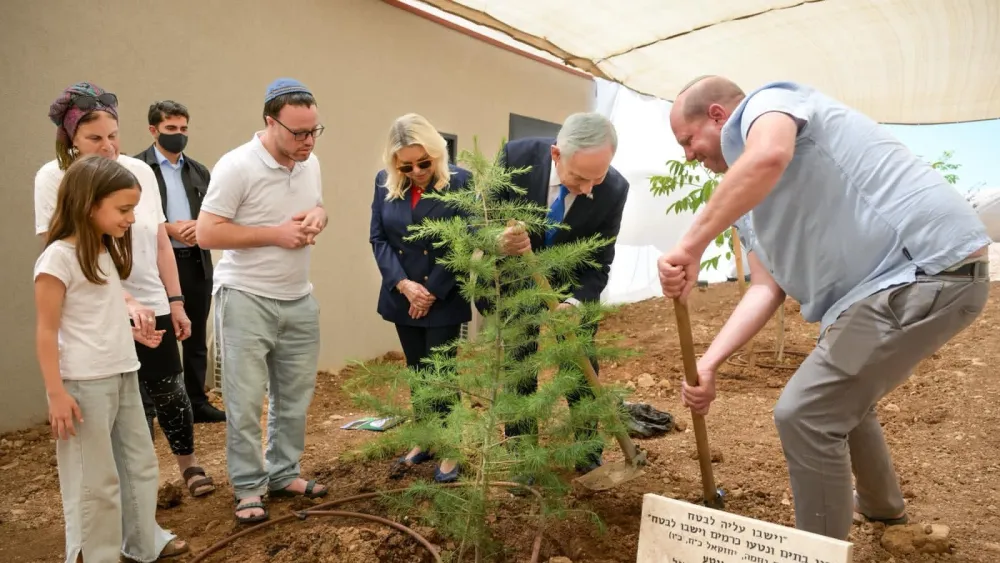
During the ceremony, the prime minister and his wife planted a tree together with Noam Leiter, son of Israeli Ambassador to the United States Yechiel Leiter and a resident of Gevaot in Gush Etzion, and Ofri Nir, daughter of Sgt. Maj. (res.) Yuval Nir, who was killed in the War of Redemption, the ongoing war against Hamas in the Gaza Strip.
The prime minister compared the growth of the neighborhood to trees he had planted during previous visits around the country.
“This tree, its treetops will grasp the sky,” he said. “You are guarding the past and securing the future. The two are intertwined, because we have no future without our past.”

‘We will remain here forever’
Later on Thursday, at a separate ceremony announcing the renaming of Highway 60 as “The Biblical Highway,” Netanyahu described the route as a living link between biblical history and modern Israel.
“This is not merely a road paved with asphalt, it is a road paved with memory, with faith, with promise,” he said. “Between the spirit of the Bible and the heroic spirit of our generation, the Victory Generation, we reaffirm: The people of Israel have returned home and we will remain here forever, because this is our land.”
Netanyahu noted that the road connects key sites in Jewish history, stretching from the Negev to the Galilee and passing through places associated with the biblical patriarchs and the foundations of Jewish identity.
“Each of those places is not merely a point on a map,” he said. “It is a chapter of our identity.”
The prime minister also used the occasion to highlight Israel’s military achievements against Iran and its regional proxies, saying the Jewish state had “fended off the danger of immediate annihilation” through Operations “Rising Lion” and “Roaring Lion.”
“Had we not acted with determination, with daring and with the supreme heroism of our fighters and pilots, Iran would today have the nuclear bombs for our destruction,” Netanyahu said. “But we did not let them.”
He said Israel had significantly weakened Iran’s “Axis of Evil,” citing military operations against Hamas in Gaza and Hezbollah in Lebanon.
“We are gripping Hamas in Gaza, where we hold over 60% of the strip’s territory,” he said. “In Lebanon, we fended off the threat of a ground invasion and shattered Hezbollah’s missile power.”
While acknowledging that “the struggle is not yet over,” Netanyahu reiterated his commitment to maintaining Israel’s security interests while preserving close ties with the United States.
“We will restore security and prosperity to the communities of the north,” he said. “This requires maintaining the security zone in Southern Lebanon. It requires that we do not withdraw from there as long as Israel’s security needs demand it.”
The security zone, he added, serves as “the barrier between Hezbollah terrorists and our citizens and communities.”
Netanyahu also reaffirmed what he called the central objective of his political career.
“We will continue to pursue the supreme goal that has guided me throughout most of my adult life: Iran will not have nuclear weapons,” he said. “As long as I am the prime minister of Israel, that will not happen.”
Concluding his remarks, Netanyahu said the Jewish people’s journey in the Land of Israel began thousands of years ago and would continue indefinitely.
“Our path began thousands of years ago,” he said. “With God’s help, it will continue from the Bible into eternity—the eternity of Israel.”
Huckabee praises initiative
U.S. Ambassador to Israel Mike Huckabee praised The Biblical Highway initiative, saying it highlighted the deep historical roots of the Jewish people in the Land of Israel.
“What you’re doing with the heritage of Israel is not just something for Israelis and the Jewish people to appreciate,” Huckabee said. “It is something for the entire world to take recognition of.”
Huckabee also praised Netanyahu, calling him “a highly respected and beloved figure” in the United States, and commended Transport Minister Miri Regev for helping advance the project.
Referring to archaeological discoveries throughout the country, Huckabee said: “Everywhere you dig in this land, you unearth yet another biblical treasure, another biblical fact, another biblical reality.
“Here’s what it tells us: This was your land for the past 3,800 years,” he continued. “God is the one who gave you the title deed. No government said that. God did.”
Emphasizing the enduring connection between the Jewish people and the Land of Israel, Huckabee added, “It was your land 3,800 years ago. It is your land today. And for the rest of time, it will always be your land.”

The Biblical Highway project
Yishai Fleisher, director of international affairs for the Jewish Community of Hebron, an elected councilman in Efrat and the creator of the Route 60 Biblical Highway project, said the designation of the roadway was the culmination of a four-year effort to transform an educational concept into a national initiative.
“Some years ago, I started teaching ‘The Biblical Highway’ as a way to help people understand the stories of the Bible that happened along this route,” Fleisher told JNS. “Then it dawned on me: Why should I keep it only as a lesson plan? Let’s turn it into an actual policy.”
Fleisher said he and lobbyist Yair Dan spent four years promoting the initiative, working with government ministries, producing educational materials and advancing tourism and heritage plans linked to the route. He also cited collaboration with former U.S. Ambassador to Israel David Friedman, whose documentary “Route 60: The Biblical Highway” helped raise awareness of the corridor’s historical significance.
“Seeing the prime minister, the transport minister, the heritage minister and the ambassador talking about the importance of the Biblical Highway was an amazing once-in-a-lifetime moment,” Fleisher said.
The project is intended to be more than a symbolic renaming, he said. Future plans include educational signage, scenic overlooks, tourism infrastructure and heritage sites along the route.
“This is not just a Judea and Samaria project,” he said. “It runs from Beersheva through Jerusalem and on to the Jezreel Valley and Afula. It’s a holistic, unifying road that connects different parts of Israel. What unifies us is the Bible and this good land.”