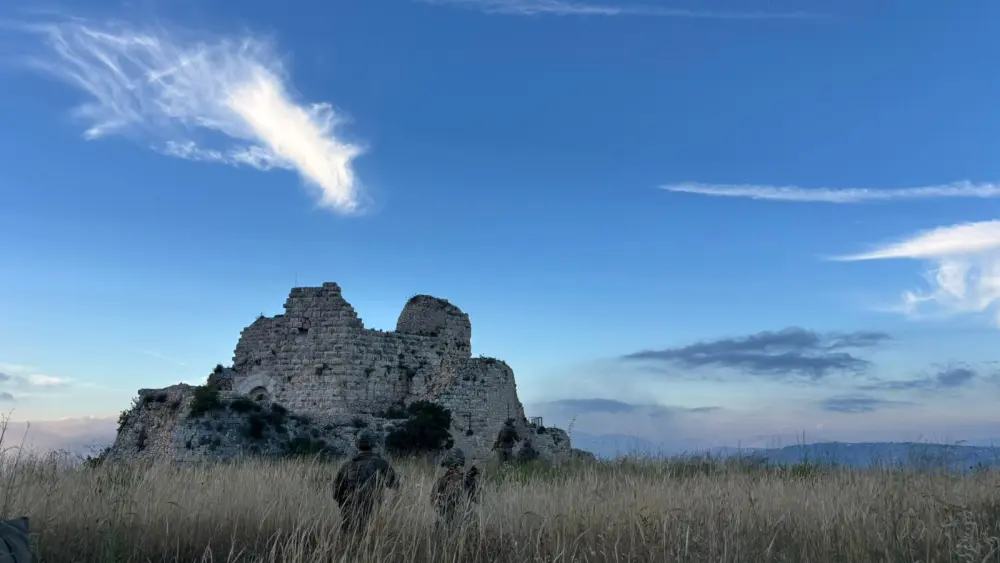
The Israel Defense Forces on Thursday released an updated map of the security zone it controls in Southern Lebanon.
“Due to operational requirements, the IDF is deployed in the security zone, approximately 10 kilometers [6 miles] inside Lebanese territory,” the military wrote in the statement.
“IDF soldiers are stationed in the designated area of operation in Southern Lebanon, and will continue to remove threats and strengthen the defense of Israel’s northern residents,” it added.
The IDF announcement came after U.S. President Donald Trump announced he reached an agreement with the Iranian regime, which declared “the immediate and permanent termination of military operations on all fronts, including in Lebanon.”
According to the updated military map, Israeli troops are operating in a security zone running along Lebanon’s border with the Jewish state, extending roughly 10 kilometers deep in the southwestern coastal sector near Ras el-Bayada and Majdal Zoun and narrowing to about six kilometers (four miles) in the southeast, facing the Israeli frontier town of Metula.
The IDF-controlled territory, demarcated to the north by a “security zone line” that loops around hilltop positions including the Beaufort and Ali al-Taher ridges, encompasses a string of Lebanese towns such as Bint Jbeil, Beit Lif and Kfarkela, while a separate naval security zone covers adjacent Mediterranean waters.
The IDF is deployed in the Security Zone, ~10 km inside Lebanese territory, due to operational requirements.
— Israel Defense Forces (@IDF) June 18, 2026
IDF soldiers will continue to remove threats and strengthen the defense of Israel’s northern residents. pic.twitter.com/jQQPCSAeIe
Iranian-backed Lebanese Hezbollah renewed its rocket and drone attacks on Israel on March 2, following the targeted killing of Iranian Supreme Leader Ali Khamenei on the first day of “Operation Roaring Lion/Epic Fury” on Feb. 28.
In response, Israel launched a broad aerial campaign against Hezbollah targets and expanded military operations in Southern Lebanon aimed at preventing cross-border attacks on Israeli communities.
Jerusalem’s policy is for the IDF to remain in security zones across Lebanon, Syria and Gaza “indefinitely” to protect Israeli border communities, Defense Minister Israel Katz said on Monday.
Katz said that Israeli Prime Minister Benjamin Netanyahu and he were “leading a clear policy” under which the military presence would be maintained in Southern Lebanon.
The defense minister said the zones would be “cleared of local residents” and that “all terrorist infrastructure, above and below ground” would be dismantled. He added that this would include the destruction of houses in border villages that had been used as terror outposts.
Trump in recent days has expressed frustration with Netanyahu over Israeli airstrikes in Beirut that he said could have jeopardized his peace deal with Iran. On Tuesday, Trump said the Jewish state had been fighting Hezbollah for too long and claimed too many civilians have died.
“You don’t have to knock down an apartment house every time you’re looking for somebody,” he told reporters on the sidelines of the G7 summit in France. “Because there are a lot of people in those apartment houses, and they’re not all Hezbollah, that I can tell you.”
He added, “I suggested to Israel to let Syria take care of Hezbollah, because to be honest with you, I think they do a better job of doing it.”