Newsletter
Newsletter Support JNS

Netanyahu makes ‘Time 100’ list for fifth time

The Israeli prime minister joins roughly two dozen world leaders, including Trump, Xi Jinping and Pope Leo XIV, on Time’s 2026 list of most influential people.

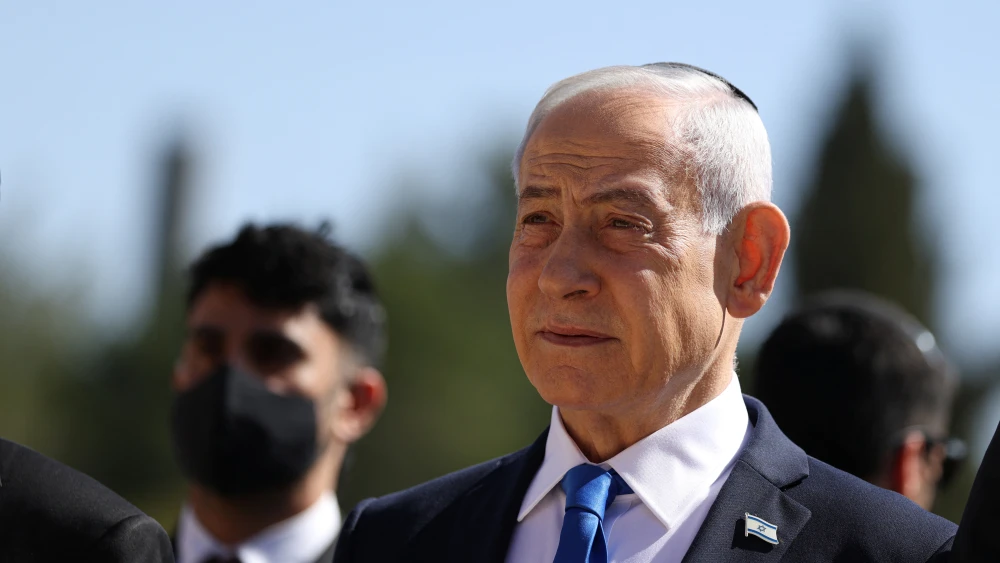
Israel's Prime Minister Benjamin Netanyahu attends a wreath-laying ceremony marking the annual Holocaust Remembrance Day at the Yad Vashem Holocaust Memorial Museum in Jerusalem on April 14, 2026. Photo by Ilia Yefimovich / AFP via Getty Images.
Israel’s Prime Minister Benjamin Netanyahu attends a wreath-laying ceremony marking the annual Holocaust Remembrance Day at the Yad Vashem Holocaust Memorial Museum in Jerusalem on April 14, 2026. Photo by Ilia Yefimovich/AFP via Getty Images.

Israeli Prime Minister Benjamin Netanyahu has been named to Time magazine’s 2026 list of the 100 most influential people in the world, the magazine announced on Wednesday.

It marks the fifth time the longest-serving premier has appeared on the annual list.

“Like President Trump, Benjamin Netanyahu once faced the political wasteland: the Hamas attacks of Oct. 7, 2023, left the Israeli Prime Minister responsible for the worst security failure in his country’s history. The political comeback he then engineered may have exceeded Trump’s own,” Time editor-at-large Ian Bremmer writes. “Israel’s devastation of Hezbollah’s military infrastructure, its crippling strikes alongside the U.S. on Iran’s nuclear program in the [June 2025] 12-Day War, and the eventual extraction of all remaining hostages from Gaza have boosted his standing with the Israeli public.”

Bremmer continues: “This same legacy may also poison international attitudes toward his country. The staggering human toll in Gaza, ongoing West Bank settlement expansion, another incursion into Lebanon, and a darkening war with Iran eroded support among younger Americans—even as Washington remains Israel’s indispensable security partner.

“More chapters will soon be written, but Netanyahu has yet to resolve the tension at the center of his comeback: the actions that saved him politically will also define—and complicate—his legacy.”

Netanyahu is among roughly two dozen political leaders recognized this year, alongside U.S. President Donald Trump, U.S. Secretary of State Marco Rubio, Chinese President Xi Jinping and Pope Leo XIV. Also included are Canadian Prime Minister Mark Carney, Mexican President Claudia Sheinbaum, U.S. Middle East envoy Steve Witkoff and Danish Prime Minister Mette Frederiksen, among others.

See more from JNS Staff
The designations include Hezbollah-linked institutions that “threaten regional stability, international security, mutual interests and global trade,” the U.S. Treasury Department stated.
Gerard Filitti, of the Lawfare Project, told JNS that “lax immigration policy” has always been the main driver of importing “terrorist ideology” into the United States.
“The teachers we have, we don’t respect and support in the way that they deserve,” Paul Bernstein told JNS. “If we’re successful and we grow enrollment, that problem only gets bigger.”
“The message being sent is that you can get away with attacking someone in broad daylight because you disagree with their opinions, especially if it involves feelings about Israel,” Joshua Burt, of the Anti-Defamation League, told JNS.
“Not identifying Hamas as a terrorist organization is, I think, a failure, Marc Miller told the Canadian Press. “And not clearly stating that, for example, Hamas intended to kill Jews is, I think, an unfortunate error in curation and should be rectified.”
“This is life for Jews under the leadership of Mayor Zohran Mamdani,” advocacy group StopAntisemitism wrote.