


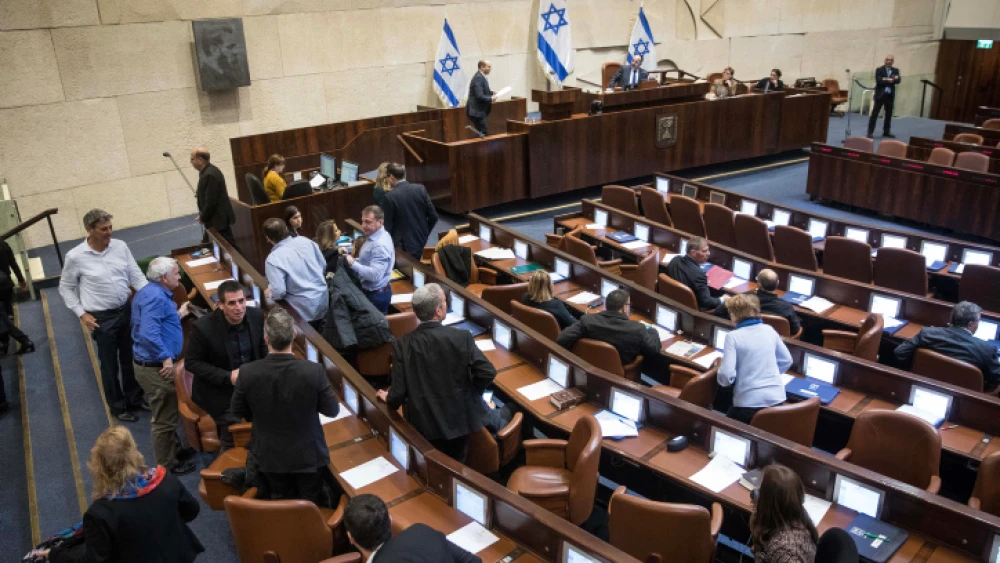
The Knesset plenum early on Tuesday passed by a vote of 65-47 in first reading a bill to split the powers of the attorney general into two separate positions. The bill now returns to the Constitution, Law and Justice Committee for further debate.
The bill’s purpose is to reduce the power held by the attorney general, who both advises the government (and whose legal opinions are binding) and manages criminal proceedings against elected officials.
Supporters of the bill say the current system places too much power into the hands of a single, unelected individual.
The proposed law resolves the issue by dividing the role in two: 1) a legal counselor, who will provide advice to the government and represent the government in civil matters; 2) a public prosecutor, who will represent the government in all criminal proceedings.
Shaul Sharf, senior lecturer in constitutional law at the Peres Academic Center in Rehovot, told JNS in late May when the bill passed out of committee: “Only in Israel is there an unelected clerk, who is the attorney general and also the public prosecutor in criminal matters. There is no such thing anywhere else in the world. There is something similar in England, but he is a politician. He is appointed by politicians.”
Among other changes, the proposed law makes the attorney general’s advice non-binding.
“This is a fundamental and essential correction, which returns the role of the attorney general to the place accepted in every normal country in the world—to advise, and not to impose his opinion by force,” said Bezalel Smotrich, chairman of the Religious Zionism Party, one of whose planks prior to the 2022 election called for splitting the attorney general’s role, in that case, into three separate positions.
The bill also introduces more steps before a case can be brought against a politician. Politicians in Israel have been indicted on little evidence, only to be acquitted or have their cases thrown out.
Unlike the attorney general in the United States, who is appointed by the president and shares his political sympathies, an attorney general in Israel can continue in the position even after the government falls, as is the case with the current attorney general, Gali Baharav-Miara, who was appointed by the Bennett-Lapid government.
She has managed to remain at her post despite having been fired by a unanimous Cabinet decision in August of last year. (Baharav-Miara appealed to the Israeli Supreme Court, which overruled the government.)
At odds with the Netanyahu coalition from the beginning, she has been accused by government members of throwing up obstacles to every piece of legislation they wish to advance.
Although the position calls on the attorney general to represent the government in legal proceedings, particularly before the Supreme Court, there have been repeated instances where the attorney general has refused to do so, in some cases, joining the opinion of the opposing side.
Most recently, Baharav-Miara joined government opponents in calling on the High Court to reject Netanyahu’s pick for Mossad director, Maj. Gen. Roman Gofman. Coalition MKs dubbed her “the opposition leader” in response. (The court upheld Gofman’s appointment on Monday.)
Knesset member Simcha Rothman of the Religious Zionism Party, who helped usher the bill forward as chairman of the Constitution, Law and Justice Committee, posted a video on X in which he thanked Baharav-Miara.
Holding a bouquet of flowers, Rothman said: “Thank you, Gali Baharav-Miara. For more than 10 years, I’ve been trying to convince the public in the State of Israel that we must split the role of the attorney general. And it is only thanks to you that I succeeded.
“It is only thanks to your stubborn stance against every policy of the government ... It is that which convinced so many. And today, the day that the law to split the attorney general role will pass its first reading by a large majority in the Knesset, is your day. Thank you, Gali.”
יש אישה אחת שמגיעה לה תודה מיוחדת היום 🌸 pic.twitter.com/pG7wDbMagM
— שמחה רוטמן - Simcha Rothman (@rothmar) June 1, 2026


