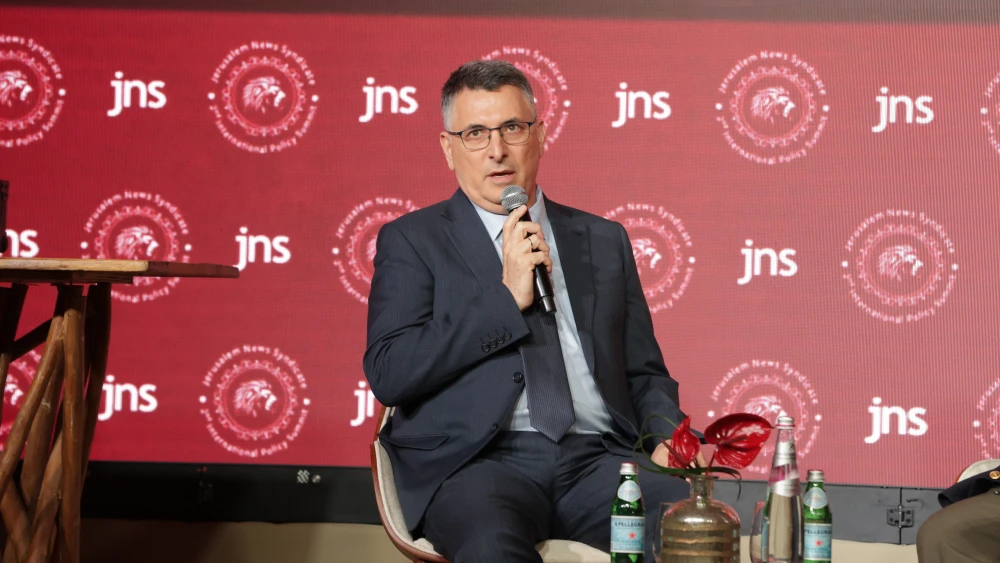
Israeli Foreign Minister Gideon Sa’ar rejected international criticism of Israel’s military presence in Lebanon on Tuesday, saying Hezbollah and Iran are the real violators.
“I hear statements in the international community that Israel is breaching Lebanon’s sovereignty. Listen to the truth. Hezbollah is breaching Lebanon’s sovereignty. Iran is breaching Lebanon’s sovereignty,” Sa’ar said at the JNS 2026 International Policy Summit in Jerusalem.
His remarks came as Israeli and Lebanese delegations met in Washington for a fifth round of U.S.-brokered political and security talks aimed at stabilizing the border and addressing longstanding disputes.
Sa’ar argued that Lebanon remains under Iran’s influence through Hezbollah, the Iranian-backed terrorist group that wields significant military and political power in the country.
“The foreign minister of Lebanon decided to expel the Iranian ambassador from Beirut some months ago,” Sa’ar said. “It never happened, because the truth is—and not so many people are saying it—Lebanon is under Iranian occupation, indirectly by Hezbollah, but under an occupation on the soil of Lebanon.”
The fundamental challenge is that Hezbollah remains stronger than the Lebanese Armed Forces, he added, calling it a “mutual problem.”
“I hope that with the talks being held today in Washington, D.C., we will be able to build on that common ground to build the common future,” Sa’ar said.
‘Open to dialogue’
Sa’ar addressed his recent decision to “sever all contact” with the office of European Union foreign-policy chief Kaja Kallas after reports that she compared Israel’s treatment of Palestinians to apartheid-era South Africa during a closed-door meeting in Mexico. Kallas has declined to confirm or deny the reports publicly
Sa’ar stressed that the move was directed at Kallas, not the European Union as a whole. He pointed to what he described as “very good, open and honest discussions” with EU Commissioner for the Mediterranean Dubravka Šuica this week in Jerusalem.
“I privately asked her to do something about it,” Sa’ar said of Kallas. “She could say, ‘I didn’t say that.’ She could have said, ‘I’m standing behind these words.’”
But, with Kallas refusing to address the report on her comments, he said, “I can’t be silent and act like it is a legitimate thing to be said against my state. Therefore, I didn’t have any choice.”
The foreign minister said Israel is open to dialogue, as evidenced by the meetings with Šuica, and while “we are used to having criticism against us, to say the least, a dialogue is not that the other side can dictate to us political positions, mainly when they are connected to very basic national interests.”
Sa’ar also highlighted what he described as growing opportunities for Israel in Latin America, citing the election of Colombian President-elect Abelardo de la Espriella, a conservative lawyer who defeated leftist Sen. Iván Cepeda in Sunday’s runoff election.
De la Espriella “is a great friend of Israel and the Jewish people. I know him personally,” Sa’ar said, contrasting him with outgoing Colombian President Gustavo Petro, one of Israel’s most outspoken critics in the region.
“But the full picture is even more encouraging when you see what happened in the elections in Peru, Honduras, Chile, Bolivia,” Sa’ar said.
He added that the recent parliamentary elections in Argentina were a sign of a significant regional shift.
“We’ll invest much more in order to strengthen our relations, and we are doing it with the same interest as our American friends, which for them the Western Hemisphere is critical in their national security doctrine, and for us it can be a hugely friendly continent,” Sa’ar said, stating that an important order of business in the coming months is to add more embassies in Jerusalem.