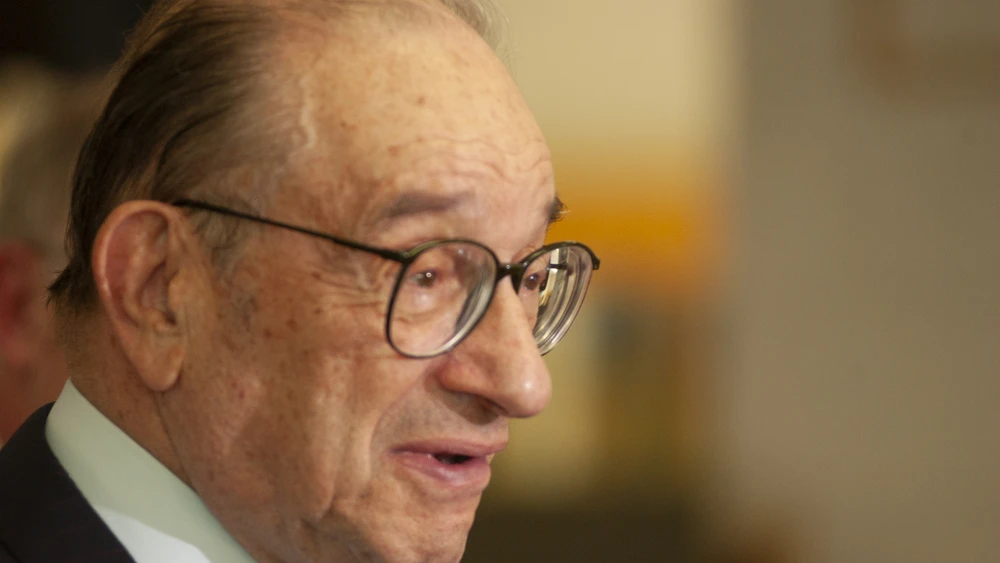
Alan Greenspan, a Jewish economist who was chairman of the Federal Reserve from 1987 to 2006, died on Monday, according to his wife, Andrea Mitchell, chief Washington correspondent and chief foreign affairs correspondent for NBC News. He was 100.
The cause was “complications of Parkinson’s disease,” according to Mitchell.
“He was a giant of a man who helped shape the U.S. economy for decades under presidents of both parties but was always honest in acknowledging his mistakes,” Mitchell told NBC.
Mitchell added that her husband of 29 years had an “irrational exuberance” for “baseball, the Washington Commanders, tennis, golf and music, especially jazz.”
The Federal Reserve stated that in his 18 years as chairman, he “guided the Federal Reserve through periods of significant economic expansion as well as periods of considerable stress.”
“Under his leadership, the Federal Reserve achieved a sustained era of price stability that supported economic growth and helped anchor the public’s confidence in the institution,” it stated. “He brought rigorous analytical discipline to monetary policymaking and helped establish the credibility that remains one of the Federal Reserve’s most important assets.”
It added that Greenspan’s legacy continues in “those he mentored directly, in the economists and public servants he inspired and in the frameworks and practices he helped shape.”
Christine Lagarde, president of the European Central Bank, called him a “towering figure.”

On Nov. 9, 2005, then U.S. President George W. Bush presented Greenspan with a Presidential Medal of Freedom.
The former Fed chair “is one of the most admired and influential economists in our nation’s history,” Bush said at the time. “So you may be surprised to learn that Alan studied music at Juilliard. He began his career playing the saxophone and clarinet in a jazz orchestra. Even then, he showed his mathematical side—his fellow band members had him fill out their tax returns.”
“He was on his way to a lifetime of achievement in the field of economics, from Wall Street to the White House, to the Board of Governors of the Federal Reserve System,” Bush said. “The era of Chairman Greenspan will always be known as one of phenomenal economic growth, high productivity and unprecedented innovation and opportunity for all our citizens.”
Daniel Friedman, professor of political science at Touro University, told JNS that Greenspan “should be remembered as the economist of the American Dream.”
“He believed deeply that home ownership offered ordinary Americans stability, dignity and a path to prosperity. If he made a mistake, it was one of optimism rather than cynicism,” Friedman said. “Greenspan saw expanded access to credit as a means of helping families achieve that dream and was too trusting of financial institutions that later exploited it through predatory lending and reckless practices.”
“His Jewish values were the foundation of his belief that every American deserves a fair chance to enjoy our nation’s blessings,” the professor, who is also a rabbi, told JNS.
Greenspan was born on March 6, 1926, to Jewish parents of Romanian and Hungarian descent in the Washington Heights neighborhood of Manhattan, according to the New York Times.
He earned college and graduate degrees and a doctorate in economics at New York University. In between, he studied as a doctoral student at Columbia University under Arthur F. Burns, an economist and future Fed chair, according to NBC.
He founded a consulting firm and later advised Richard Nixon’s presidential campaign in 1968 and worked on the transition team, but turned down a role in the administration, NBC reported.
In 1987, President Ronald Reagan appointed him chair of the Fed—a position he held under three other presidents as well: George H.W. Bush, Bill Clinton and George W. Bush. He was affectionately called the “maestro,” per NBC.
As Fed chairman, Greenspan led the central bank during what was then the longest economic expansion in U.S. history, from 1991 to 2001, according to the New York Times.

He played a central role in shaping U.S. monetary policy, steering the economy through market crashes, recessions and financial crises, including “Black Monday” in 1987.
After the collapse of the “dot-com bubble” in 2000, the “economy bounced back within a year, despite the financial and psychological shock of the Sept. 11 attacks,” per the Times. “Mr. Greenspan turned aside warnings that the real estate market was becoming a bubble during the first decade of the new century and continued to keep interest rates at relatively low levels.”
“By the time the mortgage market started to implode in 2007, triggering the broader crisis that led to the worst recession since the 1930s, Mr. Greenspan had left office,” it said. “He faced intense criticism that he had failed in his role as a financial regulator and that his easy monetary policy had backfired, destroying much of the wealth that it had helped to create.”
Among Greenspan’s economic influences was Ayn Rand, author of “Atlas Shrugged” and “The Fountainhead” and an “objectivism” philosopher, who was famously atheist and a champion of near unfettered capitalism, according to the Times.
Like Greenspan, Rand, who was born Alisa Rosenbaum in 1905 in St. Petersburg, Russia, came from a Jewish family.
Greenspan met Rand in the early 1950s through his first wife, painter Joan Mitchell, whom he married in 1952. Mitchell introduced him to Rand, and Greenspan soon became part of Rand’s close inner circle, the Times reported.
He later contributed essays to Rand’s 1966 collection “Capitalism: The Unknown Ideal,” including “Gold and Economic Freedom,” a defense of the gold standard and a critique of government deficit spending.
Greenspan was known for his expressionless face and often opaque language.

John J. Miller, director of the Dow program in American journalism at Hillsdale College, stated that he attended Greenspan’s “market-moving ‘irrational exuberance’ speech in 1996.”
“He delivered it at the annual dinner of AEI. As he gave it, I remember thinking: ‘This is boring and incomprehensible.’ Sitting next to me was Wilcomb E. Washburn, a distinguished historian at the Smithsonian,” Miller stated. “When Greenspan finished, Washburn leaned over and said: ‘And that’s why they call it ‘the dismal science.’”
“I thought it was clever. I was also heartened by the fact that a major scholar felt as I did,” Miller wrote. “The next morning, I woke up to learn that Greenspan’s speech was the biggest story in the country.”
Investors, lawmakers and foreign governments scrutinized Greenspan’s choice of words for clues about the direction of interest rates. Even small shifts in his wording could move markets.
He once reportedly joked that if he seemed “unduly clear,” he had probably been misunderstood, according to NBC.
James Kahn, a former vice president of research at the Federal Reserve Bank of New York, told JNS that Greenspan was “famously sort of ambiguous” and cultivated that ambiguity.
“I think he was aware that it was kind of a self-generating situation, because he would speak in this sort of elusive manner,” said Kahn, professor and chair of economics at Yeshiva University. “That meant every word he spoke or wrote would be interpreted or reacted to more strongly than if he had been perhaps more straightforward.”
“He didn’t want to be so explicit,” Kahn told JNS.
In his later years, Greenspan was widely criticized for failing to foresee the 2008 financial crisis, which was triggered by the collapse of the U.S. housing and mortgage markets.
Some critics pointed to his free-market philosophy, arguing that it allowed financial markets to operate with too little oversight for too long. Others blamed the Fed’s decision to keep interest rates low in the early 2000s, saying it helped fuel the housing bubble that later burst.
After retiring from the Fed in 2006, Greenspan founded Greenspan Associates, an economic consulting firm.