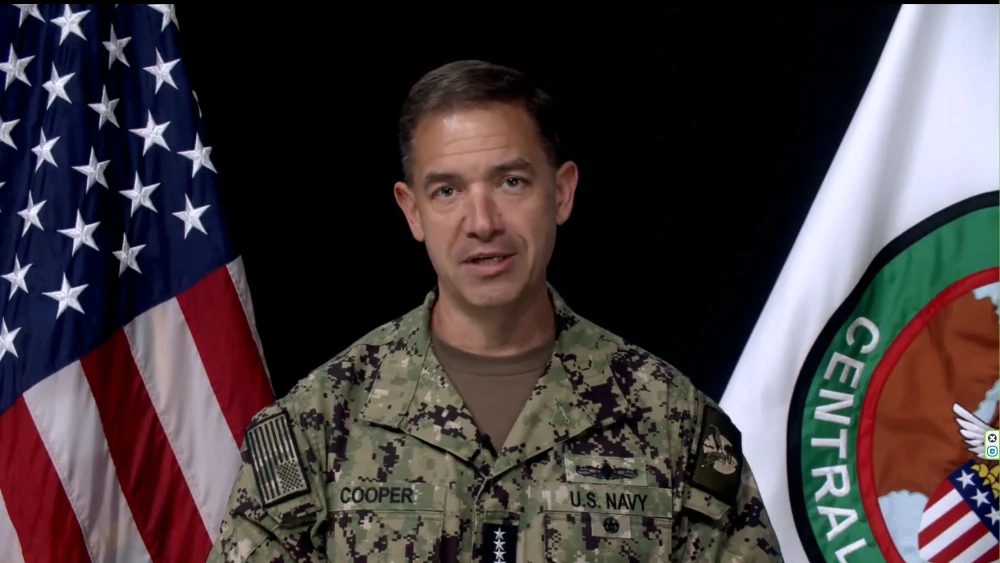
The “compounding” effect of America’s economic suffocation campaign against Iran is being felt across all sectors of its economy, including its military and the Islamic Revolutionary Guard Corps, commander of the U.S. Central Command Adm. Brad Cooper said in a recorded message on Friday.
“The financial strain on Iran’s military has become so significant that there are reports of Iran-aligned militia groups across the region withholding payments to their soldiers in order to funnel money back to the IRGC, which also is not paying its troops,” Cooper stated.
The Islamic regime is feeling “economic pain” and the IRGC is “increasingly showing signs of greater desperation as a result,” the admiral continued.
Payments, including pensions, are being withheld by the Iranian regime from workers in industries such as oil and energy, manufacturing, steel and heavy industry, he said.
Meanwhile, the IRGC continues to attack commercial vessels in the Strait of Hormuz, having killed 20 civilian mariners since the war began on Feb. 28, Cooper said, citing data from the U.N.’s International Maritime Organization.
Despite these attacks, the commander continued, the strategic waterway “remains open for business.”
Over the past week, approximately 400 merchant ships and 100 million barrels of crude oil have transited the strait, in addition to the 1.3 billion barrels that were transported in recent months, Cooper said.
Fact Sheet: Economic Pressure on Iranian Security Apparatus pic.twitter.com/g51jNZcxpn
— U.S. Central Command (@CENTCOM) October 16, 2026
These figures, totaling approximately 14 million barrels per day, roughly match the volume of crude oil that transited the choke point pre-war. However, that is less than the total of 20 million-21 million barrels per day that flowed through the strait when refined petroleum products are taken into account, according to analytics platform Kpler.
American forces initially launched a naval blockade on Iranian ports on April 13. It was temporarily lifted on June 18, when an interim U.S.-Iran agreement took effect, only to be re-imposed on July 14.
On Aug. 24, Washington initiated “Operation Economic Outcast,” also known as “Economic D-Day,” against the Islamic Republic, which added more sanctions and financial measures against Iran.
As Cooper elaborated in his recorded message, CENTCOM, in close coordination with “interagency partners,” has in recent months delivered “severe blows” to the Iranian regime in three main areas: oil exports, digital financing and payroll for security forces.
U.S. forces have thus far prevented Iran from exporting at least $25 billion worth of crude oil, he said.
CENTCOM has also frozen $350 million in digital cryptocurrency assets.
As a result, the Iranian government is finding it difficult to pay salaries to its troops and employees.
‘The single greatest financial offensive ever’
On Aug. 24, U.S. Treasury Secretary Scott Bessent said that the Trump administration’s comprehensive economic campaign against Iran is aimed at severing “every economic lifeline” sustaining the Islamic Republic.
Bessent described the campaign, announced earlier by U.S. President Donald Trump, as “the single greatest financial offensive ever marshaled against an adversary,” saying the president had created the conditions to use every available federal agency and authority against Tehran.
He also said that U.S. military action had destroyed nearly all of Iran’s military factories and buried its nuclear program.