


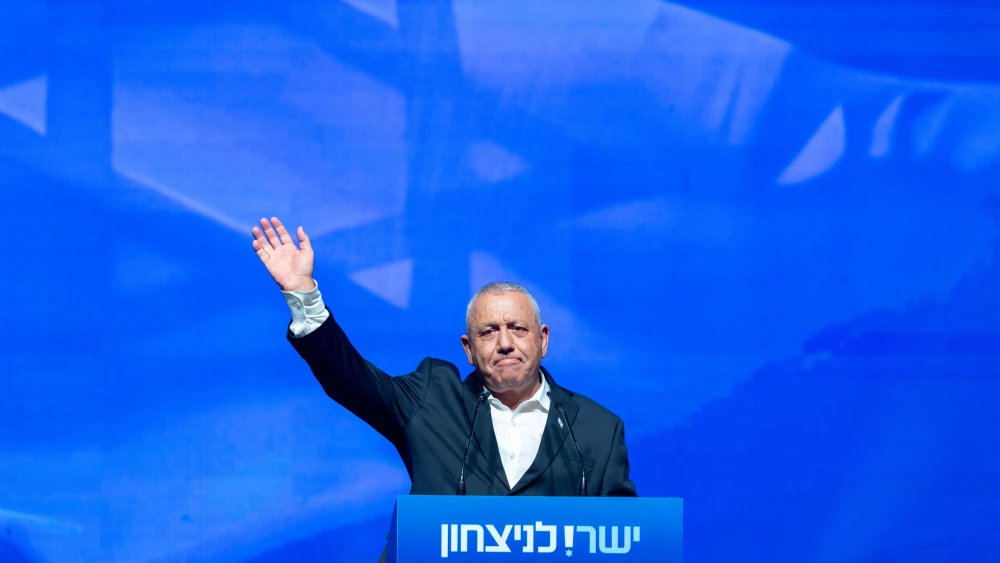
Israeli President Isaac Herzog’s decision to ask former military chief Gadi Eisenkot to form the country’s next government could reverse the worsening relations between the Jewish state and the Democratic Party, a former deputy U.S. assistant secretary of state said.
Joel Rubin, who served in the Obama administration, told JNS that it will make a difference in Congress, including among Democratic lawmakers who have voted against sending more aid to Israel as a vote of no confidence in Prime Minister Benjamin Netanyahu, who leads the Jewish state.
“It will open up some space for the Democrats, who do care deeply about the relationship with Israel, to have a more positive agenda on how to deal with Israel to counter those who just want to isolate and punish Israel,” Rubin told JNS.
Israel’s standing among Democrats came to a nadir in July, when 103 House Democrats voted to cut $3.3 billion in Israeli security assistance, while 98 opposed the amendment and 10 voted present.
“They did it to send a signal,” Rubin told JNS. “It was a powerful signal in the Israeli body politic.”
Trump’s statement on Election Day that he would cut off $4 billion in funding to Israel by the end of the year “should be another major signal,” Rubin said. “That means that there’s a lot of revaluation of the aid program.”
That evaluation will be done by new Democratic majorities in the House and Senate, with most of the newcomers more moderate Democrats from swing states rather than democratic socialists accusing Israel of “genocide.”
“There will be that discussion, but remember that many of the leading voices in the Democratic foreign policymaking jobs on the House side are very committed to Israel,” Rubin said. “There is a strong set of crucial Democrats, and the elections showed that there was a significant number of pro-Israel Democrats across the country.”
Experts and some Israeli officials have told JNS that Israel will face opposition no matter who the prime minister is and that many antisemites are hiding their Jew-hatred behind what they say is criticism of Netanyahu.
Rubin singled out the likely next House speaker Rep. Hakeem Jeffries (D-N.Y.), likely House Foreign Affairs Committee chair, Rep. Gregory Meeks (D-N.Y.), likely Middle East subcommittee chair, Rep. Jared Moskowitz (D-Fla.) and Rep. Lois Frankel (D-Fla.), who will probably soon take the gavel of the House appropriations subcommittee, which oversees the U.S. State Department.
Many of the newly elected lawmakers weren’t focused on Israel in their campaigns, according to Rubin.
“They didn’t talk ‘genocide’ in their races,” he said. “The issue related to Israel and the Middle East is the war in Iran and the gas price increase and their anger and frustration at that. Gaza-Israel is not an issue.”
Plenty of Democrats oppose Israel and its policies, and Rubin faced some at a panel on Saturday at Crooked Con, a gathering of progressive Democrats in Washington held by Crooked Media, founded by former Obama aides.
Some attendees cheered for the other panelist, Tariq Habash, a former education policy adviser in the Biden administration who resigned in protest over the former president’s support for Israel after Oct. 7.
They applauded when Dr. Abdul El-Sayed, senator-elect in Michigan whom the Republican Jewish Coalition called the most antisemitic Senate candidate in the country, was mentioned and booed when Rubin said that Israel’s response in Gaza wasn’t “genocide.”
Habash said that talk of two-state solutions and peace in the Middle East ignores the fact that the Palestinians, who live under Israeli military control, don’t have political rights and their voices need to be heard.
“We should be creating a level playing field,” he said. “You cannot keep the boots on the necks of the Palestinians. We have to give them a seat at the table.”
‘Part of our DNA’
During the debate, Rubin acknowledged the need for a Palestinian state but said that there needs to be an Israel with a Jewish majority, rejecting efforts to downplay the Jewish connection to the region.
“If you go to the synagogue on Shabbat, you will see the words ‘Yisrael,’ ‘Yerushalayim’ and ‘Tzion,’” Israel, Jerusalem and Zion, respectively, Rubin said. “That’s what Jews pray after a couple of thousand years, so that’s part of our DNA.”
Habash told JNS that he supports peace in the Middle East, but “the makeup of what that looks like should be left up to Palestinians and Israelis to figure it out.”
“I don’t think we should be as Americans dictating to the region what a solution looks like,” he said.
He supports a diplomatic solution ensuring that both Palestinians and Israelis live in peace and safety, he said.
“That means that Palestinians just like Israelis should have equal rights,” he told JNS. “They should have a right to access their natural resources. They should have a right not to be kicked out of their homes. They should have a right to live without violence in safety. They should have a right to be able to pray peacefully in the way that they want.”
Separately, Pennsylvania Gov. Josh Shapiro, who is Jewish, talked to reporters, including one from JNS, about the need for a two-state solution in the Middle East.
“What’s in our national security interests is to have a stable Middle East, a Middle East where there is peace, a Middle East where Israel and a Palestinian state are peacefully side by side,” Shapiro said.
“There’s got to be a normalized relations with the 20-plus Arab nations, but all this needs to be looked at through the prism, in my estimation, of what is in America’s national security interests,” he said. “I don’t think this should just be looked at as some political game or political talking about it.”
After the panel, Rubin said that pro-Israel progressives came up to him afterwards and thanked him for standing up in support of the Jewish state.
“For people who want to still play aggressively in progressive politics and be comfortably Jewish, they need to know that there are ways to talk about it and they deserve to be in the room,” Rubin told JNS.
“I think they felt a sense of belief that they can speak this way, and so I think that was the value of this panel,” he said.


