Jews are always going to be hunted, according to Dara Horn, author of the 2021 book “People Love Dead Jews.”
“We’re never really going to be safe,” she told JNS at an event on Sunday evening in Manhattan marking 88 years since Kristallnacht, the “night of broken glass” pogrom in 1938 before the Holocaust.
“What I think is important about that is that the opposite of safety isn’t just danger,” Horn told JNS. “The opposite of safety is freedom.”
Horn told JNS that the event, which drew 450 people and which the Yad Vashem USA Foundation held at the New-York Historical Society, was particularly moving because Holocaust survivors were there to share their experiences and views of current events.
She had spoken with some before the program and was struck by their courage and their concerns about what is happening today, she told JNS.
Jewish life has increasingly come to revolve around security, and U.S. and Israeli institutions operate under guard and communities weigh the costs of self-defense, according to the author.
Jewish tradition tasks individuals with the responsibility of making choices, and of being accountable for their actions and rebuilding after disaster, Horn said. Future generations shouldn’t raise children in a protective bubble and should instead empower young people to shape their lives, she said.
“What we are trying to build is a Jewish life where our children have the freedom and agency to decide their own future,” she told JNS.
In her remarks at the event, Horn described Jewish history as the story of Jews choosing to live their lives and honor their traditions despite the horrors they faced.
“The State of Israel exists in spite of the Holocaust,” she said at the event. “Not because of it.”
She praised an installation at Yad Vashem, the Israeli Holocaust memorial, that she said told the story of the Shoah through the structure of the Passover Haggadah, which included an uplifting message. The display showed how Jews have taken courage from their religious tradition even when others sought to kill them, she said.
Dani Dayan, chairman of Yad Vashem, spoke with Horn at the event in a conversation moderated by Adam Kuperstein, an NBC 4 New York anchor.

“If I have to define why Yad Vashem should exist in one sentence, the sentence will be this,” says Dayan, a former Israeli consul general in New York. “Six million Jews murdered in the Shoah deserve an institution that is exclusively dedicated to them.”
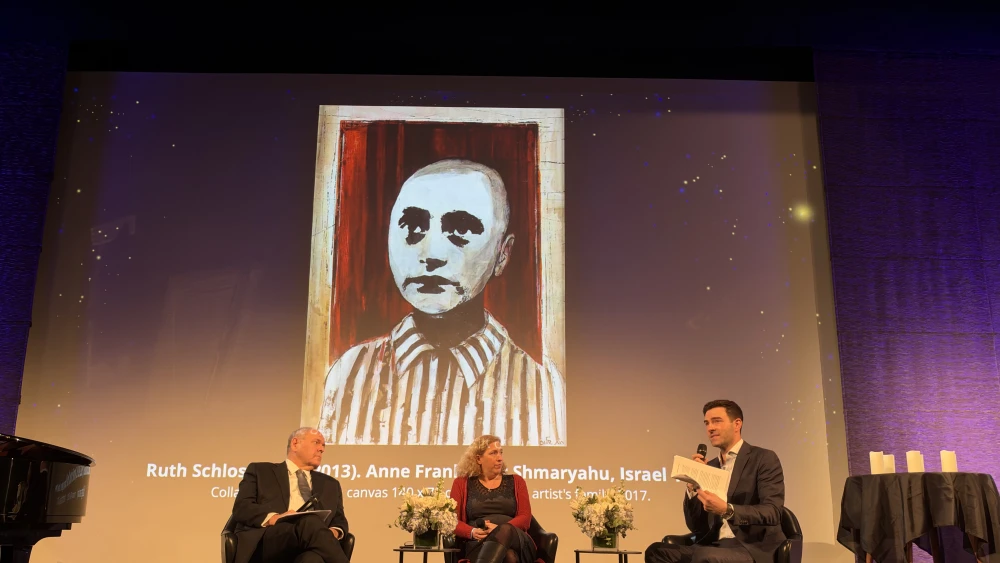
Dayan said that an exhibit at Yad Vashem includes a 1981 painting of Anne Frank by Ruth Schloss, in which the teenage girl appears with a shaved head and in a striped concentration-camp uniform at Bergen-Belsen. She is more widely known as the young diarist whose writings have spread worldwide, he said.
Frank should be remembered not only as a gifted writer but also as one of the 6 million European Jews murdered in the Holocaust, Dayan said. The painting restores the reality of her fate to the public image of her life, he told attendees.
Dayan told JNS that “never again” must come with action.
“If this leader has an implemented plan, a program to fight modern antisemitism, then he’s entitled to say ‘never again,’” Dayan said. “If he hasn’t, that’s just a shallow cliché.”
Holding the event in New York City was particularly important.
“New York is very personal for me,” he told JNS. “I spent four years here representing the State of Israel, so everything that happens in Jewish New York is very personal for me.”
“To bring the message of Yad Vashem to New York, to the largest Jewish community outside of Israel, of course, is especially significant,” Dayan said.
Kuperstein told attendees that he is the “proud grandson of four Holocaust survivors.”
“I am proud and publicly a Jew,” he said.
The news anchor recalled growing up hearing stories of survivors, atrocities, resilience and joy. His father, a historian who worked with the U.S. Holocaust Memorial Museum in Washington, devoted much of his life to Holocaust education, inspiring Kuperstein’s commitment to ensuring that younger generations understand what happened.
Kuperstein said that the commemoration was a chance to look back in time and to remember Kristallnacht as a warning about how quickly hatred and words can turn into violence.
Lillian Feintuch, a Holocaust survivor, told JNS at the event that “we are all here to show that we are still alive, and the world should always know about the Holocaust.”

Feintuch grew up in Hungary, where she saw Jewish men being beaten in the streets. Authorities came to her family’s home and ordered them to “pack up a few things and come to the ghetto,” she said.
She survived the Holocaust with her parents and three brothers, which she told JNS was “a miracle.”
“Nothing ever should happen like that,” Feintuch said.
She urges that the Holocaust be taught widely. “They should give lessons in the schools, not only Jewish schools,” she told JNS, “so that children will learn what happened to the Jews and other groups targeted by the Nazis.”
Rabbi Eric Greenberg, a former Anti-Defamation League interfaith affairs director, told JNS at the event that “we need to both battle antisemitism and educate our neighbors about what Jews are.”
The gathering included a musical tribute with Steven Skybell, star of a Yiddish “Fiddler on the Roof” production, and cantor Azi Schwartz of Park Avenue Synagogue, a Conservative congregation on Manhattan’s Upper East Side. Conductor and pianist Zalmen Mlotek, artistic director of the National Yiddish Theatre Folksbiene, accompanied.
The musicians performed traditional Jewish music using arrangements from the “Manheim Siddur,” a choir book that survived the burning of the Mannheim Synagogue during Kristallnacht.
The commemoration also included a candle-lighting ceremony with Holocaust survivors. They joined performers onstage as the audience sang “Hatikvah,” the Israeli national anthem.
Horn closed by returning to the idea of freedom as the legacy of Jewish history. She told the audience that the Jewish people can share with the world its commitment to continuing its story.
“Our children are not going to be safe. Our grandchildren are not going to be safe. Instead, they’re going to be free,” she said. “This freedom is the legacy that we carry throughout the world as Jews and that we can offer to everyone—that sense of freedom and responsibility of choosing life.”