


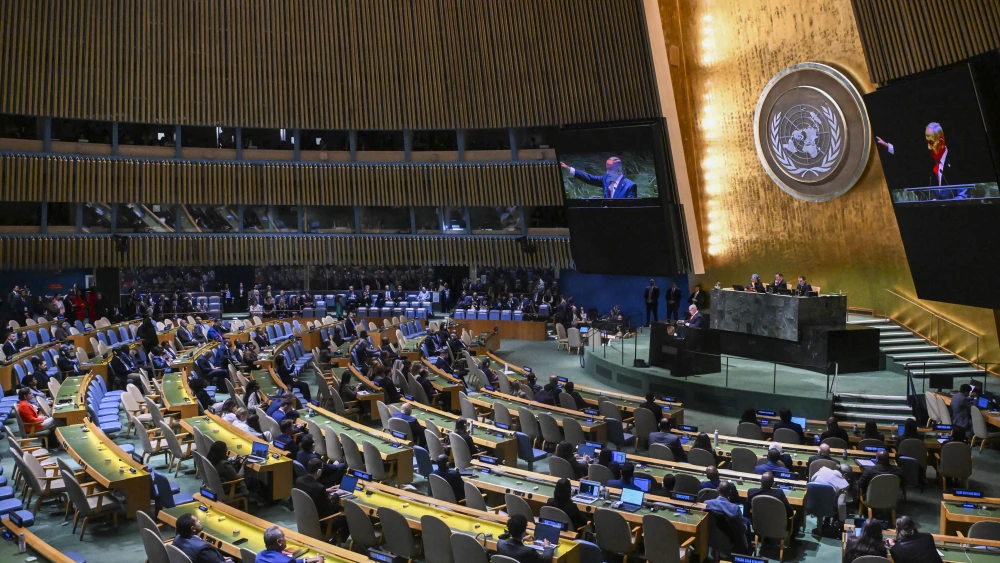
Marina Rosenberg, senior vice president for international affairs at the Anti-Defamation League, had good things to say about the German government just before she went into a meeting with German Foreign Minister Johann Wadephul on the sideline of the United Nations General Assembly last week.
“That’s one of the governments that fully understand the importance of keeping things as separate as possible but also understand the interconnection between anti-Israel bias and antisemitism, and they’re doing everything possible, including within the European Union, to fight anti-Zionism,” she told JNS.
With other countries, like Spain, Norway and the Netherlands, many of which the ADL had met, the nonprofit has had “a much more difficult conversation, trying to explain to them how their policies vis-a-vis the government of Israel can be completely legitimate,” she said.
“They’re influencing, if they want to or not, the political discourse, the social discourse, vis-a-vis Jews and Israelis in their own countries and beyond and fitting into the antisemitic extremism in those countries,” Rosenberg told JNS. “Some of them understand it but feel that they are under political pressure to keep going and taking actions against Israel.”
Efforts worldwide to undermine support for Israel “are real,” Ted Deutch, CEO of the American Jewish Committee, told JNS.
“It’s important for us to fight back against those efforts by being here, by seeing both our friends to bolster their leadership and standing with Israel and to confront the challenges with countries who are taking actions that don’t advance the relationship with their partner but that put division between them and Israel,” Deutch said.
Countries that understand Israel’s importance as a democracy and a regional player “need to to stand up,” the AJC leader told JNS. “The response in so many of these meetings is that we both leave with a bigger commitment to doing the work we do on behalf of Israel.”
Evan Bernstein, the new CEO of B’nai B’rith International, was taking part in his first diplomatic blitz in Turtle Bay.
He told JNS that he’s been talking a lot about the “horseshoe effect,” wherein the antisemitic far left and far right come together to push an anti-Jewish agenda, even as they are otherwise ideologically and politically separated. It’s especially prominent in Europe, according to the B’nai B’rith leader.
“That is something that a lot of the European leaders were not necessarily thinking about. A lot of leaders look at it either from the right or the left,” Bernstein told JNS. “They’re not understanding it’s necessarily both, and it plays into their ability to create plans to combat antisemitism in their countries.”
B’nai B’rith and others are asking world leaders to make sure that they are “understanding where that antisemitism is coming from and where is the uncomfortability coming from within their Jewish communities,” Bernstein said.
He told JNS that Jewish groups, who know the issues deeply, have to go back to the basics when they explain things to the leaders.
“I think it’s a challenge, because a lot of us make assumptions that a lot of these diplomats actually know more than they really do, and I think for us, it’s really an opportunity to re-educate and to have an open dialogue,” Bernstein said. “It’s nice when a diplomat says, ‘Tell us your opinion on this. I don’t know enough.’”
Rosenberg, of the ADL and a former ambassador, told JNS that it’s unclear when diplomats are interested in substance or mere lip service.
“Some countries are really just saying what one would expect—that they’re taking note and of course, antisemitism is a serious problem. But others really understand how antisemitism is threatening their own countries, their own democratic values and how it’s being used in the United Nations for promoting a political agenda,” she said.
Some countries come into meetings with Jewish groups with a set agenda, and some are amid national elections, making a more robust conversation more difficult.
“I do think that they’re interested and they’ve asked a lot of good questions, and I think they’ve used their time very well,” Bernstein said. “I think we were prepped really well to go into conversations.”
He noted the “incredible value” of just being in the room.
“If you talk to my grandparents from the ’30s, they would never have imagined that Jews would have time to sit in front of the president of Poland, or the foreign minister of Germany or senior officials from countries all over the world, and talk about being Jewish, talk about Israel, talk about antisemitism,” Bernstein said.
“It’s something that we take for granted in this generation, but not only a generation ago, we did not have that opportunity, and we have to really hold on to that and keep taking advantage of it,” he told JNS.


