


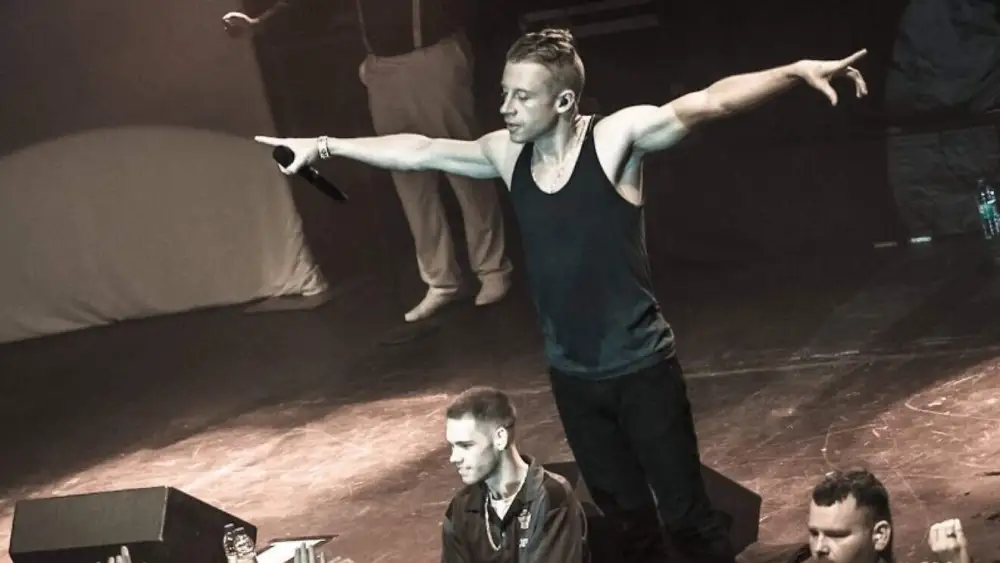

The recent decision to boot rapper Macklemore off the bill as opener for pop-music superstar Ed Sheeran’s U.S. tour was made primarily by Robert Kraft, owner of the New England Patriots and Boston’s Gillette Stadium, where the tour was soon scheduled to appear. While defenders of Macklemore disingenuously claim that he was canceled because he shouted “Free Palestine” during his performance, the truth is that Macklemore has also ranted libels about Israeli genocide in Gaza; called the Jewish state illegitimate; and paraded on stage dressed as a hairy, big-nosed caricature Jew out of the pages of the Nazi publication Der Stürmer.
Macklemore is not truthfully a critic of Israel; rather, he’s a hateful antisemite who despises and slanders both the Jewish state and the United States.
Dumping Macklemore from the tour raises three critical social and political questions: 1) If the American right (and pro-Zionists) object to the “cancel culture” of the left, then how can they justify Macklemore’s banning? 2) Do Macklemore’s political statements qualify as valid criticism of Israel or as malicious slander? And 3) How does Macklemore’s hostility toward Israel translate to a political position: What does he want for the Palestinians, what does he really want Israel to do?
First, how can Kraft and Israel supporters justify dumping Macklemore? What’s the difference between the progressive left’s “cancel culture,” which bars pro-Israel speakers from political rallies and university podiums, and barring an outspoken rapper from performing?
One difference is the audience’s freedom to choose. Those who attend a speech or rally on campus opt specifically to attend that event and can leave any time at no cost. Those who pay an average of $150 to $250 to attend a mellow, apolitical Ed Sheeran concert are not expecting to first be hostilely harangued, as were Jewish and Israeli attendees at his first performance in New Jersey.
Another difference is business. The U.S. Constitution forbids governments and public institutions from limiting speech, but it doesn’t hold that a private business, even a newspaper, must allow all manner of speech, especially messages the business owner finds anathema. Kraft is not only one of America’s foremost foes of antisemitism, but he is also a businessman who judged Macklemore to be bad for his business. Clearly, the Sheeran tour’s promoters reached the same business decision when they concurred that Macklemore should be excised from the show.
Second, Macklemore’s songs, speeches and skits are not criticism, but hate speech. When the rapper chants slogans, sings words of slander, and performs racist skits, he delivers an emotional outpouring of disjointed opinions. His accusations of genocide, apartheid and starving children are not backed by fact-based arguments against Israel’s actions.
Third, Mackelmore’s “political positions” are mostly incoherent, signifying nothing. While “Free, Free Palestine” has a nice cadence, it has no clear meaning. What is “Palestine” exactly? Not a state, not a sovereign territory, not really a defined people. If we think about it (which we can be sure 95% of Macklemore’s audience do not), we can assume that because “Free Palestine” is usually chanted with “from the river to the sea,” it means expel all Jews from the land of Israel. In other words, a bloodbath. We know Macklemore opposes ethnic cleansing, apartheid and starvation in Gaza—as surely all good people do. The problem is, those things factually are not occurring anywhere in “Palestine”—unless, of course, Macklemore’s demand to “Free Palestine” comes to pass. Thus, while Macklemore’s political analysis is worthless, his onstage message is genocidal.
Should celebrities mouth off on important topics about which they are functionally ignorant? Many of us dedicated supporters of Israel would love to entice Macklemore (or actors Mark Ruffalo or Hannah Einbinder) into a debate for the opportunity to destroy their lies about genocide in Gaza, apartheid in Israel and stealing “Palestinian land.” But clearly these “stars” prefer platforms that allow them to deliver their libels in sound bites that permit no factual rebuttal.
We should note that when celebrity millionaires like Macklemore intersperse their performances with political diatribes about Israel, they often couple their messages with a greater anti-American hostility. Macklemore screams “F**k the police” and ridiculously associates America’s “white supremacist” society with U.S. support for Israel. In 2009, he conspiratorially tweeted “911 … bush knocked down the towers.” Einbinder laced her Emmy acceptance speech with “Free Palestine” and “F**k ICE.” In short, while some fans of Macklemore and other celebrities may welcome the performers’ empty opinions and profanity-laced rants, rational lovers of Israel and America are obligated to oppose them with facts and logic.
In short, Macklemore has every right to create “art” that twists reality to serve his political opinions, but as American citizens, we have every right to expose his hate speech and call him a fool. We also have the right not to do business with him—and to be spared his anti-Israel and anti-American propagandizing when we pay to attend a friendly concert.
Originally published on Facts and Logic About the Middle East (FLAME).


