


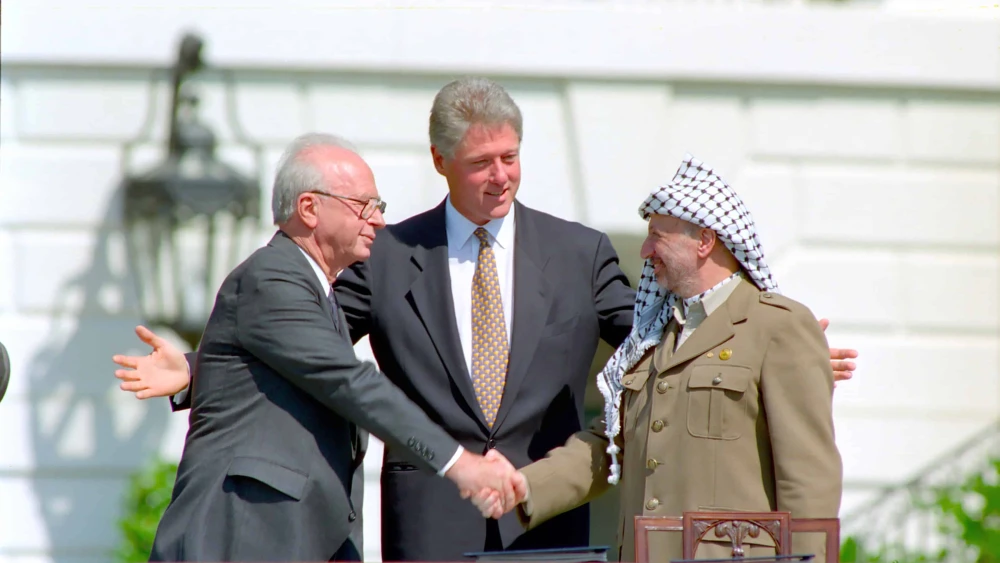

On Sept. 13, 1993, Israel and the Palestine Liberation Organization signed the Oslo Accords’ Declaration of Principles on the South Lawn of the White House. This month, the accords turned 33. There was no ceremony in Jerusalem or Ramallah.
States mark the documents that made them. They hold anniversaries, give speeches and argue every year about what the date means. So, the silence in both capitals is itself significant. Thirty-three years is long enough to reach a verdict on an agreement, and both publics have reached one without announcing it.
The conventional reading holds that Oslo was a peace process that stalled, derailed by assassination, terrorism, bad faith or settlement construction, depending on who tells the story. That reading assumes the agreement is still standing, waiting to be resumed. It is not. Oslo is an unowned agreement. It was signed by leaders but never owned by the public that was supposed to carry it out.
That distinction matters. Palestinians are scheduled to vote in November under rules requiring candidates to accept the PLO’s commitments. In Gaza, the second phase of the Trump plan is being built on disarmament pledges and an internationally supervised transition. Both rest on a premise Oslo has spent three decades disproving.
What was signed in 1993 was ambitious. Days before the ceremony, Israel and the PLO exchanged letters of mutual recognition. The PLO recognized Israel’s right to exist in peace and security and renounced terrorism; Israel recognized the PLO as the representative of the Palestinian people. The Declaration of Principles created a Palestinian self-governing authority and a five-year interim period in which the parties were to negotiate Jerusalem, refugees, borders and settlements. Oslo II, in 1995, divided Judea and Samaria into Areas A, B and C. That temporary division is now 31 years old.
The yardstick for the agreement was not set by its opponents. It was set by its architects. Yossi Beilin, then deputy foreign minister and the man who launched the secret contacts between Israel and the PLO that led to the agreement, proposed a test of blood: whether more would be spilled after the agreement than before. Israeli leaders later called those killed in the bus and cafe bombings of the 1990s “victims of peace.” The phrase never took hold, because Israelis had a simpler idea in mind: The killing was supposed to stop. It did not.
Somewhere along the way, the signature at the bottom of the document stopped corresponding to anything above it.
On the Palestinian side, a different agreement was signed that day. While Israeli Prime Minister Yitzhak Rabin and PLO chief Yasser Arafat shook hands in Washington, Jordanian television aired a prerecorded Arabic address by Arafat. There, the accord was presented not as a historic compromise but as an implementation. Arafat reminded his listeners that the Palestine National Council had resolved in 1974 to establish a national authority over any part of the land that Israel vacated in a Phased Plan to eventually take over the rest. Oslo, in this telling, was a stage in the struggle, not a substitute for it.
Eight months later, on May 10, 1994, in a Johannesburg mosque, Arafat supplied an essential analogy. Speaking in English and apparently unaware he was being recorded, he compared Oslo to the Treaty of Hudaybiyyah, the truce that Muhammad concluded with the Quraysh tribe and later set aside when he took Mecca. A South African journalist had the tape running.
Thirty-three years on, the terms themselves can be measured. In a poll published Aug. 12 by the Palestinian Center for Policy and Survey Research, two-thirds of Palestinians opposed requiring election candidates to accept the PLO’s commitments, including its agreements with Israel. Only 27% supported the requirement. At the core of those commitments are the recognition letters of September 1993. The condition on which Oslo was signed is rejected today by the public it was meant to bind.
The lesson is not about Palestinian intentions, which have been argued over for three decades and will be argued over for three more. It is about consent. An interim agreement assumes the interim will be governed by the consent that produced it. Thirty-three years is not an interim. Somewhere along the way, the signature at the bottom of the document stopped corresponding to anything above it, and no mechanism existed to recognize the problem.
This is not a historical curiosity. The frameworks now being assembled for Gaza rest on the same architecture: a disarmament sequence tied to a reconstruction timetable, elections that confer a mandate, an internationally supervised transition and pledges accepted by candidates as a condition of running. Each assumes that a signature at the top can bind a public that was never asked. Hamas now says it accepts disarmament. Washington should weigh that announcement against the two speeches Arafat gave in 1993 and 1994.
Agreements built on the Western model, in which a document creates obligations that outlast political changes, require something the Middle East has rarely supplied: A party able to carry a commitment after the leader who made it is gone. Oslo built an address in Ramallah so that such a party would exist. The address is still there. What it was built to hold is not.
The practical conclusion for Jerusalem and Washington is simple: The next agreement should be judged by what the public beneath the signature demonstrably accepts, and its security terms should be enforceable by Israel without depending on anyone’s goodwill.
Oslo was not a process cut short before it could mature. It is an agreement neither public still holds; Israelis because it failed the test its own architects set, Palestinians because they never regarded it as more than a stage. Thirty-three years on, there is no ceremony, and no one left to hand the keys back to.


