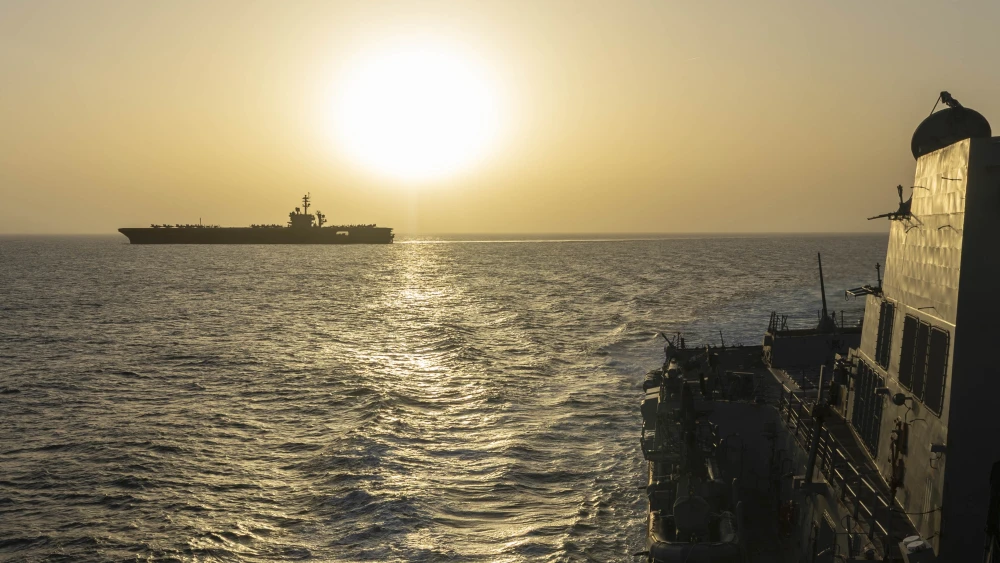
Iran declared the Strait of Hormuz to be “completely open” on Friday, following the ceasefire agreement between Israel and Lebanon. Despite the regime’s announcement, U.S. President Donald Trump said that the American naval blockade of Iranian ports would continue.
Abbas Araghchi, Iran’s foreign minister, said that the strait was now open to all commercial vessels but seemed to suggest that the opening was conditional and only applied during the ceasefire and only on a predetermined path.
“In line with the ceasefire in Lebanon, the passage for all commercial vessels through the Strait of Hormuz is declared completely open for the remaining period of the ceasefire, on the coordinated route as already announced by Ports and Maritime Organisation of the Islamic Republic of Iran,” he stated.
In peacetime, most shipping passing through the strait goes through Omani territorial waters.
Trump welcomed the news in a flurry of social media messages about the Strait, a potential peace deal with Iran and the Israel-Lebanon conflict.
“The Strait of Hormuz is completely open and ready for business and full passage, but the naval blockade will remain in full force and effect as it pertains to Iran, only, until such time as our transaction with Iran is 100% complete,” Trump wrote. “This process should go very quickly in that most points are already negotiated.”
Even as Iran said that the announcement was connected to the ceasefire in Lebanon, Trump wrote that the deal was not tied “in any way” to that conflict. He also insisted that Israel stop its campaign against Hezbollah.
“Israel will not be bombing Lebanon any longer,” Trump wrote. “They are prohibited from doing so by the United States. Enough is enough.”
The 10-day ceasefire agreement to which Israel and Lebanon agreed on Thursday includes a provision allowing Israel to act in self-defense “at any time against planned, imminent or ongoing attacks.”
Israeli Prime Minister Benjamin Netanyahu stated on Friday that the ceasefire was a temporary agreement at Trump’s request to allow the Lebanese government to try to disarm Hezbollah. Israel still had “things we plan to do regarding the remaining rocket threat and the drone threat,” he stated.
Both Iran and Trump confirmed that the Strait of Hormuz would now be open to commercial traffic, but the U.S. president provided details about other provisions that the Islamic Republic has not yet acknowledged publicly.
“Iran, with the help of the United States, has removed or is removing all sea mines,” Trump stated. “The United States will get all nuclear ‘dust,’ created by our great B-2 bombers. No money will exchange hands in any way, shape or form.”
The New York Times reported earlier in the month, citing U.S. officials, that Iran is incapable of removing all of the naval mines that it placed in the strait, because it has lost track of them.
Trump said previously that Iran would agree to remove the remnants of its enriched uranium stockpile, which he refers to as “nuclear dust” and which was likely buried during U.S. airstrikes on Iranian nuclear facilities in June.
Markets welcomed the news about the opening of the strait, which is one of the world’s most critical energy bottlenecks. The price of Brent crude fell by more than 10% to below $90 a barrel, and U.S. stock indices rose.