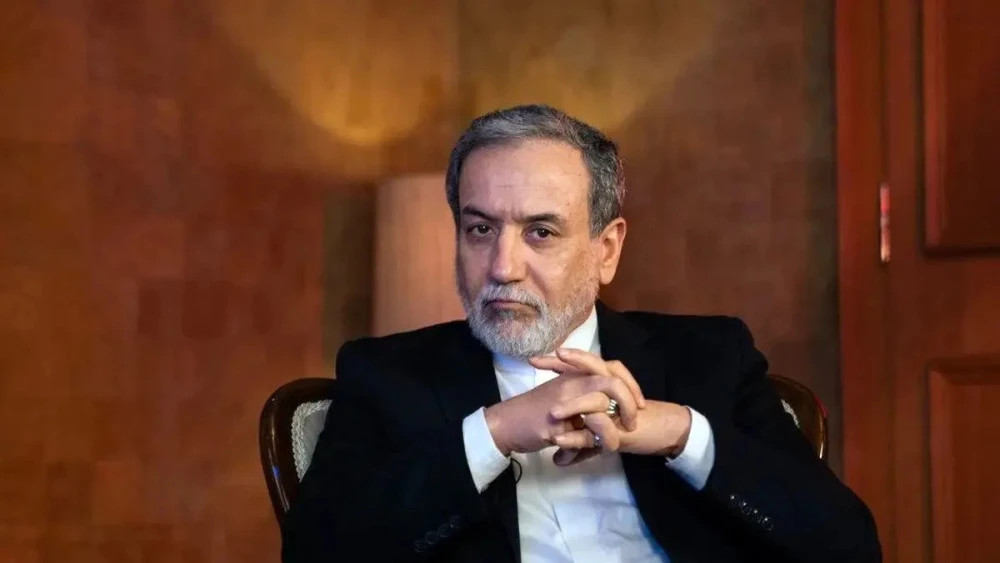

On May 23, Iranian Foreign Minister Abbas Araghchi sent a letter to Hezbollah Secretary-General Naim Qassem stating that Tehran would not abandon its demand for an end to the “aggression against Lebanon” as a fundamental condition for any permanent agreement to end the war with the United States.
On May 24, Hezbollah confirmed in an official statement that Qassem had received the message from Araghchi, which declared that “the Islamic Republic, until the very last moment, will never cease supporting movements seeking justice and freedom, foremost among them Hezbollah, the victorious resistance movement.”
The letter further stated that “from the very first moment several regional states entered mediation efforts aimed at reducing tensions between Iran and the United States, the Islamic Republic linked any possible agreement to a ceasefire in Lebanon,” emphasizing that “this important issue remains a nonnegotiable principle and an integral part of the just demands of the Iranian government and our heroic people, and it will remain so in the future.”
Araghchi also clarified that “in the latest proposal submitted by the Islamic Republic through the Pakistani mediator, aimed at achieving a permanent and stable end to the war, the demand to include Lebanon within the ceasefire framework was explicitly emphasized.”
Hassan Fadlallah, a member of Hezbollah’s “Loyalty to the Resistance” parliamentary faction in the Lebanese parliament, stated on May 24 that the accelerating regional developments would also affect Lebanon. He urged the Lebanese government to take advantage of the changing regional environment to halt the “Israeli aggression” and protect Southern Lebanon.
Speaking during a Hezbollah memorial ceremony for fighters killed in battles around the town of Khirbet Silm, Fadlallah stressed that “the Islamic Republic of Iran stands alongside Lebanon and the resistance,” adding that Tehran had tied any agreement with Washington to ending the war in Lebanon and across the region.
Meanwhile, commentators in the Gaza Strip have expressed considerable astonishment that Iran linked Lebanon to any agreement with the U.S. while refraining from doing the same for Gaza and Hamas, despite Hamas being a clear component of the Iranian-led “Axis of Resistance.”
This is particularly notable given that Hamas leader Ismail Haniyeh was assassinated by Israel in Tehran on July 31, 2024.
Senior Israeli security officials believe that Iran is operating according to a clear strategic hierarchy in which the Lebanese arena is viewed as far more important than Gaza and Hamas.
Not a strategic asset
There are several central reasons for this assessment.
First, from Tehran’s perspective, Hezbollah constitutes the most important strategic asset within the “Axis of Resistance.”
The organization serves as Iran’s primary deterrent force against Israel, possessing a vast arsenal of missiles, rockets, UAVs and explosive drones, as well as direct influence along Israel’s northern border and the capability to threaten the Israeli home front.
For this reason, Iran sees restoring Hezbollah’s strength and ending the fighting in Lebanon as a top-tier national security interest.
By contrast, Hamas and the Gaza Strip are viewed by the Iranian leadership as a less critical strategic arena.
The war in Gaza has already significantly weakened Hamas, while large portions of the Strip’s military and civilian infrastructure have been destroyed by Israel.
Therefore, from Iran’s perspective, although Hamas retains ideological and symbolic importance, it is not considered a strategic asset on the same level as Hezbollah.
Another reason is that the current negotiations with the U.S. are focused primarily on preventing a broader regional escalation, reopening the Strait of Hormuz, securing Iranian oil exports, and regulating the confrontation involving Iran, Israel and the U.S. Lebanon is directly tied to this confrontation because of Hezbollah’s involvement and the fear of a full-scale regional war.
The Gaza Strip, by contrast, is viewed by the Iranian leadership more as a distinct Palestinian-Israeli arena.
According to Israeli security assessments, Iran concluded that it would be unable to impose a comprehensive arrangement covering both Gaza and Lebanon simultaneously on Israel and the U.S. Tehran, therefore, chose to focus its efforts on the arena where it possesses a far more direct and powerful lever of influence, namely, Hezbollah in Lebanon.
Another possible factor is the growing tension in recent years between Tehran and Hamas leadership, particularly regarding the management of the war and its devastating consequences for the Gaza Strip.
By contrast, Iran’s relationship with the Shi’ite Hezbollah movement is considered far closer and more disciplined. In the eyes of the Iranian leadership, Hezbollah’s command structure is viewed as significantly more obedient and reliable than the Sunni Hamas leadership.
Originally published by the Jerusalem Center for Security and Foreign Affairs.