


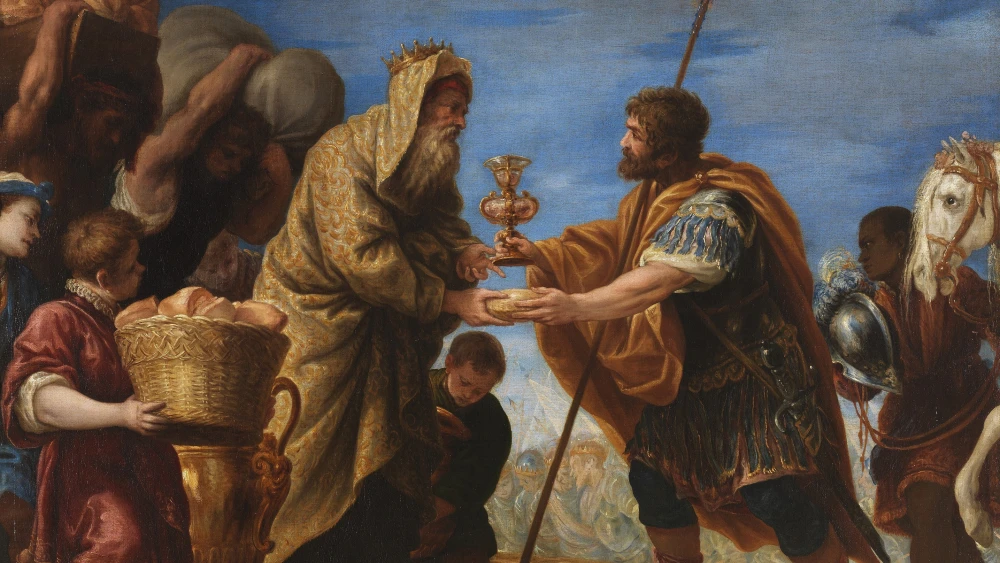

I love the name “Abraham Accords.” May its members grow. Abraham is the father not only of the Jewish people but of all the monotheistic, Abrahamic faiths.
He is also the father of sacred martyrdom. Whenever we speak of self-sacrifice for God, for our mission, for our purpose, Abraham is the paradigm. He blazed the trail. He was the first to be prepared to sacrifice his own son Isaac on the altar because God asked him to.
Of course, it was only a test—the tenth and final test of faith, and he passed all 10. But think of what he was prepared to do. He took Isaac up the mountain, bound him on the altar and raised the knife. Only when the angel called out, “Do not lay your hand on the child,” did he stop.
We invoke that historic encounter regularly in our prayers. Every single day we call to mind the binding of Isaac, and many times over in our High Holiday liturgy.
So the question is, why the fuss over Abraham? Tragically, we have had millions of martyrs since. Some 6 million in the Holocaust. More than 1,200 on Oct. 7. Long before that were those lost in the Crusades, the Inquisition—pogroms without number.
So, why do we keep going back to Abraham’s sacrifice? And those who came after him were not personally commanded by God either. So why is Abraham’s martyrdom so special?
One answer is precisely that: He was the first. It is far easier to follow a path once somebody has walked it. Abraham had no map, no precedent and no one to learn from. His own father, Terach, was a pagan who manufactured idols. Abraham had to be the first in his family, the pioneer.
There is a verse in Ezekiel (33:24)—Echad haya Avraham, “Abraham was one.” And still, everything came from him. All of Jewish history flowed from Abraham and his ground-breaking faith. But echad also means “first.” He was not only one. He was the first.
I always say that this makes Abraham the perfect role model for anyone who is the first in their family to take a new step Jewishly. Maybe you didn’t grow up with a Jewish education. Maybe nobody in your home lit candles or went to synagogue. Maybe they never had a bar or bat mitzvah.
If so, then Abraham is your role model. He started from zero, and so can you.
Some years ago, I was invited to a recital by a well-known Afrikaans actor, Patrick Mynhardt. He was a superb actor, and he performed a scene from a World War II film. Private Peters is under fire in North Africa. His friend, a Jewish soldier, is shot dead beside him. Peters survives only because he is crouching behind a tree. When he sees his friend is gone, he reaches inside his shirt and pulls out a Magen David, a Star of David. Nobody had known that Peters was Jewish. And there, under fire, he recites Kaddish for his fallen friend.
Mynhardt recited that Kaddish word-perfect, in a way that would make any rabbi proud. It is not easy Aramaic, and he pronounced the entire prayer impeccably. I thought about it all night. Here was a non-Jewish actor reciting Kaddish perfectly, which, sadly, is better than far too many Jews can do. How many times have I stood at a funeral while a son struggled with the words of Kaddish over his own father’s grave? Often, he must read it in English, and even then, it is a struggle.
But think about it. If a non-Jewish actor playing a role on stage can learn to recite Kaddish fluently, how much more so can we, the children of Abraham? If he can do it for a part in a play, can we not do it for the real thing?
I once had a man in my congregation, a brilliant civil engineer with a wicked sense of humor. I loved our conversations. One day, I invited him to join my Tuesday night Talmud class. His reply: “Rebbe, ich bin a poyur. Rabbi, ‘I’m a peasant.’ I grew up in a small town far from any Jewish community. I never went to a Jewish day school. How could I possibly join a class in Talmud?”
But I didn’t let up. I told him it was for beginners, that it was in Hebrew and English, and that an intelligent man like him would love the Talmud’s legal discussions and debates. I don’t like to nag, but in his case, I made an exception. Eventually, he said, “OK, Rabbi, I’ll try it once. No obligations.”
He came. He enjoyed it. He became a regular. And he would often ask such sharp, penetrating questions that I had to dig deeply to find the answers. He made a real contribution to the class.
That is the lesson of Abraham.
And if you say, “Rabbi, I’m too old to start,” let me tell you about the man who said exactly that to his rabbi. “Rabbi, I’m 70. I can’t start learning Hebrew now.”
The rabbi said, “My friend, in five years you will be 75, whether you learn or not. The only question is whether you will be a 75-year-old who can read the aleph-bet or one who can’t.”
Years later, the man said, “Rabbi, that was the best advice I ever got. I’m 82 now. And I’m still learning.”
So Abraham was the first, and that is one reason that his martyrdom is so special. He had no one to learn from, nobody to show him that it could be done. He stood alone on that mountain with no precedent and no one to say it’s been done before.
We are never in that position. We have Abraham. We have Sarah, Isaac, Jacob and a chain of generations behind us—all the way to the engineer in South Africa who finally said, “OK, rabbi. I’ll try it once.”
So whatever the first step is for you—whether it is Kaddish, a Torah class, a Shabbat table or a mitzvah you have never done—remember that Abraham did it first with no one to guide him. But you have him to guide you.
Echad haya Avraham. Be the first in your family, and your children will say you were the one who started it all.


