Newsletter
Newsletter Support JNS

‘New York Times’ accused of whitewashing antisemitic term

The paper is “just casually whitewashing what ‘J-pilled’ actually means,” Jerry Dunleavy of ‘Just the News’ stated. “ Hint: ‘Israel’ doesn’t start with ‘J.’”

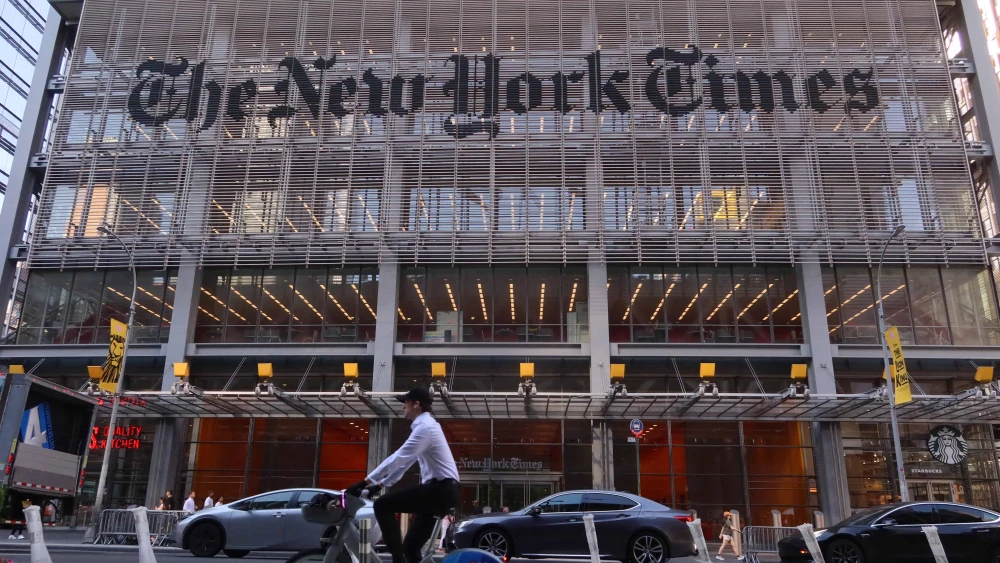
A person cycles past the front of “The New York Times” headquarters on Eighth Avenue in Midtown Manhattan on June 24, 2025. Photo by Gary Hershorn/Getty Images.

The New York Times is facing backlash over its characterization of the term “J-pilled,” with critics accusing the paper of downplaying the antisemitic nature of the word.

In an article titled “I Think That MAGA Is Dying: Inside the Youth Movement at CPAC,” reporter Nathan Taylor Pemberton wrote that, “20-somethings in rumpled suits were gathered in clusters, debating the merits of a ground invasion in Iran, the conservative backlash against those who were ‘J-pilled’ (far-right slang for skepticism of Israeli influence), the backbreaking costs of American life and what they saw as the slow demise of the Trump era.”

Critics said the description misrepresented the term. An entry on Urban Dictionary, a crowdsourced online dictionary for slang words and phrases, defines “Jew pill” as adopting conspiratorial or hostile beliefs about Jews.

“They are so used to smoothing out woke left antisemitism, they did the same to woke right,” political writer Katya Sedgwick stated.

Jerry Dunleavy, chief investigative correspondent for Just the News, wrote that the paper is “just casually whitewashing what ‘J-pilled’ actually means (hint hint: ‘Israel’ doesn’t start with ‘J.’)”

Lahav Harkov of Jewish Insider compared it to “when the BBC translates Palestinians talking about the ‘Yahood’ (Jews) as Zionists.”

Melissa Weiss, executive editor of Jewish Insider, questioned how multiple editors at the Times looked at the story without asking what the “J” stood for.

“Here’s a hint. It isn’t Israel,” Weiss stated.

Four Republicans voted with nearly every Democrat to discharge the war powers resolution calling for U.S. President Donald Trump to withdraw American forces from hostilities with Iran.
“I would like to see something that says, ‘And here’s what’s going to be there instead,’” Rep. Adam Smith, ranking member of the House Armed Services Committee, told JNS.
In a report delivered to the U.N. Security Council, the board says the terrorist organization’s refusal to give up its weapons remains “the principal obstacle to full implementation” of the Gaza ceasefire.
“Over time, the members of the Congress, both houses, both parties, are going to understand that this is a cost that is not only affordable but absolutely a necessary investment,” Eric Fingerhut, president and CEO of the Jewish Federations of North America, told JNS.
The U.S. secretary of state cited “overwhelming support” for a U.S.-Bahrain resolution demanding Tehran halt attacks and remove sea mines from the strategic waterway.
“At their core, sanctions are not acts of aggression,” Scott Bessent said at an annual terrorism funding conference. “They are instruments of peace.”