The Board of Peace, chaired by U.S. President Donald Trump, wants the U.N. Security Council to pressure Hamas to disarm, according to a report of its activities viewed by JNS.
That report was delivered to the United Nations on May 15 and is set to be made public on Wednesday. It is slated to be discussed on Thursday during a U.N. Security Council meeting.
Through a resolution passed last November, the Security Council gave force to Trump’s 20-point peace plan for Israel and Hamas, and the proposed groundwork for Gaza’s future governance and recovery.
The Board of Peace cites Hamas’s refusal to disarm, as called for in the plan, as “the principal obstacle to full implementation” of the ceasefire, criticizing its “refusal to accept verified decommissioning, relinquish coercive control and permit a genuine civilian transition in Gaza.”
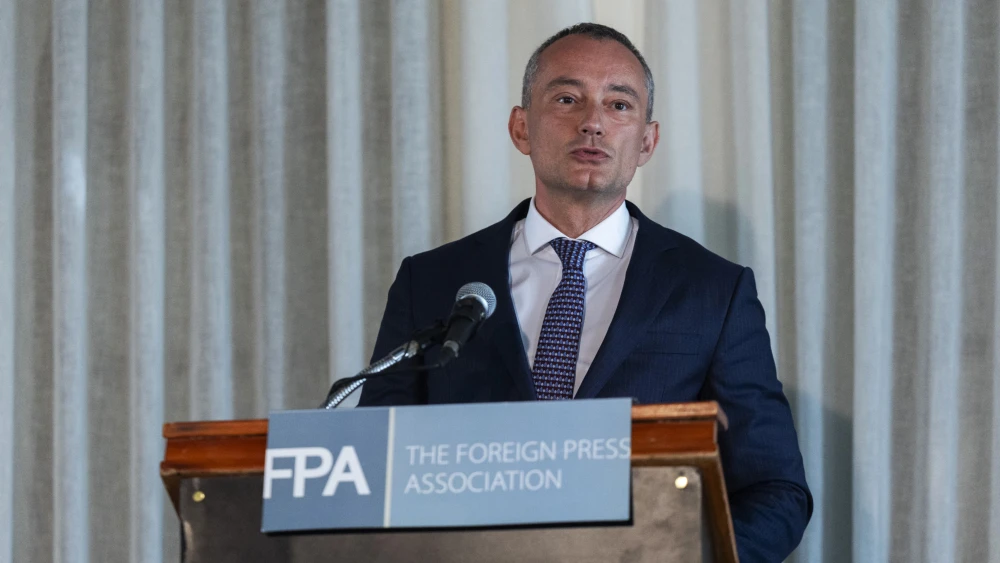
Nickolay Mladenov, the board’s high representative for Gaza, testified to the council last week that the terror group’s obstinacy is paralyzing progress.
Disarmament is supposed to go hand-in-hand with a phased withdrawal from Gaza by the Israel Defense Forces and the entry of a board-backed transitional Palestinian governing body, which has been stuck operating from Cairo and “has not yet been able to enter Gaza in areas that remain under Hamas armed control.”
Instead, the National Committee for the Administration of Gaza has spent the reporting period “preparing the technical foundations of the transition, including the development of the legal, financial and administrative architecture of transitional administration, setting standards for senior civil servants, personnel procedures and building partnerships.”
Meanwhile, training for a Gazan police force “is ready to commence,” with Egypt “as the lead training partner,” the board says.
“Institutions, resources and plans are in place to take the next steps,” according to the board.
The board is now calling on the Security Council to “reiterate publicly, clearly and consistently that the decommissioning of weapons in Gaza is not merely a requirement” to end the war, “but critical for reconstruction to begin, for a time-bound Israeli forces withdrawal, and for a credible pathway to Palestinian self-determination and statehood to be pursued.”
An international security force under the board’s auspices has not started operating, even though the report said “a pre-deployment site survey” by the five countries contributing troops was completed in late April.
Hamas blames Israel for failing to uphold its end of the truce, including in allowing humanitarian aid to enter unimpeded and to allow a fuller flow of people around the enclave.
Mladenov “has underscored repeatedly that the ceasefire constitutes the foundation of the entire transition and that every violation, from whatever quarter, risks unraveling what has been painstakingly built,” the report says. The Board of Peace calls on all parties to exercise maximum restraint and to honour the commitments they have undertaken.”
Money is another issue. While the board received $17 billion in pledges around the time of its inaugural meeting in February, the report states that “the gap between commitment and disbursement must be closed with urgency,” without identifying funders who may be lagging.
It’s also calling on U.N. member states and international organizations to step up if they haven’t donated yet and to get the dollars out the door.
“The faster the international community moves from pledge to disbursement, the faster the NCAG can demonstrate that Palestinian-led administration delivers,” the report says.