Dave Yost, the Ohio attorney general, filed another lawsuit against the main Reform Judaism training center to force its Cincinnati campus to remain open, the state prosecutor’s office said on Tuesday.
The suit, filed in Hamilton County Common Pleas Court, alleges that Hebrew Union College-Jewish Institute of Religion’s plan to close its rabbinical program by the end of this academic year runs afoul of state charitable laws. It also accuses the college of shifting donations designated for its Cincinnati campus to other locations.
“Hebrew Union accepted millions of dollars in donations based on a 76-year-old promise it now would like to break,” Yost stated. “We’re suing to keep these assets in Cincinnati where they belong.”
Hebrew Union College was founded in Cincinnati more than 150 years ago. It has U.S. branches in New York City and Los Angeles, and its Jerusalem campus is the only seminary in Israel that trains Reform clergy.
The suit centers on a 2022 decision by the college’s board to remove a line from a 1950 agreement, which combined Cincinnati’s Hebrew Union College with New York’s Jewish Institute of Religion. It said that it would “permanently maintain rabbinical schools” in both locations.
That same year, the Hebrew Union board of governors in New York voted to wind down rabbinical ordinations in Cincinnati. Only four rabbinical students remain there, and their ordinations are scheduled for next month.
The college announced plans to consolidate its three U.S. campuses into a national school, operating on two residential campuses, “while also reimagining our historic Cincinnati campus to ensure our world-class library, archives and museum serve students, scholars and community learners in new and innovative ways.”
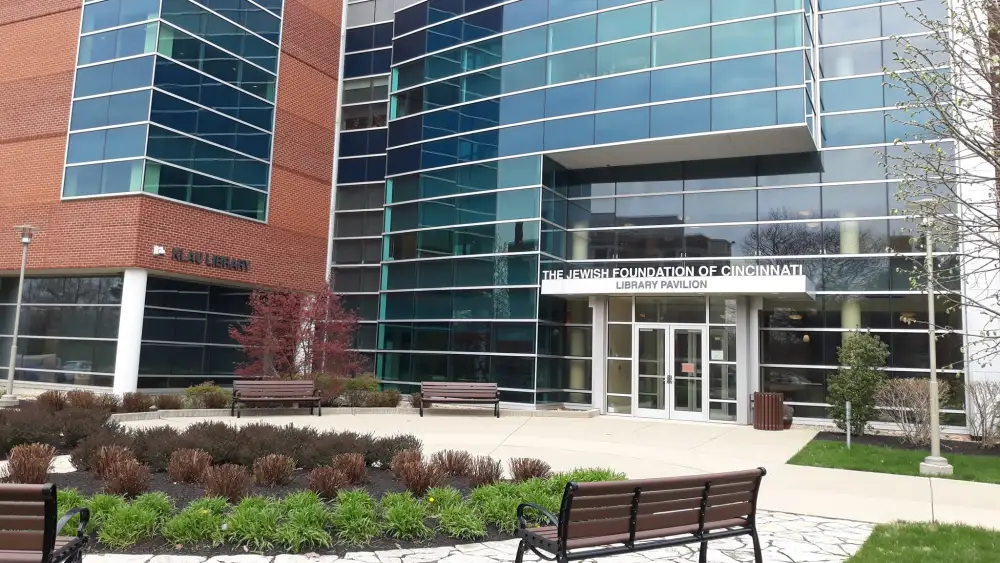
The Cincinnati campus is home to the Klau Library, the Jacob Rader Marcus Center of the American Jewish Archives and the Skirball Museum.
Gary Zola, executive director emeritus of the American Jewish Archives and professor emeritus at Hebrew Union College, told WVXU radio that the announced plans to keep a Cincinnati campus in place without a school are suspicious.
“You don’t need any education to know that if there are no students, if there are no academic programs, if nothing exists here and people have given money over 75 years for the purpose of sustaining rabbinic education—scholarship money, funding for the campus, all this—and nothing exists, well, I certainly can understand the attorney general’s point of view,” he told the station.
Yost is asking the court to prevent any sale of the campus and to keep donations intended for Cincinnati in Ohio. He also wants the court to order an accounting of the school’s state-based assets and to support the establishment of a permanent rabbinical campus in the city.
This is the second time he is suing the school. In 2024, he took HUC to court after media reports suggested the school might sell off rare books from its Klau Library collections.
That suit resulted in a 2025 settlement, including an accounting of rare books and manuscripts and other special collections in the library and an order to provide Yost’s office with notice 45 days before the sale or removal of items from those collections.
“It is nauseating to consider that where the Cincinnati community sees the sacred vessels of the Jewish people, others see dollar signs,” Matthew Kraus, associate professor and head of the Judaic studies department at the University of Cincinnati, and director of the public school’s Hebrew program, told JNS in 2025.
“While I am grateful that the attorney general of Ohio has taken steps to prevent this tragedy, it is shameful that he has to defend the destruction of an irreplaceable Jewish library from an HUC administration that has lost sight of its mission and purpose and has commodified Jewish tradition,” Kraus said at the time.
Andrew Rehfeld, president of Hebrew Union College, stated at the time that “although we had no intent to sell the collection and took no steps to initiate the sale of any part of it, we periodically assess our assets as an aspect of our responsible management of these precious resources.”
Zola is now the founding president of the College for Contemporary Judaism, a new rabbinical seminary being formed in Cincinnati.
“We believe it is imperative that there be a strong, vibrant rabbinical school in Cincinnati to serve the liberal American Jewish community, especially between the coasts where access to congregational rabbis and rabbinical education is severely limited,” the new seminary stated, of the lawsuit.
“It is vitally important that assets subject to the lawsuit are used as originally intended: to support a strong, thriving rabbinical school in Cincinnati,” the new seminary said.