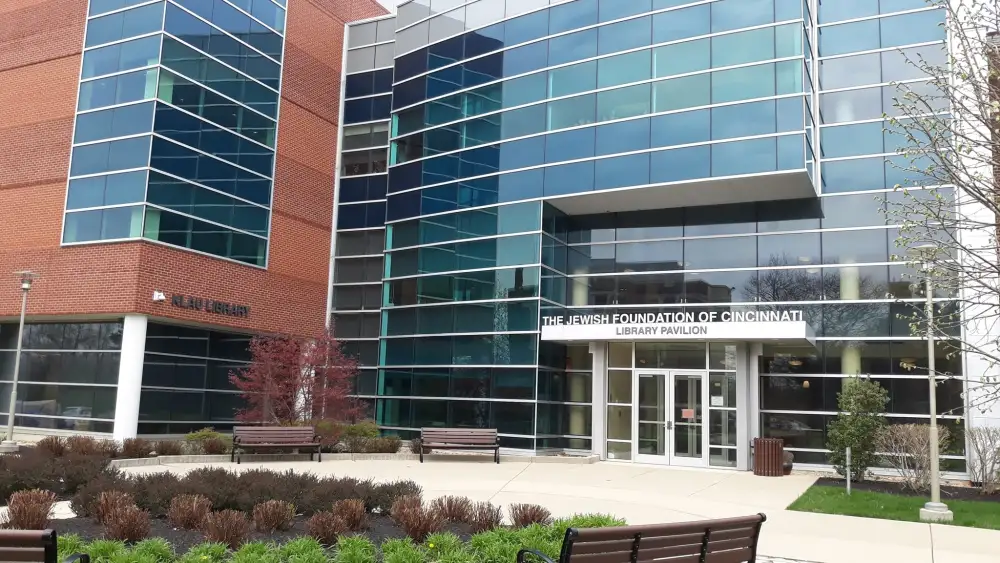
Hebrew Union College, the Reform Jewish movement’s seminary, hailed its agreement with the attorney general of Ohio about books it wanted to sell from its library as affirmation of “the library’s educational, religious and scholarly role within our institution and its service to communities and scholars around the world.”
But Matthew Kraus, associate professor and head of the Judaic studies department at University of Cincinnati, and director of the public school’s Hebrew program, told JNS that the takeaway from the state’s settlement with HUC is very different from the seminary’s framing.
Ohio attorney general Dave Yost’s settlement with the seminary “is to be applauded, because it prevents rare Jewish books from becoming even rarer,” Kraus said. “The rare book room of the Klau Library contains the sacred heritage of the Jewish people that the Jewish community of Cincinnati has been entrusted to preserve and protect.”
“It is nauseating to consider that where the Cincinnati community sees the sacred vessels of the Jewish people, others see dollar signs,” the scholar said. “While I am grateful that the attorney general of Ohio has taken steps to prevent this tragedy, it is shameful that he has to defend the destruction of an irreplaceable Jewish library from an HUC administration that has lost sight of its mission and purpose and has commodified Jewish tradition.” (JNS sought comment from HUC.)
The Jewish community has taken the responsibility of preserving Jewish heritage seriously for almost 150 years of “dedicating time and resources to ensure that all the parts of the Cincinnati campus of Hebrew Union College flourish,” Kraus told JNS.
“Anyone familiar with Jewish history will recognize the value of preserving Jewish writings, as exemplified by the profound impact in the 20th and 21st century of the Dead Sea Scrolls and Cairo Genizah, other literary collections that were saved,” he said. “Moreover, the sacred task of preserving our sacred heritage has provided countless opportunities for people around the world, not just Cincinnati, to have a powerful connection to Judaism by encountering the actual material elements of the Jewish experience.”
Nothing replaces a “firsthand encounter with the objects handled by our ancestors and the sources of their inspiration,” the scholar said. “In addition, protecting our sacred books has represented an act of resistance to the instances of Jewish book burnings and bannings over the past millennia.”
He added that although Hebrew Union College “no longer matters like it once did to Cincinnati,” it is “never a good feeling to see a beloved institution that has been put on life support have its limbs being harvested and sold piecemeal.”
‘Irreplaceable documents’
The Ohio attorney general stated last week that it had settled with the Reform seminary and set “new ground rules for the management and removal of invaluable ancient artifacts housed in Cincinnati’s Klau Library at Hebrew Union College.” The state said that the agreement “mandates greater transparency from the college and grants the attorney general’s office oversight to ensure that the library uses its collection of rare books to benefit the public.”
“These sacred texts were entrusted to Hebrew Union with the promise that they would be preserved for the benefit of scholars and researchers worldwide,” Yost, the attorney general, stated. “I commend the college’s leaders for renewing that pledge with this agreement.”
Yost filed a lawsuit in June 2024 “following reports that the college, the first permanent Jewish institution of higher learning in America, had expressed interest in selling some of the precious texts—potentially worth millions of dollars—to offset its sizable deficits,” the attorney general’s office said. “Yost warned that doing so could be a breach of the Hebrew Union board’s fiduciary duties.”
Under the settlement, the seminary must give the state a “complete list of items in the library’s special collections and rare book and manuscript collection, identifying any that have donor restrictions,” per the attorney general’s office. “The college must notify the office at least 45 days before making any attempt to sell or remove such items from its collection.”
Any sales proceeds must be used only to buy new items for the collection, “unless the college’s board declares an acute financial need via a two-thirds majority vote,” Yost’s office said. It added that donor restrictions on the collection must stay in place.
Andrew Rehfeld, president of Hebrew Union College, stated in an email to the school’s community that the agreement “upholds our mission to preserve and maintain access to the Klau Library rare books and manuscripts collections in service to the Jewish people, Judaism and global academic scholarship.”
“Concerns from community members following a routine assessment and valuation of our rare book collection in January 2024 prompted this inquiry,” Rehfeld wrote in an email shared with JNS. “Although we had no intent to sell the collection and took no steps to initiate the sale of any part of it, we periodically assess our assets as an aspect of our responsible management of these precious resources.”
Rehfeld wrote that though the seminary “incurred significant legal costs” due to Yost’s legal action, “it will have been worthwhile if it leads to the restoration of trust.”
Mark Raider, professor of modern Jewish history at the University of Cincinnati, where he also directs the Center for Studies in Jewish Education and Culture and chairs the Israel Initiative Committee, is a visiting American Jewish history professor at Hebrew Union College’s Cincinnati branch.
He told JNS that Yost’s “intervention represents a crucial victory for scholarship, Jewish heritage preservation and the broader academic community” and the settlement “ensures that one of America’s most significant repositories of Jewish learning remains intact and accessible.”
HUC’s Klau Library is “one of the premier Judaica libraries in the world outside of Israel,” according to Raider.
“Its collections rival those of major international institutions. The library serves not only HUC students and faculty but also researchers from the University of Cincinnati, visiting scholars from around the region, country and globe,” he told JNS. “Most critically, HUC’s rare manuscripts collection represents a priceless treasure of Jewish civilization,” including “irreplaceable” medieval Hebrew manuscripts, early printed books, rabbinic responsa and “unique historical materials that exist nowhere else.”
“Once dispersed through private sales, these materials would become inaccessible to scholars and potentially lost to the academic community forever,” he said. “The impact on Jewish scholarship cannot be overstated.”
“The loss of this collection would create an irreparable gap in Jewish academic infrastructure in North America,” he added.