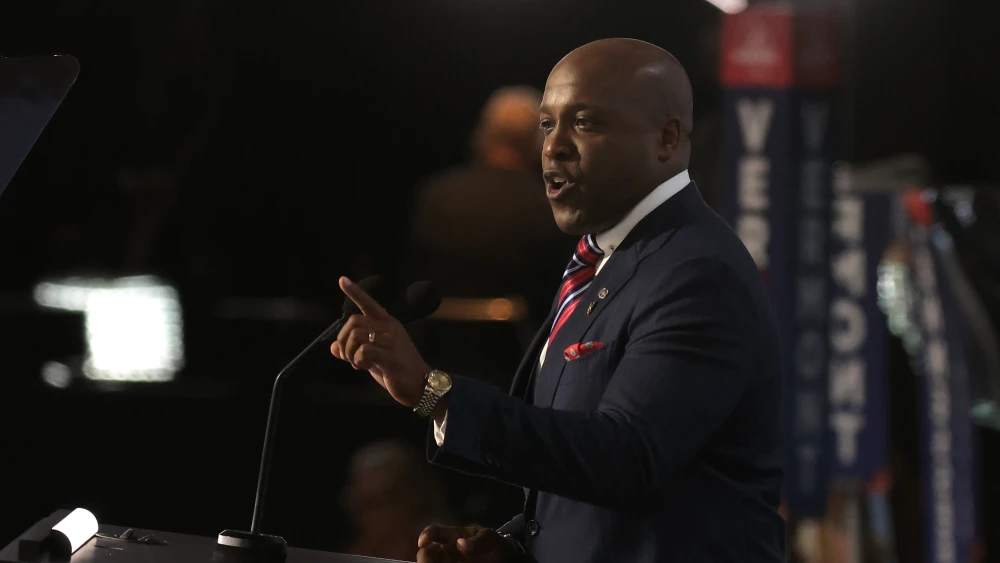
Rep. Wesley Hunt (R-Texas), the Trump administration’s nominee for U.S. ambassador to Saudi Arabia, where Hunt served for two years as a U.S. Army diplomatic liaison officer, faced tough questions from Senate Foreign Relations Committee Democrats in a confirmation hearing on Tuesday.
Sen. Jeanne Shaheen (D-N.H.), outgoing ranking member of the panel, asked Hunt, who has made statements in the past about Sharia Muslim extremism, about how he would work in the kingdom, which has a Muslim government and oversees the holiest sites in the faith.
“I’m concerned about some of the statements that you’ve made about Islam, and particularly as the ambassador to Saudi Arabia,” Shaheen said.
Hunt is a member of the Sharia-Free America Caucus, a congressional group launched last year to oppose the spread and influence of Sharia law in the United States.
Hunt previously said that “the mandate that’s been given to Islam is to basically go to other countries and infiltrate them, have a heavy population and then eventually take them over” and that “this is what’s happened for generations,” according to the senator.
“Is this your view of Islam?” Shaheen asked Hunt.
“I think I was actually condemning the extremists,” Hunt told her.
The congressman cited comments that Mohammed bin Salman, the Saudi crown prince, made when he met with U.S. President Donald Trump in the Oval Office last November. Those remarks are evidence that Saudis are reforming, according to Hunt.
The prince said that he feels pain for the families of American victims of 9/11 and that CIA documents show that “Osama bin Laden used Saudi people in that event for one main purpose,” to “destroy this relation, to destroy the American-Saudi relation.”
“That’s the purpose of 9/11,” bin Salman said.
The prince said that “strong relations between America and Saudi Arabia is bad for extremism. It’s bad for terrorism.”
Hunt told Shaheen that “There are some cultural differences that we are going to have to diplomatically work through.”
“From the time when I was stationed there, Saudi Arabia has had immense growth, and they have changed tremendously under the leadership of Mohammed bin Salman,” he said. “When I was stationed there, women did not have the right to drive or operate a motor vehicle. They were still having public beheadings.”
‘Part of the negotiation process’
Sen. Jeff Merkley (D-Ore.) asked Hunt about the bilateral civil nuclear cooperation agreement, known as a 123 agreement, that Washington and Riyadh signed in July.
The 30-year agreement governs peaceful nuclear cooperation and U.S. technology exports, but unlike past U.S. nonproliferation standards, this one doesn’t meet the traditional nonproliferation “gold standard” of a strict nonproliferation commitment.
In such a commitment, a partner nation forgoes activities that can produce material for a nuclear weapon and provides the International Atomic Energy Agency with expanded access and verification powers.
“We need to try to get as close to the gold standard as possible,” Hunt said. “We also need to understand that if we aren’t the ones that are able to provide them with this program, then they, the Saudis, may turn to China or, God forbid, even Pakistan.”
“If that’s the case, then we have absolutely no say in the direction that they could take their nuclear program,” he said.
Critics of the deal are concerned that its terms will provide additional leverage to Iran in any potential nuclear accord with the Islamic Republic and could prompt the United Arab Emirates to rethink its “gold standard” agreement with Washington.
Shaheen also asked Hunt about Trump’s claim that approval for the Saudi nuclear cooperation agreement depended on Riyadh joining the Abraham Accords and opening diplomatic relations with Israel.
The agreement text reportedly doesn’t mention such normalization and, according to reports, Trump’s announcement caught Saudi leaders off guard.
Riyadh has said multiple times that normalization with the Jewish state can only take place in connection with advancing a Palestinian state.
“That’s actually a part of the negotiation process,” Hunt said, of Trump’s condition for normalization. “We all know that we have to start at one place until we get to the finish line.”
A former Apache helicopter pilot and Army captain, Hunt ran an unsuccessful campaign this year for a Senate seat. His tenure in the House ends in January after two terms.
Republican opposition to his nomination as envoy to the kingdom has been reported, and his chances of being confirmed are far from certain given a packed Senate schedule as the end of the year approaches.
The Senate Foreign Relations Committee has yet to schedule a vote on his nomination. The U.S. embassy in Riyadh has lacked an ambassador since just after the start of Trump’s second term in January 2025.