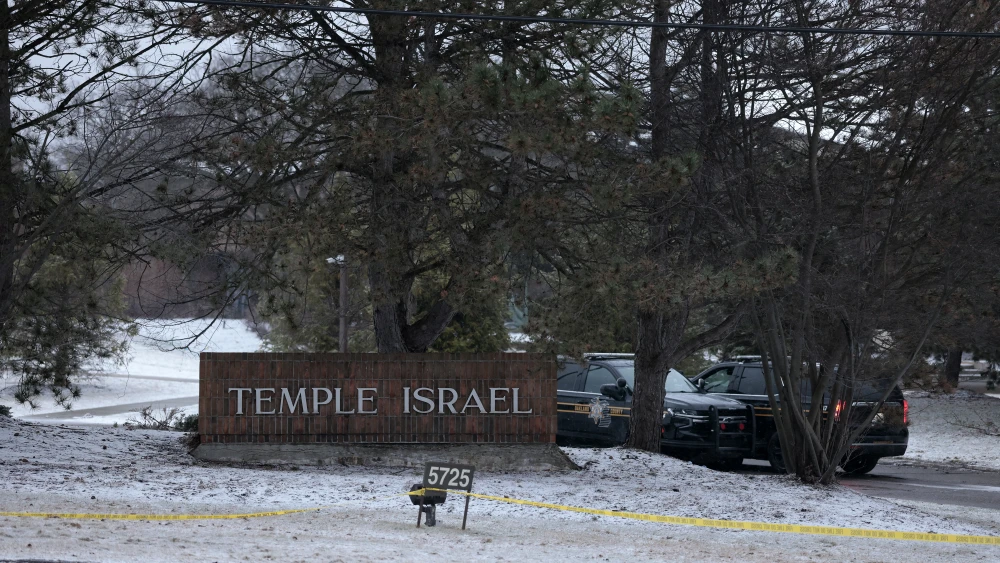
A rabbi from Temple Israel and the heads of the Jewish Federations of North America met with members of Congress on Tuesday to call for a near-four-fold increase in federal security spending after last week’s attack on the Reform congregation in Michigan.
Eric Fingerhut, president and CEO of the Federation, told JNS that it was “sheer miraculous luck” and years of preparation from the synagogue’s security team that prevented the attacker from carrying out a massacre.
Ayman Mohamad Ghazali, 41, a U.S. citizen born in Lebanon, rammed his vehicle into the synagogue in West Bloomfield Township, a suburb of Detroit, shortly after noon on Thursday. His truck was laden with improvised explosives believed to be gasoline and fireworks, according to the FBI.
Ghazali struck one of the temple’s security officers with the vehicle and began firing a gun through the windshield, unable to exit the stuck truck. Ghazali then shot and killed himself after engaging in a gunfight with synagogue security and his truck catching fire.
“This could have been the greatest terrorist tragedy in America since 9/11,” Fingerhut said. “It would have been the greatest attack on Jews since Oct. 7 if the truck had gotten inches further through the hallway instead of being stopped by the walls and by the armed security guards.”
Rabbi Jen Lader told JNS that the hallway Ghazali drove the truck into is usually “filled with children” under the age of 5.
“We have babies in the building who are in a stroller to sleep for nap time,” Lader said. “One of our guys was hit by the car. He was unconscious and broke his leg and has lots of injuries, and he woke up and dragged himself over to the wing, which is right in the hallway where our two rooms of our littlest babies are, and bolted the door shut, so that they wouldn’t get hurt.”
None of the 140 children at the synagogue’s early childhood center was harmed, and the security guard was the only member of its staff who was injured.
Lader showed JNS images of the aftermath of the attack, one of which she agreed to share for publication, of shattered glass in the hallways and nursery rooms of the synagogue and the incinerated hallway where she normally spends time high-fiving children.
Fingerhut said that the Trump administration and members of Congress from both parties support additional security efforts for Jewish institutions but were “shocked” by the descriptions they shared of the attack in Michigan.
“The question is: Do they understand how close we are to the kind of tragedy that would change America forever?” Fingerhut told JNS.
In a perverse sense, the attack on Temple Israel represented a best-case scenario. The synagogue spends $250,000 annually on security personnel and has invested millions on other security features.
Its guards responded to the threat immediately and prevented a much larger tragedy, with no fatalities other than the assailant. But it also showed the vulnerability of a congregation that thought it was secure.
Lader said that the Temple Israel community is now reckoning with those two conflicting facts—that the community is safe and that “this is a devastating catastrophe.”

“We had every possible prevention method in place,” Lader told JNS. “We were so prepared. We just practiced three weeks before, and everything worked beautifully, and still, somebody came into my house to shoot my babies.”
“We have to hold both of those things at the same time,” the rabbi said.
Fingerhut described the kinds of additional security measures that Temple Israel and other Jewish institutions across the country are now forced to consider when even the most secure of such facilities are saved only by the inches it would have taken to allow Ghazali to exit the car.
“We need to extend the perimeter,” Fingerhut told JNS. “We’re going to have to put up gates around parking lots. It’s going to be license recognition and cameras and people watching these cameras around all the perimeters of all of our institutions.”
In the 2025 fiscal year, Congress spent $274.5 million on the Nonprofit Security Grant Program, which is designed to help improve the physical security of Jewish day schools, synagogues and other at-risk sites.
The Federation and Temple Israel asked members of Congress, including House Majority Leader Steve Scalise (R-La.), Minority Leader Hakeem Jeffries (D-N.Y.) and Senate Minority Leader Chuck Schumer (D-N.Y.) to raise that figure to $1 billion.
The grant program is intended to bolster physical security, and so its terms currently allow state agencies that distribute the federal money to cap the percentage of spending that can go to paying the salaries of security guards.
It also requires those guards to be independent contractors. Fingerhut told JNS that those restrictions should be lifted.
“The security guards that are the most effective are the ones that work for the synagogue, work for the Jewish community center,” he said. “They know the building. They know the people. They know how to respond.”
The Federation estimates that the American Jewish community now spends some $765 million annually on security on top of grants from the federal government, a burden that is not shared by most other religious denominations in America.
Churches in the United States do not usually have armed guards and don’t have to contemplate installing license plate scanners to prevent would-be attackers from staking out their parking lots.
Media reporting and some commentary on the attack has further singled out Temple Israel and other U.S. Jewish institutions by drawing connections between the synagogue, the attack and Israel.
The New York Times wrote that Temple Israel was “founded in 1941, dedicated to the formation of a Jewish state,” and the mayor of Dearborn Heights, Mich., stated in the aftermath that Ghazali “lost several members of his own family, including his niece and nephew, in an Israeli attack on their home in Lebanon.”
Mayor Mo Baydoun did not mention that two of Ghazali’s brothers killed in those strikes were members of Hezbollah, according to the Israeli military, and the FBI is investigating whether Ghazali had ties to the terrorist group.
While motive and potential intelligence or law enforcement failures to identify an affiliation with a foreign terrorist organization are relevant to stopping future attacks, Lader told JNS that some media organizations and commentators threaten Jews by being willing to treat those circumstances as a mitigating or justifying factor for Ghazali’s actions.
“This week, it’s been the New York Times. It’s been PBS. It’s been NPR. It’s been CNN,” she said. “I feel like I’m living in a dream world and it’s obscene. And you know what? It’s going to get us killed.”
For now, many U.S. Jewish institutions can afford the ever-increasing costs of ever-increasing security measures, but creating fortress-like institutions cannot solve the underlying problem of Jew-hatred as visited upon a tight-knit community like the Jews of West Bloomfield, whom Lader described as “the nicest people on Earth.”
“These are people who would give you the shirt off their back without knowing you,” she said. “These are people that run an unbelievable number of social service agencies to help other people and volunteer their time and money.”
“The nicest, most wonderful people on the planet are the ones whose babies people are trying to kill,” she said.
“My daughter told me this week that she’s afraid to sleep in my house,” Lader told JNS. “She said that if these people are coming to find me at work, then what’s to say they’re not gonna find me at home?”
The attack in Michigan—like the wave of attacks on synagogues in Europe, like the attack on Jews celebrating Chanukah at Bondi Beach in Australia, like the car-ramming and stabbing attack in Manchester, England—raises urgent questions about the need for increased funding for the security of synagogues and schools.
It also raises more fundamental questions about the place of Jews in the United States and the West.
It’s not yet clear whether attacks on Jews might join school shootings and other forms of mass violence that Americans have largely grown accustomed to, or whether a concerted effort on the part of lawmakers and law enforcement might somehow reverse the trend.
Lader described a conversation with a colleague after the Oct. 7 attacks about the “100-year blips” in history of greater tolerance for Jews in places like Germany before the Holocaust and pre-Reconquista Spain.
“I think that we’ve been blessed, all of us, to have lived some of our lives in one of these blips,” she said of the United States. “Now I think that the blip is probably over.”
“I hope that I’m wrong,” she said.