The U.S. Department of Homeland Security’s new rule limiting how long foreign students can stay on visas could make it more difficult for some anti-Israel activists to remain in the country indefinitely, experts told JNS.
Markwayne Mullin, the U.S. homeland security secretary, stated on Thursday that the “duration of status” system, which has existed for almost 50 years, has “compromised national security and created an environment ripe for immigration fraud.”
“Foreign students have been admitted into the U.S. indefinitely, allowing thousands to abuse our immigration system by perpetually enrolling in courses to avoid having to leave the U.S.,” he said.
According to the department, the rule limits foreign students and exchange visitors to four years in the country, after which they must apply for an extension. The rule also reduces the grace period for foreign students to leave the country, transfer schools or change their immigration status from 60 days to 30 days.
Mark Goldfeder, director of the National Jewish Advocacy Center, told JNS that under the “duration of status” system, “a foreign student was vetted exactly once, and then never again, sometimes for a decade.”
“We have spent the last few years watching what unexamined, open-ended status can produce on a quad,” he said. “This rule restores the unremarkable principle that a guest’s visa gets reviewed by the government that issued it, on a schedule.”
“The overwhelming majority of international students are exactly what they say they are, and a student who comes here to study will graduate inside four years without ever noticing this rule exists,” Goldfeder added. “But the perpetual activist on his seventh year of loosely defined coursework will notice it, and that is rather the point.”
Rabbi Eric Fusfield, director of legislative affairs at B’nai B’rith International, told JNS that “we recognize the need for proper national security vetting and the monitoring of foreign nationals who support terrorist organizations and foment hatred on campuses.”
“At the same time, we hope that the process of applying to immigration authorities for extensions will allow students who do not pose a security risk sufficient time to finish their study programs,” Fusfield said.
Simon Hankinson, a senior research fellow at the Border Security and Immigration Center at the Heritage Foundation, told JNS that “there’s some nexus between the real antisemitic Palestinian protesters and people who don’t study.”
“It probably would help cut down on antisemitic protests on college campuses. I don’t think that was the purpose behind it,” he said.
“If you’re a consular officer and you’re interviewing someone for a student visa and you see that they basically haven’t done any academic work and all they’ve done is protested, then you might not be inclined to issue them a visa to go back because their primary purpose of going to the U.S. doesn’t seem to be studying,” Hankinson said.
Jay Greene, a senior fellow at the Defense of Freedom Institute for Policy Studies who studies antisemitism in higher education, told JNS that the new rule is an “important and necessary step.”
According to Greene, the rule means that “foreigners cannot extend their stay by delaying completion of their degrees or seeking more degrees.”
“It also discourages universities from using these foreign students as cheap workers to teach introductions classes and run research labs, which delays the time it takes to complete a degree,” he told JNS. “The enforcement of the new rule is delayed until four years after it is published, allowing students and universities to adapt their plans to these reasonable limits.”
He believes that the rule will help reduce how much “foreign governments and non-governmental movements” use student visas to “plant agents and activists who remain indefinitely on college campuses to advance foreign political agendas.”
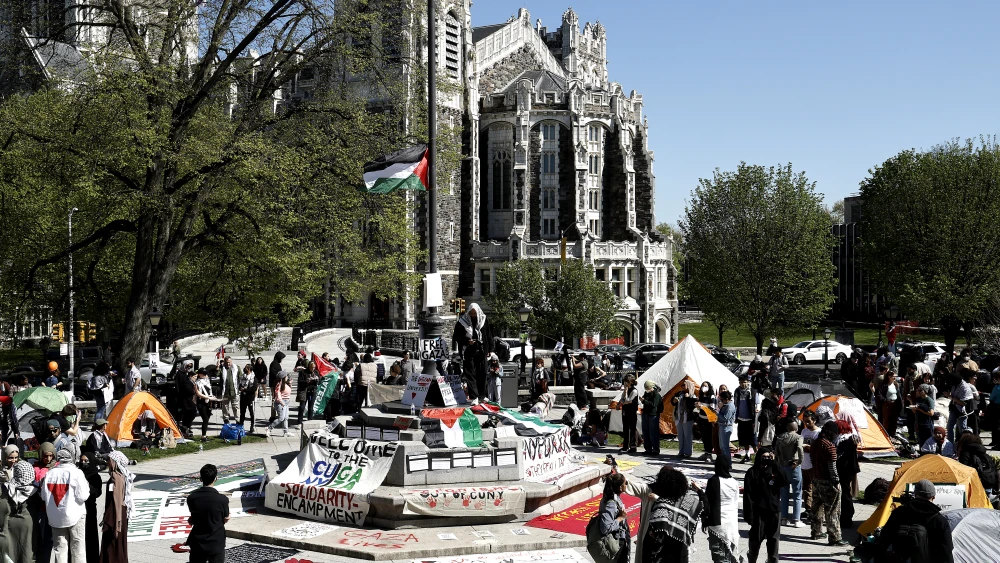
Greene said there have been “high-profile cases” like Mahmoud Khalil, a former Columbia University graduate student facing deportation over his anti-Israel activism, “who use the cover of being perpetual students to promote anti-Israel and anti-American goals at American universities.”