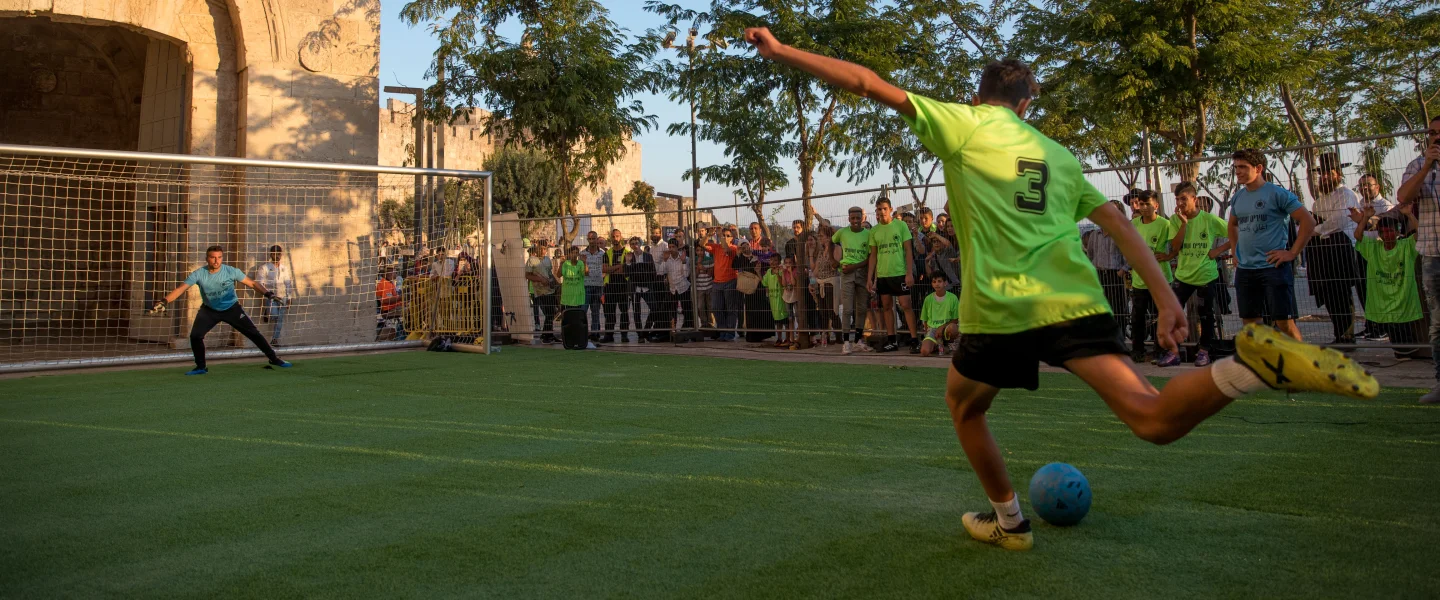
Ahead of Sunday’s FIFA World Cup final between Argentina and Spain, soccer’s biggest prize could once again be decided by an innovation championed more than half a century ago by Israeli soccer official Yosef (Joseph) Dagan.
Dagan, who died in 2020 at the age of 93, is widely credited with helping bring about the adoption of the penalty shootout after Israel’s elimination from the 1968 Olympic Games in Mexico City.
Israel held Bulgaria to a 1-1 draw after extra time in the Olympic quarterfinals. As was the custom, the referee determined the winner by the drawing of lots.
Israel captain Mordechai Spiegler pulled a slip marked “no” from a large sombrero, while the Bulgarian captain drew “yes,” sending Bulgaria into the semifinals and ending Israel’s historic Olympic run, The Jewish Chronicle reported.
The arbitrary result convinced Dagan that international football needed a fairer way to decide tied knockout matches.
Working with Micha Almog, then chairman of the Israel Football Association’s technical committee and later its president, Dagan proposed replacing the drawing of lots with a penalty shootout. In a 1969 letter to FIFA President Sir Stanley Rous, Dagan and Almog urged world soccer’s governing body “to stop this way of deciding the winner by drawing lots, an immoral and even cruel system for the losing team and not honorable for the winner.”
They proposed that tied knockout matches be decided by a penalty shootout consisting of five kicks per team, followed by sudden death if the scores remained level. The letter was published in FIFA’s official magazine that year and, following international debate, the International Football Association Board adopted the system in 1970.
Dagan was not alone in proposing the idea. German referee Karl Wald independently advocated a similar system around the same time. However, UEFA credited the Israeli official with presenting the proposal before the sport’s governing bodies.
The penalty shootout has since become one of soccer’s defining spectacles, deciding countless domestic cup finals, continental championships and World Cup matches. It was first used at a FIFA World Cup in the 1982 semifinal between West Germany and France, with the Federal Republic emerging the victor.
The 1994 final between Brazil and Italy became the first World Cup final to be decided on penalties. After a scoreless 120 minutes, Brazil claimed its fourth World Cup title by defeating Italy 3-2 in a penalty shootout after Italian star Roberto Baggio blasted the decisive spot kick over the crossbar.
Should Sunday’s World Cup final remain level after extra time, Dagan’s legacy could determine the sport’s ultimate champion. The final has been decided by a penalty shootout three times—when Brazil beat Italy in 1994, Italy beat France in 2006 and Argentina beat France in 2022.
⚽ Football's (soccer) ultimate tiebreaker didn't happen by accident.
— Israel ישראל (@Israel) July 15, 2026
What many fans don't know is that Israeli football official Yosef Dagan championed the idea of penalty shoot-outs after Israel was eliminated from the 1968 Olympics by a random draw.
As the road to the World… pic.twitter.com/ae5LLBiXxv
‘It’s the best system’
A former sports journalist, Dagan devoted decades to Israeli soccer. He served the Israel Football Association as general secretary, national coach and director of external relations, and played a key role in Israel becoming a member of UEFA in 1994.
Abraham Klein, 92, one of Israel’s most distinguished referees, officiated at three World Cups and knew Dagan well. A Holocaust survivor from Romania who made aliyah in 1948, Klein lives in Haifa with his wife, Bracha.
In an interview with JNS, Klein said: “Yossi Dagan was a very intelligent person and his English sounded like Shakespeare. Before 1970, when they introduced the penalty shootout, we used to toss a coin or draw lots. After the Israel-Bulgaria match in 1968, Dagan told them they had to change the system.”
Klein said Dagan’s solution has stood the test of time.
“In my opinion, it is the best system, absolutely,” he said. “Dagan was right. This was the best idea.”

UEFA honor
In 2002, UEFA awarded Dagan its Order of Merit in Ruby for outstanding services to European soccer. It praised his contribution to the sport, saying he “had a leading role in the growth of football in Israel” and recognizing him as “a major catalyst for the penalty shoot-out procedure.”
Looking back on the introduction of the penalty shootout in a 2013 interview with Ynet, Dagan recalled how quickly the system spread after its adoption.
“After the proposal was approved, it started being used in June 1970. It wasn’t introduced in time for that year’s World Cup, but the first kick was taken by George Best in an August match between Manchester United and Hull,” he said. “After that, it made its way into Euro 1976 and the 1982 World Cup.”
Dagan rejected professional criticism that penalty shootouts were unfair, arguing that alternative proposals had failed.
“There were other ideas that never caught on,” he said. “There was the golden goal, but they abandoned it because it didn’t give both teams an equal chance. A penalty shootout does.”
He remained unapologetic about the system he helped introduce until the end of his career.
“If they have a better solution, let them tell me,” he said.
Following Dagan’s death on March 22, 2020, then-Israel Football Association CEO Rotem Kamer hailed his contribution to the global game.
“Joseph Dagan had a leading role in the growth of football in Israel, and we thank him for his contribution,” Kamer said. “Over many decades, he gave of himself and nurtured our international relations.”
More than five decades after a slip of paper ended Israel’s Olympic dream, the solution Dagan introduced remains the sport’s standard—and most dramatic—way of settling a deadlock.