Newsletter
Newsletter Support JNS

‘To cover our ears to one cry is to silence them all,’ Kaploun says at concentration camp site in Bosnia and Herzegovina

“Whether it is denying the Holocaust, any genocide, or any atrocity, any attempt to rewrite the historical record is an insult to the victims at Jasenovac and an insult to any victim of the atrocities,” the U.S. special envoy said.

Kaploun
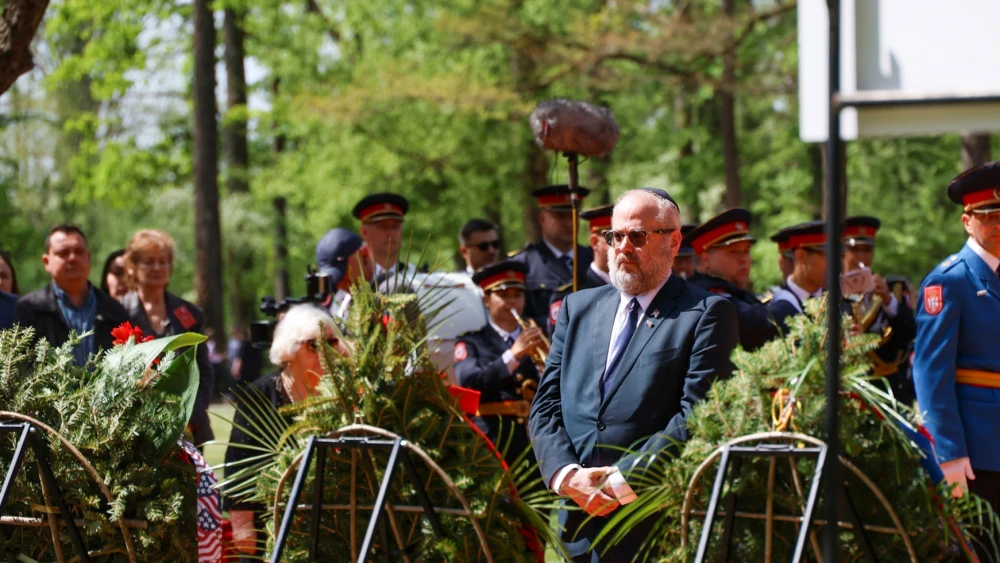
Yehuda Kaploun, a rabbi and U.S. State Department special envoy to monitor and combat antisemitism, speaks at the annual Donja Gradina commemoration hosted by Republika Srpska in Bosnia and Herzegovina, April 19, 2026. Credit: Courtesy of the State Department.

Yehuda Kaploun, a rabbi and U.S. State Department special envoy to monitor and combat antisemitism, spoke at the annual Donja Gradina commemoration hosted in Bosnia and Herzegovina at the site of the Jasenovac concentration camp.

The Croatian regime killed between 77,000 and 99,000 people at Jasenovac between 1941 and 1945, according to the U.S. Holocaust Memorial Museum.

“To cover our ears to one cry is to silence them all,” Kaploun said at the ceremony. “Whether it is denying the Holocaust, any genocide or any atrocity, any attempt to rewrite the historical record is an insult to the victims at Jasenovac and an insult to any victim of the atrocities.”

That is why U.S. President Donald Trump and Secretary of State Marco Rubio “have been clear: there can be no compromise with evil, and there can be no compromising the truth,” Kaploun said. “From standing with Jewish communities to fighting today’s axis of evil, we have made clear that hatred has no place in a civilized society.”

“As antisemitism surges globally, we have no choice but to remember,” he added. “Together, we must educate about the past, and learn from the past, to protect the living.  We must commit to fighting hatred wherever and whenever we see it, and we must build a better world for us all.”

Kaploun
Yehuda Kaploun, a rabbi and U.S. State Department special envoy to monitor and combat antisemitism, speaks at the annual Donja Gradina commemoration hosted by Republika Srpska in Bosnia and Herzegovina, April 19, 2026. Credit: Courtesy of the State Department.

Emir Suljagić, head of the Srebrenica Memorial Center, stated that he was “deeply moved” by Kaploun’s speech.

“Mr. Kaploun showed rare integrity and honesty in confronting contemporary genocide denial alongside Holocaust denial and antisemitism. He did not shy away from condemning all forms of historical revisionism and genocide denial,” Suljagić said. “That he said all of this in Jasenovac—a place that is hallowed ground for Jews—only underscores the weight of his words. His willingness to reach across historical and religious divides is a testament to his character and openness.”

Barbara Feingold, a board member at the Republican Jewish Coalition, which spent $5 million supporting Gallrein who defeated Massie, told JNS that voters “don’t want someone who is a blatant antisemite.”
Deena Margolies, of the Brandeis Center, told JNS that antisemitism in healthcare is a bigger problem than a single union or doctor and is becoming “normalized.”
Four Republicans voted with nearly every Democrat to discharge the war powers resolution calling for U.S. President Donald Trump to withdraw American forces from hostilities with Iran.
“I would like to see something that says, ‘And here’s what’s going to be there instead,’” Rep. Adam Smith, ranking member of the House Armed Services Committee, told JNS.
In a report delivered to the U.N. Security Council, the board says the terrorist organization’s refusal to give up its weapons remains “the principal obstacle to full implementation” of the Gaza ceasefire.
“Over time, the members of the Congress, both houses, both parties, are going to understand that this is a cost that is not only affordable but absolutely a necessary investment,” Eric Fingerhut, president and CEO of the Jewish Federations of North America, told JNS.