


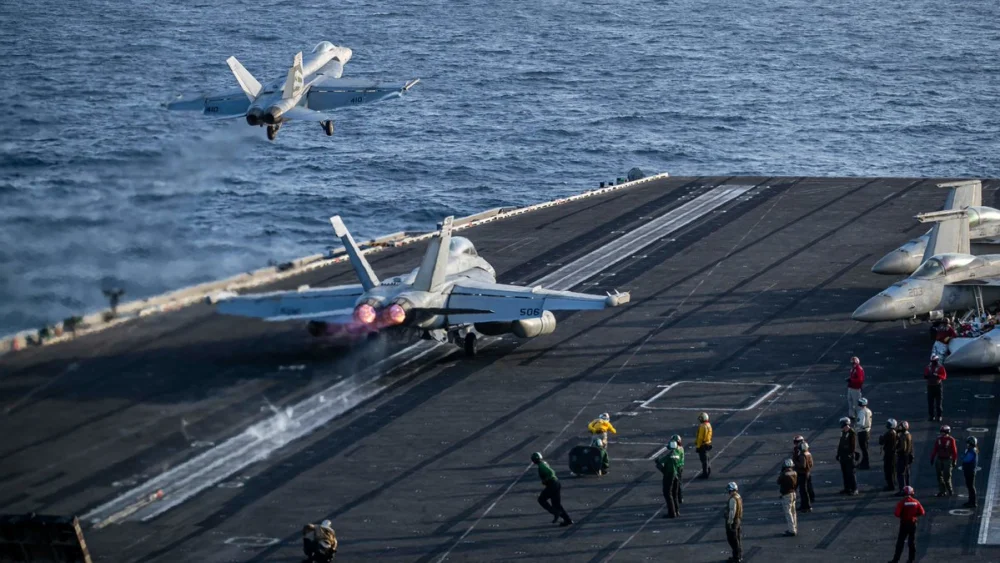
The U.S. military on Tuesday completed a wave of retaliatory strikes against Iran in response to the downing of one of its helicopters over the Persian Gulf.
United States Central Command said it struck Iranian air defense systems, ground control stations and radar sites near the Strait of Hormuz “with precision munitions from U.S. Air Force and Navy fighter jets.”
“The operation was a proportional response to recent attacks on U.S. forces and international commercial ships transiting regional waters,” it stated. “U.S. forces remain vigilant and postured to defend against unjustified Iranian aggression.”
Explosions were heard at three strategic sites around the Strait of Hormuz, Iran’s semi-official Mehr News outlet reported. Tehran’s state-run IRIB broadcaster said the strikes hit two water reservoirs, cutting water supply to the area.
In an earlier statement, CENTCOM said that U.S. forces “began launching self-defense strikes against Iran at 5 p.m.” Eastern Time at the direction of U.S. President Donald Trump.
Trump promised a military response earlier on Tuesday after the downing of the helicopter on Monday.
“Last night, the Iranians shot down one of our highly sophisticated Apache helicopters while patrolling over the Strait of Hormuz,” Trump wrote on social media. “The United States must, of necessity, respond to this attack.”
Trump said that the two aircrew piloting the Apache had been recovered safely and that they were unharmed. An earlier CENTCOM statement described the crew as being in “stable condition.”
Following the U.S. strikes on Tuesday, Iran’s military and its Islamic Revolutionary Guard Corps launched attacks on American assets in the region, including in Jordan, Kuwait and Bahrain, according to a statement carried by Tehran’s Fars News outlet.
“Several American bases in the region were targeted in a powerful assault by the heroic Army of the Islamic Republic and the brave men of the Islamic Revolutionary Guard Corps,” stated the Khatam al-Anbiya Central Headquarters, Iran’s highest operational military command.
“The criminal U.S. military should understand that any further aggression against the Islamic Republic of Iran will be met with even more devastating and widespread attacks against pre-designated targets across the region,” it added.
A U.S. official told Reuters that initial assessments showed nearly all missiles and drones launched by the Islamic regime were intercepted. Washington not immediately aware of any harm to U.S. personnel or damage to military sites, the official said.
The Jordanian Armed Forces announced that Amman had shot down five missiles launched from Iran toward the country’s al-Azraq area. The military said debris from the interception fell inside Jordanian territory but caused no injuries or damage.
In Kuwait, air defenses intercepted “hostile aerial targets in accordance with approved operational procedures,” the Gulf Kingdom’s military said.
Meanwhile, a media adviser to Bahraini King Hamad bin Isa Al Khalifa announced on X that the country’s air defenses were “repelling Iranian attacks.”
Webcam footage geolocated by CNN appeared to show a bright flash of light coming from the direction of the U.S. Fifth Fleet naval base in Manama shortly after air-raid sirens sounded in the Bahraini capital.
Iranian Foreign Minister Abbas Araghchi said that, “despite its defeats on the battlefield, the U.S. opted to test our determination.”
“Our powerful Armed Forces will leave no attack or threat unanswered,” Tehran’s top diplomat wrote on X. “Leave our region if you want to be safe.”
“History of the Persian Gulf has many chapters on dire fates of intruding outsiders,” he added.
Trump said on Wednesday that Iran would “have to pay the price” for stalling ceasefire talks. “They’ve taken too long to negotiate a deal that would have been great for them,” he wrote on his Truth Social platform.
The president said that Iran’s military was a “complete and total mess” following the U.S.-Israeli campaign against Tehran.
“Much of it, like their Navy and Air Force, doesn’t even exist anymore - they have been completely defeated,” he wrote, adding: “Iran is all talk and no action. The bully of the Middle East is dead!!!”
Trump told reporters on Tuesday that Washington and Tehran were “in the final throes of what will be a very, very good deal,” saying the agreement being negotiated with the Islamic regime “will not allow in any way, shape or form nuclear weapons, etc., and that the Strait [of Hormuz] will open up right away.”
The deal could be signed within two or three days, Trump declared, speaking with reporters after attending the NBA Finals in New York late Monday night.
“We should be doing it in one hour—I don’t think there are any sticking points,” he stated. “We will have a signed document that is stronger than doing the bombing.”
“If we go and bomb, which we could do very easily if we want, and we spend another few weeks bombing, they will have nothing left whatsoever,” the American leader said, warning that “a lot of people will be killed.”
According to Trump, his ongoing naval blockade on Iranian ports “has turned out to be much stronger than bombing.”
“You know, their economy is really suffering, and they are going to make a deal,” he concluded.
U.S. Vice President JD Vance told Fox News‘ “Jesse Watters Primetime” on Monday that a deal preventing Tehran from obtaining a nuclear weapon would be a “home-run win for the American people.”
Vance spoke after the Islamic Republic and its regional terrorist proxies fired multiple missile barrages at Israel from Sunday night into Monday, breaking a fragile ceasefire that had been in place since April 8.



