Newsletter
Newsletter Support JNS

US lifts sanctions on Iran oil for 60 days

The U.S. treasury secretary justified the move by saying that “Iran has committed to free and open transit in the Strait of Hormuz and to permit International Atomic Energy Agency inspectors into the country.”

Bessent
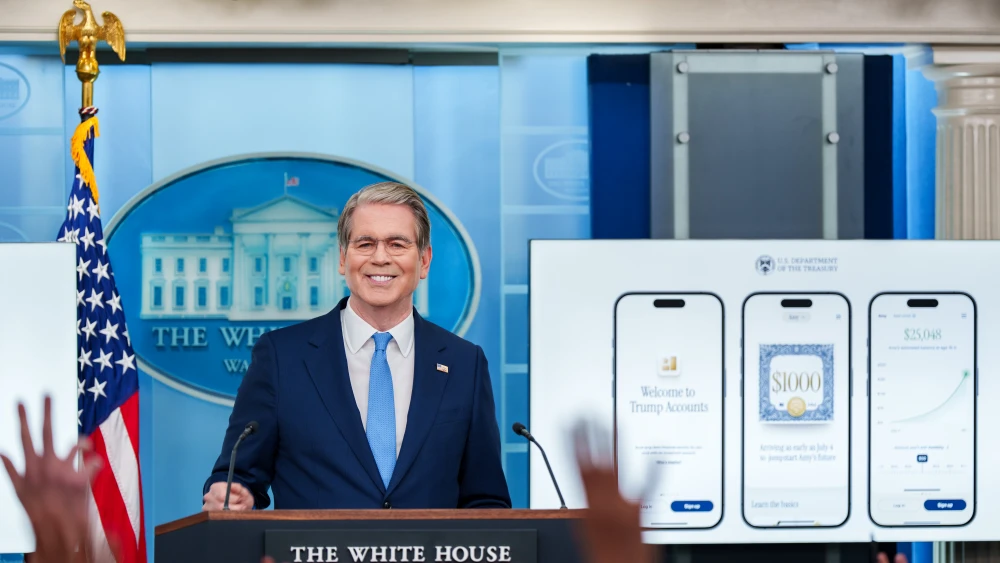
Scott Bessent, U.S. treasury secretary, holds a White House press briefing, May 28, 2026. Credit: Abe McNatt/White House.

The Iranian regime will receive a 60-day waiver on sanctions on its oil, the Trump administration said on Monday.

Amid a two-month negotiation window with the Islamic Republic after Washington and Tehran signed a memorandum of understanding, the regime is to be authorized to produce, deliver and sell “crude oil, petrochemical products and petroleum products of Iranian-origin through Aug. 21,” the Trump administration said.

“In line with ongoing productive talks in Switzerland, Iran has committed to free and open transit in the Strait of Hormuz and to permit International Atomic Energy Agency inspectors into the country,” wrote Scott Bessent, the U.S. treasury secretary.

“Treasury has issued a temporary 60-day general license authorizing the production, delivery and sale of Iranian oil,” he stated.

The license covers transactions “ordinarily incident and necessary” to the production, sale, delivery or offloading of such oil, petrochemical or petroleum products, and docking, anchoring, repairs, environmental work, storage, insurance and other areas of business.

It also relates to oil and products produced under global terrorism sanctions, in addition to other sanctions schemes.

U.S. Vice President JD Vance wrapped up a second day of talks with Iran in Switzerland on Monday. Technical teams are remaining in the country in the coming days to advance talks.

The negotiations come amid congressional concern, including from Republicans, that loosening sanctions and unfreezing seized Iranian assets are a repeat of mistakes made by the Obama administration as part of the original Iranian nuclear accord, from which Trump withdrew in 2018.

Mike Wagenheim is a Washington-based correspondent for JNS, primarily covering the U.S. State Department and Congress. He is the senior U.S. correspondent at the Israel-based i24NEWS TV network.
Rapid, tech-driven strikes killed Tehran’s top commanders in seconds and secured air superiority in hours, the Rafael chair and former minister said.
“Our goal is not merely to end antisemitic discrimination and harassment at the NEA but also to ensure an equal playing field for members of all races, religions and national origins,” said Kenneth L. Marcus of the Brandeis Center.
“While Republicans are grossly generalized as white supremacist extremists, the Democrats’ besetting sin of antisemitism is entirely whitewashed,” Victoria Coates of the Heritage Foundation told JNS.
“The story of resilience is the story of our people,” Israel’s U.S. ambassador said at the launch of Resilience on Campus, a new program seeking to equip students with the emotional tools to navigate hostility, isolation and identity-based challenges.
“That’s not criticizing a lobby. That’s laundering antisemitism from your podium as mayor of a city with more than a million Jews,” stated Rep. Josh Gottheimer.
“I’m proud to see the dedication these students bring to the challenges facing our communities,” the Jewish congressman stated.
Benny Gantz, JNS editor-in-chief Jonathan S. Tobin, Gilad Erdan, Mosab Hassan Yousef, Nissim Black and leading voices in security, diplomacy, media, law and Jewish communal affairs headline the summit’s third day in Jerusalem.