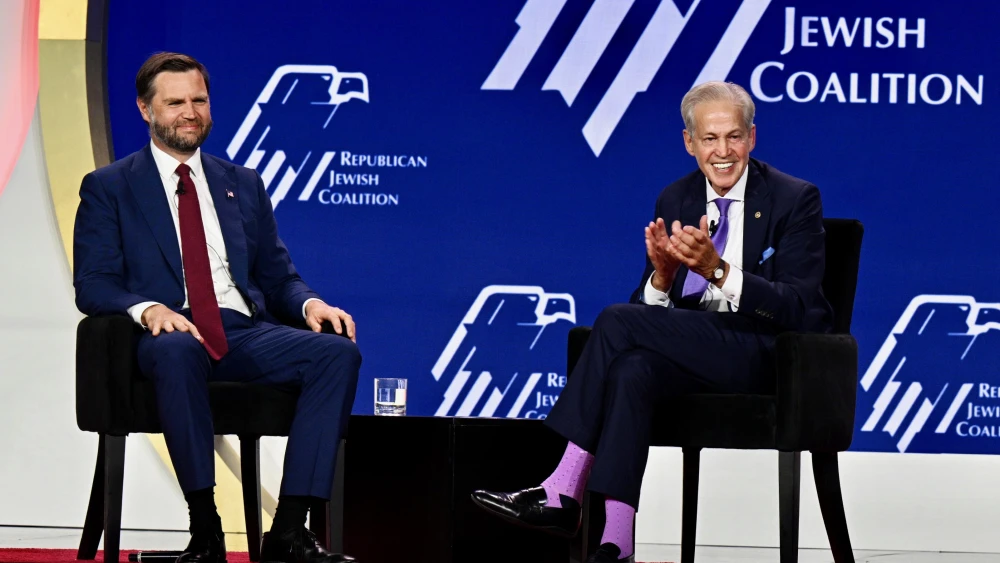

U.S. Vice President JD Vance reminded attendees at the Republican Jewish Coalition’s (RJC) annual leadership summit in Las Vegas this week why the Trump administration is the most pro-Israel presidential administration in American history.
The vice president was greeted with a standing ovation—and another when his conversation, which was mediated by former Sen. Norm Coleman (R-Minn.), drew to a close. Over the course of the evening, Vance made a substantive case for why Americans should stand against antisemitism.
Without reservation or qualification, he spoke about why the United States has a strong interest in maintaining its close relationship with Israel. For anyone in attendance, the most striking element about his defense of the latter was that Vance did not rely on slogans. A foreign-policy realist by his own description, the vice president spoke in concrete and precise terms.
As he explained, Israel and the United States have deep and overlapping interests in intelligence, technology and national security. He pointed, for example, to U.S. cooperation with Israel on the kinds of missile-defense technology that could help protect the American homeland, while changing the economics of defending against cheap rockets and missiles.
That is precisely the kind of argument America needs to hear—particularly from leaders speaking to younger Americans, an alarming number of whom have grown skeptical of our nation’s deep and special bond.
Vance is only 42 years old, and he understands that his generation will not be persuaded simply by being told that America has always supported Israel, and so it always must. He believes we have to explain why the relationship serves American interests. So he did so in spades.
But his support for Israel is not merely transactional. He spoke movingly as a Christian about walking through Jerusalem, and the profound cultural and spiritual connection he felt while visiting the Holy City. The vice president offered similarly thoughtful commentary on the shared religious heritage and liturgical overlap between Christianity and Judaism.
But perhaps the most important—and powerful—comments the vice president made across the course of his conversation were his condemnations of antisemitism. He addressed a reality that too many Democrats refuse to confront: Mass immigration can import into the United States ancient and categorical hatreds that must have no root here.
To that end, Vance unequivocally rejected the poisonous belief that any one person bears responsibility for the perceived actions of others. He likewise condemned the enduring myth of blood libel, an ancient antisemitic conspiracy that has fueled persecution for generations. The vice president drew a bright, unmistakable line against those who traffic in such ideas, including voices in the media on both the left and the right whom he described as genuinely hateful toward Jews.
That willingness to speak plainly is as welcome as it is timely, especially as Democrat politicians continue to be led by the antisemitic wing of their party, rather than leading them with moral clarity.
Perhaps the most encouraging part of the evening was Vance’s connection with the young Jewish Americans in the room. The RJC has invested heavily in bringing Jewish college students and young leaders together; their enthusiasm was clear.
Some attendees may have arrived hoping to get a better sense of where the vice president stood on a number of topics. By the time he left, it was clear that many of the young people in that room already understood why Vance represents something important for the future of the Republican Party.
He is as prepared as he is substantive. And when confronted with difficult questions, at no point does he retreat into canned answers.
At a time when antisemitism is again demanding moral courage from American leaders, the vice president showed exactly what that courage looks like. With his and U.S. President Donald Trump’s unprecedented leadership, the U.S.-Israel relationship will never be broken.