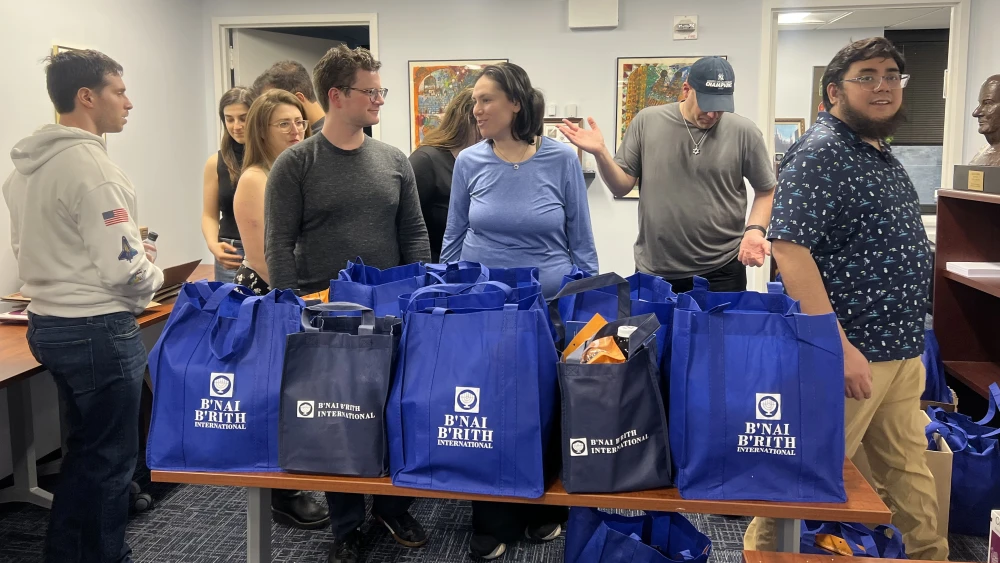
As the grandson of a Holocaust survivor, it was particularly meaningful for Elliot Horlick to assemble Passover care packages for survivors in Manhattan on Wednesday.
“My grandma and her siblings are all survivors,” the Long Island native, 32, told JNS. “Especially after Oct. 7, I was looking for more ways to give back to the Jewish community.”
Horlick, who was one of about 15 young professionals to volunteer in B’nai B’rith International’s Project HOPE, or Help Our People Everywhere, told JNS that the phrase “never forget” has become less of a slogan and more of a meaningful sentence that has applicability.”
He and other volunteers in the program, a partnership with the nonprofit Blue Card Fund, packed kosher-for-Passover items, supplied in part by the Met Council, which will be distributed to survivors across the New York City area leading up to the holiday.
Organizers said that the initiative aims to ensure that survivors can observe the holiday with dignity while staying connected to the broader Jewish community.
Noemi Kohn addressed those assembled at the event and talked about growing up in Hungary during World War II and about hiding from the Nazis in a nunnery and an orphanage.

“We were so sure that nothing could happen in Hungary. We felt safe, but everything changed suddenly,” she told the group. “If we forget what happened, very bad things will come.”
Kohn told the group that many survivors receive assistance, but financial challenges remain, particularly for those living on fixed incomes.
“It’s a little difficult for survivors,” she said. “Many live on very limited income.” Due to groups like Blue Card, she added, “I don’t think we’re forgotten.”
Seeing young volunteers step forward to help “warms my heart,” Kohn added.
Many Holocaust survivors in the United States live below the poverty line and face ongoing expenses for healthcare, housing and daily living, organizers said.
“We’re a nonprofit organization that aids Holocaust survivors all across the U.S. with any kind of financial needs that they have,” Maya Gavriel, a program coordinator at the Blue Card Fund, told JNS.
“Most of the Holocaust survivors that we help are below the poverty line,” she said. “We assist with everything from medical and dental bills to things like stair lifts or hearing aids, really any request.”

Gavriel told JNS that it is “really powerful” to connect volunteers and survivors.”
“Many volunteers have never had the chance to meet a survivor in person, and hearing their stories firsthand makes the impact of their work tangible,” she said. “I hope participants take these stories with them and share them within their own communities, inspiring others to get involved.”
“You go in every day knowing your work helps people, but something like this makes it real,” Gavriel said. “Hearing stories directly and seeing the community come together really boosts my passion for this work.”
Elisabeth Krebs, associate director of programs at B’nai B’rith, said at the event that the group was “thrilled” to work with Blue Card.
“We are very grateful for the connection and bringing Holocaust survivors to our programs and sharing their stories with your generations, which is really more important than anything else right now,” she told attendees, who were in their 20s and 30s. “Really hearing those stories, repeating them and passing them down.”

Met Council provided the food for this project. “We’ll be packing about 50 bags that will be delivered through Blue Card,” Krebs said.
“If people were to take one thing away from tonight, it should be sticking together and giving back to the Jewish community,” Horlick told JNS. “This is a great way to come together, support survivors and make a real difference.”