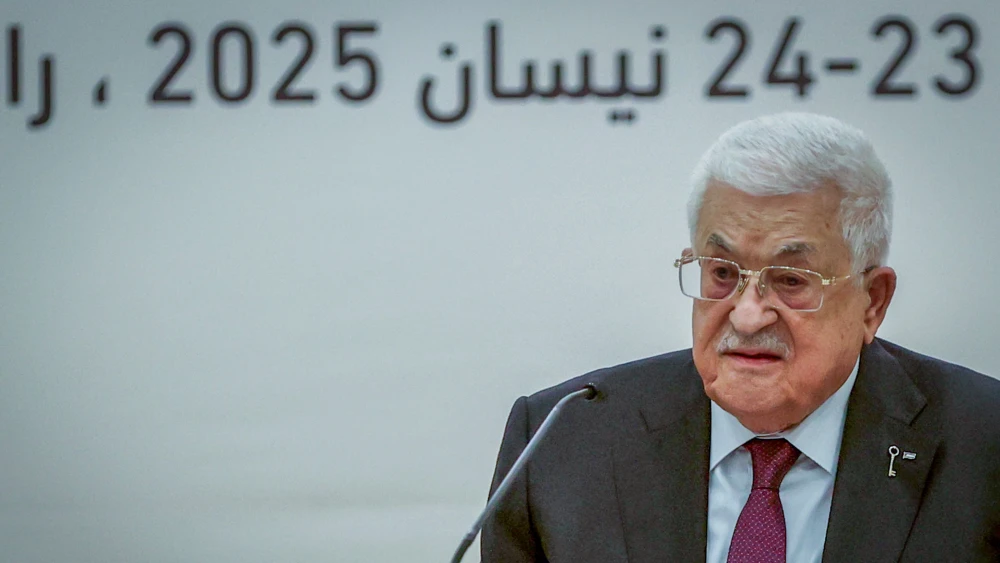
Palestinian Authority leader Mahmoud Abbas arrived in Ankara, Turkey, on Tuesday afternoon for a two-day visit, Ramallah’s official Wafa agency reported.
Abbas was met at the airport by Turkish Trade Minister Ömer Bolat and the P.A.'s envoy to Ankara, Nasri Abu Jaish, according to the report.
The P.A. chief is scheduled to meet Turkish President Recep Tayyip Erdoğan during the visit, in what Wafa described as part of “regular political consultations” between the two leaders.
The talks are expected to address developments in Judea, Samaria and Gaza, as well as ties between the Palestinian Authority and Ankara, Wafa stated.
Wafa said the P.A. delegation includes PLO Executive Committee member Ziad Abu Amr; Fatah Central Committee member Maj. Gen. Majed Faraj, who also heads Ramallah’s General Intelligence Service; and Abbas advisers Majdi al-Khaldi and Mahmoud al-Habbash.
Israeli national security analysts warned that the diplomatic engagement poses a threat to Jerusalem. Alan Baker, former legal adviser to Israel’s Foreign Ministry and currently at the Jerusalem Center for Foreign and Security Affairs, told JNS that Erdogan is “trying to get every finger he can into the region.”
Because of Ankara’s fierce hostility toward the Jewish state, Baker said, “Turkey is one of the few countries in which Abbas would be welcomed.” He added that the visit serves as a “win-win situation both for Erdoğan and for Abbas,” as it signifies to the Turkish president his own “importance, which is something that he considers very vital.”
Baker emphasized that skepticism of Turkish involvement is shared by the “Israeli government in general.” He noted that Jerusalem’s firm position against Ankara was recently communicated to U.S. President Donald Trump during his meeting with Israeli Prime Minister Benjamin Netanyahu.
Martin Sherman, CEO of the Israel Institute for Strategic Studies, warned that a visit by Abbas to Turkey can “never really be a good thing,” calling both leaders “among the largest mischief-makers in the Middle East.”
Pointing to Ankara’s role as a base for the Muslim Brotherhood and its affiliation with Hamas, Sherman told JNS that “Turkey is perhaps just as dangerous an enemy of Israel as Iran,” though “a little more constrained because of some of its ties to the West.” He cautioned that Israel must be “very, very vigilant” and “try to nip any mischief in the bud.”
Israeli Finance Minister Bezalel Smotrich condemned Abbas’s visit, describing the P.A. leader as “an enemy at the head of a terror authority that encourages and funds terror against the State of Israel.”
Smotrich called on Israeli Prime Minister Benjamin Netanyahu to prevent Abbas from returning to Israel and Judea and Samaria, adding that the Palestinian Authority “must be dismantled.”
Sherman echoed Smotrich’s desire to block Abbas’s return, adding that Israel must “eventually work towards the dissolution and the removal of the Palestinian Authority.” Despite criticism of Smotrich and National Security Minister Itamar Ben-Gvir, Sherman noted that out of all Israeli politicians, “they’ve been the most accurate in their prognoses.”
He added that Israel is “continuing to harvest the bitter fruits of Israel’s agreement to acknowledge Palestinian national rights,” calling it a genie that will be difficult to put back into the bottle.
Baker, however, dismissed the finance minister’s remarks, stating that Smotrich is simply pandering to his electorate and cannot legally prevent the P.A. leader from reentering the territory.
Israel’s Foreign Ministry on Tuesday accused Erdoğan of military aggression “that knows no borders,” saying Ankara occupies roughly 36% of Cyprus, 5% of Syria and 2,000 square kilometers of Iraq, with thousands of Turkish troops stationed across the three countries.
The ministry made the comparison amid Turkish criticism of Israel, writing on X, “Turkey has the audacity to criticize Israel. But what are the facts on the ground?”
Israel, by contrast, “temporarily controls merely 0.1% of Syria,” the ministry said, describing it as “a buffer zone to protect its citizens from proven security threats.”