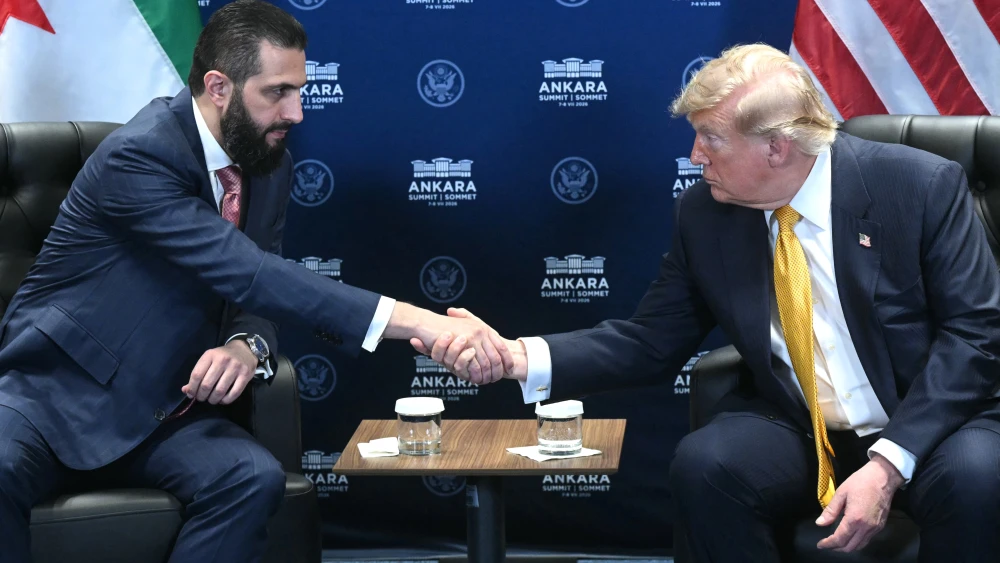
Washington and the Syrian government have agreed to let the International Atomic Energy Agency remove nuclear material stored by the Assad regime at a secret site, Axios reported on Monday.
An agreement between the nuclear watchdog and Damascus was signed three weeks ago, following months of U.S.-brokered negotiations to prevent a potential escalation involving Israel and perhaps Turkey, the report read.
In 2007, Israel bombed the clandestine Al-Kibar reactor developed by Assad’s regime, but several research and development sites connected with Syria’s nuclear program remained, including nuclear material stored at a location identified as “Site 99.”
A U.S. official, speaking on condition of anonymity, told Axios that the material included yellowcake, a powder made from uranium ore that can be further processed and enriched as part of a nuclear fuel cycle. Other “leftovers” from the Al-Kibar reactor were transported to “Site 99,” the official added.
Although the material cannot be used for a nuclear weapon, it can be converted into a conventional explosive device that disperses radioactive material, known as a “dirty bomb.” This raised concerns in Jerusalem, which kept close tabs on the situation, the report continued.
Senior officials from both Israel and the United States have worked closely to resolve the issue, with Israeli officials threatening to bomb the site if the material was not removed.
When the Trump administration approached Syrian officials about the subject, the latter were not aware of the site’s existence, according to the report.
Talks, however, were fruitful.
“When we work with the Syrians on things—they are good partners,” the U.S. official was quoted as saying.
Negotiations accelerated after Israel detected “movements” near Site 99 a few weeks ago, according to Axios.
Washington asked Israel not to take any action, and eventually facilitated IAEA’s agreement with Damascus.
“We think everybody is happy with the result. Hopefully we will be able to kick off the removal process soon and end it before the end of the year,” the U.S. official was quoted as saying.
After Assad’s regime fell in December 2024 to jihadist rebels and other insurrectionists, the Israel Defense Forces carried out its heaviest air campaign in Syria since the 1973 Yom Kippur War.
Involving some 300 strikes in the span of a few days, the blow to the Syrian Air Force was especially devastating, according to Israeli media at the time.
The IDF’s campaign was to ensure that leftover military weapons and equipment could not be used against the Jewish state in the future.
Moscow reaches settlement over its forces in Syria
Meanwhile, Syria and Russia have reached an agreement restructuring Moscow’s military presence in the country, with Damascus set to regain control of civilian facilities at the Hmeimim Air Base and Tartus port, The New York Times reported on Sunday.
As part of the deal, some Russian military installations will be converted into joint Syrian-Russian training centers, according to the report.
The memorandum of understanding, reached after about 18 months of negotiations, gives the two sides up to three months to complete the transition, the Syrian Foreign Ministry said. Russia did not immediately comment on the agreement.
The deal significantly scales back the autonomous military footprint Moscow maintained under former Syrian President Bashar Assad, whose regime Russia supported during the civil war. Russia retained forces at Hmeimim and Tartus after Assad was ousted in December 2024 while negotiating their future with the government of Syrian President Ahmed al-Sharaa.
Al-Sharaa’s forces conduct first air force drill
Israel’s defense establishment has identified accelerated Syrian efforts to rehabilitate its air force, Israel’s Kan public broadcaster reported on Monday.
The new regime is recruiting pilots, conducting exercises with airplanes and helicopters, and on Sunday carried out its first exercise involving Russian-made Sukhoi fighter jets in the northern part of the country, according to the report.
The report quoted an Israeli security official as saying, “We are monitoring developments in Syria and sharing our concerns with the United States.”
The regime in Damascus is receiving aid from Turkey, Saudi Arabia, Russia, France and other countries, according to Kan.
Israel’s main concern is the Turkish involvement in Syria and the potential deployment of air defense systems that would impair the Israeli Air Force’s freedom of access in the region.