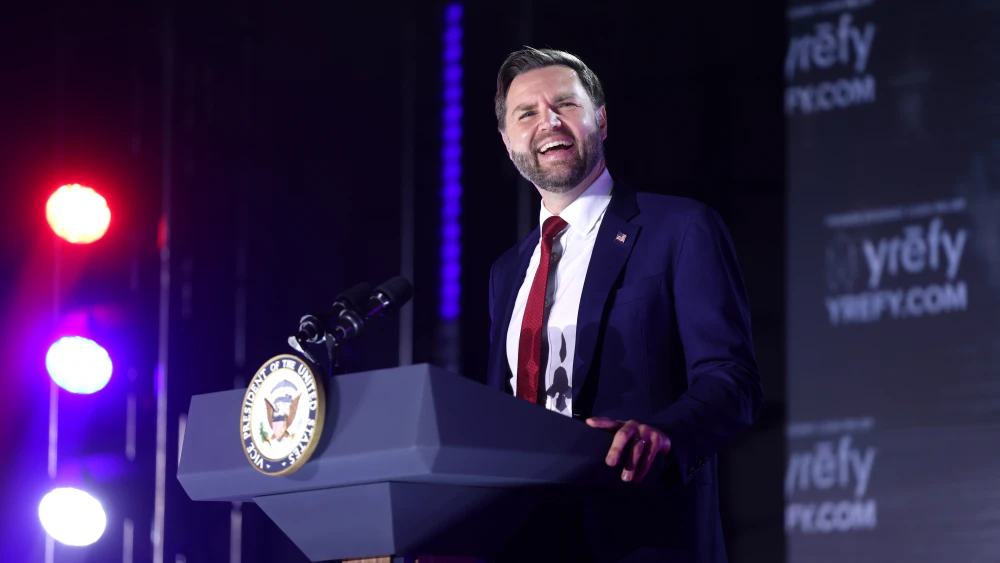
U.S. Vice President JD Vance told reporters that “a lot of good progress” had been made during the first high-level talks between the United States and Iran since the start of the war in February, during a press conference at a resort near Lucerne, Switzerland, on Monday.
Washington succeeded in achieving the four objectives it had set out to accomplish at the talks, Vance said, with a final deal to be reached within 60 days.
First, the two sides, with the participation of Qatari and Pakistani mediators, set up a mechanism to keep the Strait of Hormuz open, including procedures to demine the strait and address maritime incidents to prevent escalation and flare-ups.
Second, the U.S. and Iran created a framework for reducing the risk of broader conflict.
“As the president of the United States has himself said, sometimes these ceasefires just mean you’re shooting a little bit less. But we wanted to make sure that we had the proper coordination set up, so that if there is shooting—if Hezbollah fires at Israel, or if Israel responds, if there are other conflicts that arise in the region—we’re actually talking to each other and figuring out how to stop the shooting, how to make the region safer,” Vance said.
Third, Iran agreed to allow International Atomic Energy Agency inspectors back into the country. The vice president described this as a significant milestone toward addressing concerns about Tehran’s nuclear program and “what we’re most excited about, as Americans.”
Fourth, the parties created a structure for continued technical negotiations, with United States, Iranian, Qatari and Pakistani teams to hold discussions through the coming weeks under the political oversight of a “High Level Committee” set up at the talks.
“We laid a very good foundation for a successful final deal,” Vance said. “The final deal is the house. We set the foundation. We haven’t built the house, but we’ve laid a successful foundation to get to a good place for the American people.”
Qatar and Pakistan issued a joint statement on Monday echoing Vance’s comments, saying “encouraging progress” had been made in a “positive and constructive atmosphere.”
The talks had a rocky start on Sunday when U.S. President Donald Trump threatened to take over the Strait of Hormuz and “collect tolls” if diplomatic talks failed, speaking in a Fox News interview.
He also warned Iran to rein in its proxies in Lebanon or face attack, in a Truth Social post on Sunday. “Iran must immediately stop their highly paid PROXIES in Lebanon from causing trouble,” Trump wrote. “If they don’t, we’ll hit Iran very hard again, just like we did last week, only harder!!!”
The threat angered Iran’s chief negotiator, Parliament Speaker Mohammad Bagher Ghalibaf, who said, “We don’t take the Americans’ threats seriously at all. They had better watch their words carefully. Our armed forces are ready to give them a response in a different way. No matter how much they talk, it is we who take action.”