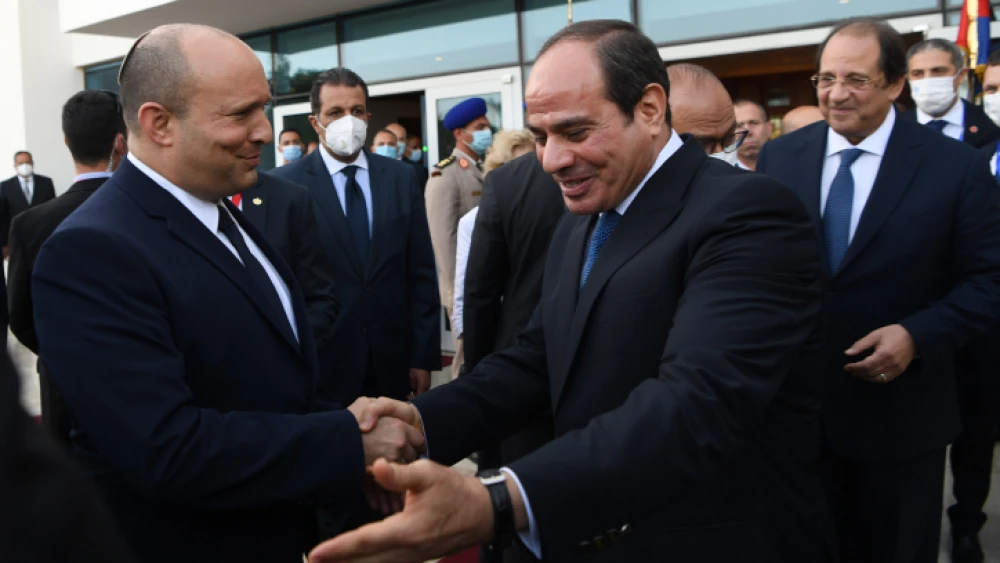

Israeli Prime Minister Naftali Bennett’s meeting with Egyptian President Abdel Fattah el-Sisi grabbed headlines in Israel last week, not necessarily due to its substance but rather to the fact that it was the first public meeting between the two countries’ leaders on Egyptian soil in over a decade.
With that, there were individuals in Israel who wished to view the meeting as an expression of warming relations between the two countries, and even as evidence of an Egyptian desire to tighten and enhance those relations. These people even voiced their hope that Cairo would enlist to help Israel in the two countries’ common struggle against Hamas in Gaza, and against Iran’s regional aspirations.
However, and with all due respect to Hamas and Iran, the Egyptians currently care about one thing only. Indeed, the reports from Cairo about the el-Sisi-Bennett summit made virtually no mention of Hamas or Iran. The president’s mouthpieces, however, said he had raised the question of the Grand Ethiopian Renaissance Dam (the al-Nahda Dam) being built by Ethiopia, which could impede the flow of water from the Nile River into Egypt. Ethiopia’s determination to move ahead with this project has driven an unprecedented diplomatic wedge between Cairo and Addis Ababa, even to the point of possible military conflict. Yes— the construction of a dam on the Nile is again leading to war. Almost 65 years ago, it was the Aswan Dam, built by the Egyptians in the country’s south. After Western countries refused the Egyptians’ request to fund the dam’s construction, then-Egyptian President Gamal Abdel Nasser nationalized the Suez Canal, which at the time was under British and French control. In response, Great Britain and France launched an attack on Egypt. Israel also joined the fray, launching the Sinai Campaign (“Operation Kadesh”). This time, the tables have turned. For the past decade, Ethiopia has been building a massive dam, in an effort to hoard the Nile’s water before it crosses into Sudanese territory and from there to Egypt. All efforts to mediate and reconcile the two sides, which have even included the U.N. Security Council, have failed, and now Ethiopia is taking huge strides toward completing the dam and making it operational.
Egypt, though, is now alone in this confrontation with Ethiopia. African countries do not want to intervene in a conflict between two continental powers; Arab states are dragging their feet, while global powers, such as Russia and China, are projecting sympathy for Cairo but are heavily invested in gigantic, lucrative projects in Ethiopia.
In the past, officials in Cairo accused Israel of being behind the plan to build the dam, to hurt Egypt. Now, however, new winds are blowing from Cairo. As al-Sisi’s spokespeople said following the meeting with Bennett: “The leaders reached an understanding, and it was agreed upon to work together to resolve the problem that Egypt considers a question of life or death.”
Egypt expects Israel to help it find a solution to the dam problem. This expectation, however, is about as realistic as Israel expecting Egypt to lead the Arab world in a war against Iran and Hamas. We can only hope it’s clear to both Bennett and el-Sisi what the two countries can and cannot do to help one another.
Eyal Zisser is a lecturer in the Middle East History Department at Tel Aviv University.
This article first appeared in Israel Hayom.