
So, what is the secret of human happiness?
A fellow was walking down the street from his house and noticed an older-looking man sitting on the porch, looking like the happiest man on earth. So he asked him, “What’s your secret to enjoying a happy life?”
The old man answered, “Three packs of cigarettes a day, I eat whatever I like, I go through a bottle of whisky a week, and I never exercise.”
“Wow!” said the passerby. “How old are you?”
“26,” said the man.
Every year on Yom Kippur, I look out at the sanctuary, and my heart swells. Every seat is taken; people are even standing in the aisles. Five days later, on Sukkot, I don’t need a calculator. I can count everyone by name.
A rabbi once bumped into a congregant he saw only on Yom Kippur. “Mr. Feldman, we’d really love to see you the rest of the year.”
“Rabbi, it’s simple. When I’m sick, I go to the doctor. When I’m healthy, I don’t. Why should I go?”
“A fine philosophy,” said the rabbi. “But you’ve only ever seen the emergency room. Why don’t you come to the wedding hall?
This is the tragedy of Jewish life today. Millions know only the emergency room of Judaism: the fasting, the confessions, the chest-beating, the white robes that look uncomfortably like shrouds. Then they conclude that they’ve seen Judaism.
No wonder so many of our children say, “Thanks, but no thanks. If this is all there is to Judaism, I’m outta here.”
Yet the Torah’s own vocabulary is very different. The Psalmist says, Ivdu et Hashem b’simcha: “Serve God with joy” (Psalm 100). About Sukkot, the Torah says, V’samachta b’chagecha, “You shall rejoice in your festival,” and adds, V’hayita ach sameach, “You shall be only joyful.” The festival is called the “Season of Our Rejoicing.” This is no side dish. It is the main course, and we keep skipping it.
Notice the timing. Sukkot comes five days after Yom Kippur. Having done the work of teshuvah (“repentance”), you’ve earned the right to celebrate. Yom Kippur is the cleansing, and Sukkot is putting on the clean clothes and going to the party.
Even Yom Kippur is not meant to crush us. The Mishnah says Israel had no days as joyous as Yom Kippur and the 15th of Av because it is a day of confidence that God forgives us. The Kabbalists read Yom Kippurim as Yom k’Purim, a day like Purim. We fast for a day. We are not meant to be sad for a lifetime.
The Chassidic masters distinguished between two kinds of sorrow: merirut and atzvut. Merirut—the healthy bitterness of “I could have been better”—has its season, and that is Yom Kippur. But atzvut—“heavy, stuck, joyless melancholy”—had no season, and they warned against fiercely.
Regret says, “I’ll do better.” Melancholy says, “What’s the use?” The Baal Shem Tov taught that the evil inclination’s cleverest trick is to make you so depressed about your failings that you stop trying to fix them.
Let me note a word of caution because I would never be glib about this: Clinical depression is not a spiritual failing. It is an illness, and the answer is not “cheer up, it’s Sukkot.” The answer is a doctor, a therapist and a community that surrounds you with love, and there is no shame in that. Jewish joy is not denial of pain. It is a stubborn conviction that life is a gift and that we are not alone in it.
Sukkot is Judaism as it really is. Yom Kippur is the exception, not the rule. Every single Shabbat, we celebrate with good food and wine, sitting around the table with family, friends and guests.
And this matters most when it comes to our children. Think of how many of us introduce God to a child only at a moment of loss. “Why did Grandma die?” And if the answer is “God took her to heaven,” the child may conclude: “God is nasty. I hate God. He took Granny away from us.”
Can we blame them? If the only time God enters the conversation is at a time of loss and bereavement, what else should children think?
But if children live with God every day, everything changes. They wake up and say Modeh Ani: “Thank You, God, for giving me a new day.” Then they’re taught to thank God for food and drink, and for everything they enjoy in life.
Then, when sadness comes (and it will), that child already knows that God is good, giving and loving. And if God found it necessary to take Grandma up to heaven, we can find comfort because we know He loves us and is not punishing us. We accept the loss more easily because we live with God all the time, not only when something goes wrong.
Then, as if Sukkot were not enough, the Torah gives us Shemini Atzeret.
Rashi offers a parable. A king makes a big feast of several days. As the people leave, he says to his son, “Please, stay one more day. It’s hard for me to part from you.”
That is Shemini Atzeret. God is whispering, “Don’t go yet.”
So, here is my proposal. By all means, come to synagogue on Rosh Hashanah and Yom Kippur; of course, you will. But don’t let Judaism be only that.
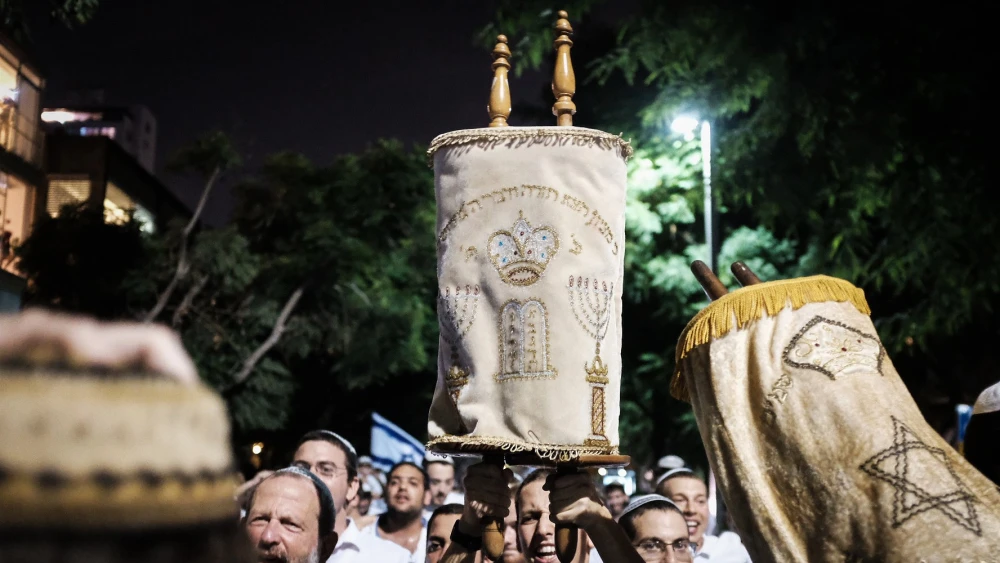
If you’ve had a year of the emergency room, come and taste the wedding hall. Bring your children and grandchildren, and bring the friend who says Judaism is just too heavy. Shake a lulav, hold the etrog, eat in the sukkah and dance with the Torah on Simchat Torah, even if you dance badly. God is not grading us on technique.
Let the next generation see that we can weep, but we can sing; we confess, but we celebrate. We know how to say, “Forgive us,” and we know how to say, L’chaim.
Let us celebrate Judaism for what it truly is: a joyous celebration of life. Don’t simply visit for the sad part. Come for the joy and stay … “stay one more day.”
Chag Sameach!