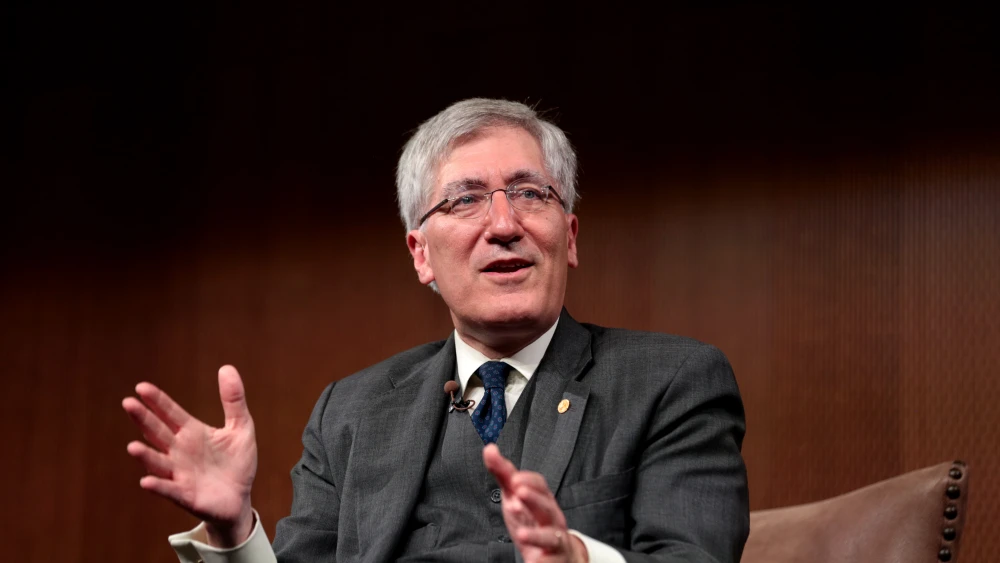
Robert P. George, McCormick professor of jurisprudence at Princeton University and director of its James Madison program in American ideals and institutions, wanted to study rising Jew-hatred even before Oct. 7.
As chair of the New Jersey Advisory Committee to the U.S. Commission on Civil Rights, the pro-Israel scholar, who has been very outspoken about antisemitism, was in a position to do so.
When Saulo Santiago, a fellow commissioner, proposed the motion and it was approved in January, George supported it eagerly, particularly after seeing a rise in antisemitism on college campuses for several years, he said.
“I’ve been really concerned for a number of years now, even before Oct. 7, 2023, about the revival of antisemitism,” George told JNS.
“Then, of course, in the wake of the Oct. 7 Hamas massacres, we got this spike of antisemitism,” he said. “Given this resurgence, and just given the history of antisemitism and the horrible consequences throughout history—I’m not just talking about the Holocaust, although, certainly that is central—but throughout history, the consequences of antisemitism have been so horrific that I think whenever you see this monster raise its head.”
“You’ve got to act,” he told JNS.
The January vote came a year after the 10 commissioners were appointed to four-year terms. The commission held seven listening sessions, taking testimony from experts and comments from the public and a variety of witnesses, including Jewish, Christian and Muslim religious leaders and several educational leaders.
Now the members are drafting their report, which could spill over into next year.
“I was surprised to see a resurgence of antisemitism in the United States of America. I mean, the really hardcore antisemitism,” George told JNS. “I did not expect to see in the United States of America, a resurgence of the kind of antisemitism that I myself identify with old Europe.”
“I thought we had a stronger immune system against that evil,” he said. “Now to see people, who are regarded as respectable people on both the right and the left, advancing antisemitic notions and ideas is a shock to me.”
“The hearings are confirming what I had come to see and what I’ve been worried about for more than a decade,” he said.
There were 687 antisemitic incidents in New Jersey last year, behind only New York and California, according to an annual Anti-Defamation League audit.
The New Jersey advisory commission’s study is different from the one conducted by the U.S. Commission on Civil Rights, which focused on Jew-hatred on college campuses. That bipartisan report was approved in July.
The advisory board’s report and its recommendations also will go to the U.S. Civil Rights Commission.
One of the major issues with which the New Jersey commission struggled was how to define antisemitism, since even some hate speech falls under the First Amendment. There are also differences between Jew-hatred and political criticism of the Israeli government.
“Jews criticize Israeli governments all the time. Israeli Jews criticize the Israeli governments quite freely,” George told JNS. “No one wants to identify that with antisemitism.”
“There’s a trickier issue, though, and that is when the question is not the criticism of the policies of this or that Israeli government but criticism or the rejection of the very existence of the state of Israel,” he said.
The difference between language protected by the First Amendment and that which is not was the subject of a lengthy discussion last month with David Schizer, a former Columbia Law School dean and co-chair of Columbia University’s new task force on Jew-hatred.
College campuses have to strike a balance between the First Amendment right to even controversial or offensive speech, which could create a hostile environment, Schizer said.
“Whatever balance universities choose to strike in protecting free expression and in combatting discrimination, they have to be consistent,” Schizer said at the hearing.
“This means the protections for Israelis and for Jews have to be the same as the protections for Latino, black, Asian, Palestinian, female and LGBTQ+ students and faculty,” he said. “In other words, the rules need to be the same for everyone.”
What happened is universities traditionally deferred to groups protected by anti-discrimination laws who complained that some speech made them feel uncomfortable, Schizer said.
But when Jews raised the same objections after Oct. 7, universities did not defer to them but instead defended the right to free speech, he said.
Schizer and panelists discussed the differences between permissible and impermissible speech.
For example, while “free Palestine” is protected by the First Amendment, “globalize the intifada” could be seen as a call for violence against Jews, because intifada “was used to describe waves of terror, which many Jews and Israelis remember,” Schizer said.
That’s why cross burning isn’t protected speech either, because of its historical use to intimidate and threaten black people, he said.
“How do you think universities should handle unauthorized encampments or disruption of classes without violating the First Amendment or over-relying on law enforcement?” commission member Erica Jedynak asked.
Schizer recalled protesters shouting at 3 a.m. while students were trying to sleep before exams later that morning.
It would be “ideal for all members of the community to understand why that should be inappropriate,” he said. “People should be allowed to protest, just not in ways to disrupt the academic mission, and at the same time, the university should make available other places and other times for people to express their views.”
The bottom line, George told JNS, is that the commission’s recommendations will have to strike a balance.
“I am prepared to protect an awful lot of speech that I find offensive, prejudiced and discriminatory, and so forth,” he told JNS. “We have to make sure that we’re not stepping on civil liberties while we, at the same time, try to make sure that Jews are not harassed, intimidated, threatened or discriminated against.”