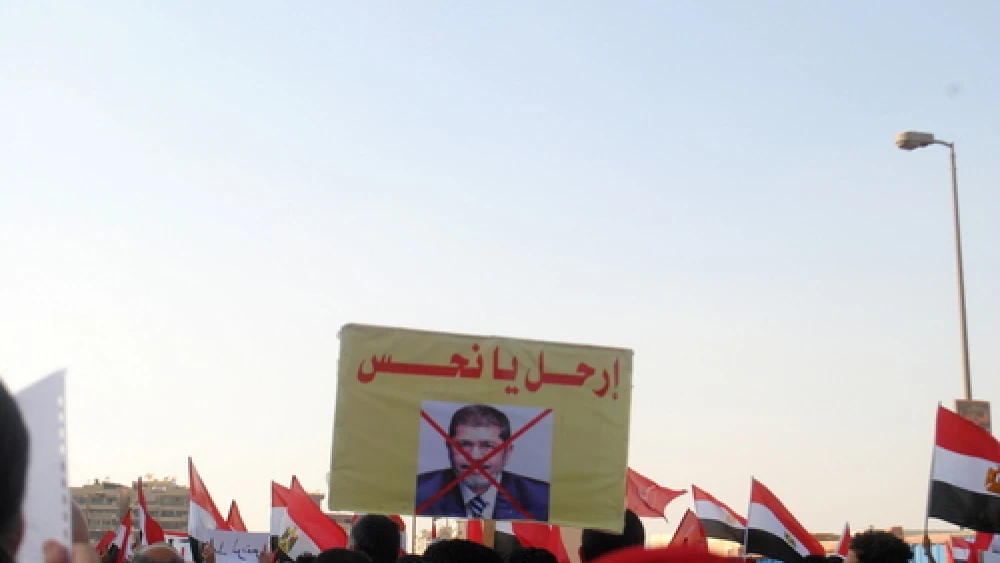

We received news last week that Mohamed Morsi—a member of the Muslim Brotherhood who served as Egypt’s president for one year until he was ousted by the current president, Abdel-Fattah El-Sisi—collapsed and died in court. Morsi was one of the heroes of the so-called Arab Spring and ascended to power in its wake.
Many believed (and others even hoped) that Morsi’s death would rouse the masses of Brotherhood supporters to take to the streets. In actuality, news of his passing was received with relative apathy, even as agitators such as Turkish President Recep Tayyip Erdoğan or the Qatar-based Al Jazeera satellite network implied that Morsi was murdered by the regime.
Riding the wave of hope for change following the fall of former Egyptian president Hosni Mubarak, Morsi was elected to the presidency in the summer of 2012. His victory was first and foremost a victory for the Muslim Brotherhood, which had previously won a majority of the seats in the parliament.
It was the Brotherhood’s finest hour in Egypt, similar to the developments in Tunisia and very briefly in Syria, finally rising to power after generations of marginalization. Amid the chaos of the Arab Spring, the Brotherhood emerged as the only organized political force, having maintained ties with its supporters vie religious institutions and charity organizations.
Very quickly, however, the Brotherhood proved incapable of governance; it was averse to shedding its radical rhetoric and ideology. Despite the fact that it rose to power through democratic elections, it quickly attempted to seize control of state and media institutions, and even sought to permeate the military. It methodically worked to promote legislation aimed at turning the country into a theocracy, akin to Iran.
Morsi also endeavored to cultivate and embrace Hamas, an offshoot of the Brotherhood. And although he was also careful not to violate the peace treaty with Israel, it was obvious it could never survive under his rule. In fact, the only country he severed ties with was Bashar Assad’s Syria. He even proposed sending Egyptian troops to help the rebels fighting Assad and his allies. This proposal was met with widespread opposition in a country tired of the Brotherhood’s wars, whether in Syria or previously against Israel.
Morsi’s policies and actions, much like his failure to run the country or improve its economy, pushed the army, backed by large swaths of the Egyptian public, to retaliate and topple his government. The Brotherhood didn’t only fail in Egypt. In Tunisia, it was forced to relinquish power in the face of rising public outcry. In Sudan, meanwhile, it isn’t the Islamists who have benefited from the latest coup, but rather the generals of the Sudanese army, supported by El-Sisi.
Hamas, therefore, is the only Islamist movement in the Arab world still in power, and even this is mostly due to Israel’s prerogative. But the Brotherhood’s failure in Egypt is also a reminder to Hamas that its days are numbered. Hence, Islamism is still an important force in the Middle East, but Islamists seizing control of Arab countries do not pose the greatest threat to the region.
Interestingly, Islamists have only been successful in the two non-Arab Muslim countries in the region, Turkey and Iran, whose regimes at present don’t appear to be in jeopardy of cracking.
Eyal Zisser is a lecturer in the Middle East History Department at Tel Aviv University.
This column first appeared in Israel Hayom.