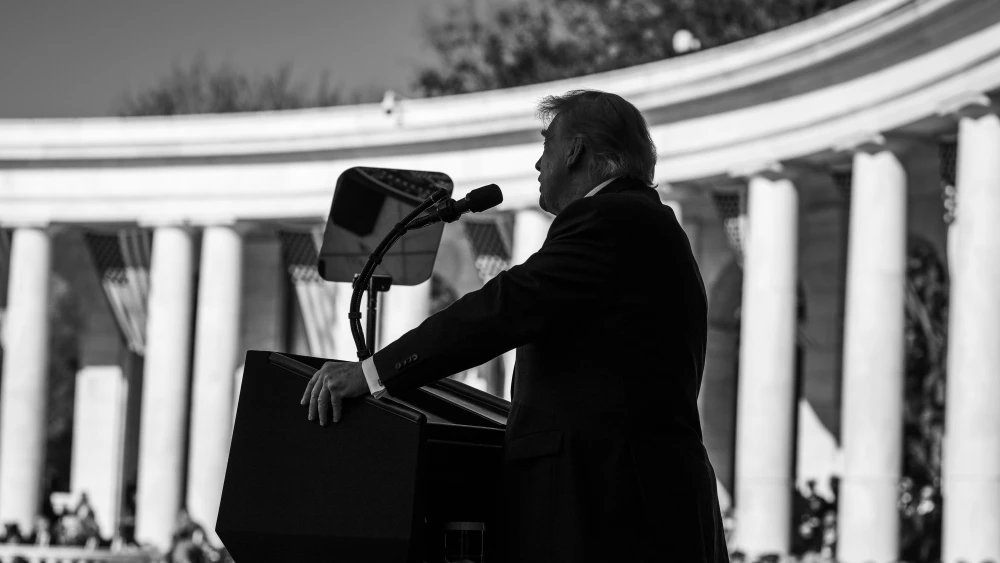

U.S. President Donald Trump’s recent announcement that he will immediately cut U.S. military aid to Israel was a desperate attempt to jolt midterm voting to the Republicans’ favor. This Hail Mary effort to sway votes failed miserably; Democrats gained control of both chambers, and Dr. Abdul El-Sayed, who consistently voiced anti-Israel sentiment through his campaign, won his Michigan Senate race.
While the existing U.S. 2016 Memorandum of Understanding provides $3.8 billion annually to Israel through fiscal year 2028, it’s unclear when the cut will be implemented.
No matter: Contrary to popular assumptions, its effects will actually harm U.S. defense and economic interests more than it will Israel’s. In short, Trump’s decision was a mistake, and every indication is that it will be a net boon to Israel.
Benefits of aid cut to U.S. will largely be political and illusory.
This aid reduction will primarily provide vague comfort to hardline critics of Israel’s defensive wars and the U.S.-Israel relationship. But contrary to the false message of the “Banana Libel” campaign commercial that ran to boost El-Sayed, it will not benefit U.S. taxpayers in any tangible way.
Indeed, the $3.8 billion Israel aid package represents only one-twentieth of 1% of the annual U.S. budget—a relative pittance, not nearly enough to affect the price of supermarket commodities. In short, the antisemitic trope that Israel is responsible for Americans’ high cost of living is simply a lie.
Likewise, in terms of total foreign-aid grants, Israel represents only a fraction of the America’s $48 billion annual total. Israel’s grant stands well below the $6.75 billion we provide Ukraine and the nearly $4.9 billion we send to seven African nations—for which the United States receives not a penny nor any military benefits in return.
Negative impact to U.S. of aid cuts to Israel will be concrete.
It’s mistaken to see aid to Israel as a gift, since it really represents a high-return investment. Nearly all of the $3.8 billion grant to Israel is spent in the United States on American-made systems, supporting hundreds of U.S. firms. Surely, a large portion of that will be lost, robbing the U.S. defense industry of significant revenue and jobs.
In addition, the aid cut will inhibit U.S. intelligence-gathering and strategic military options, especially in the Middle East. As part of the U.S.-Israel partnership, Israel conducts extraordinary espionage on Iranian leadership, nuclear and missile programs, terrorist networks and regional threats that former U.S. Air Force Intelligence Chief Gen. George Keegan once equated to the output of five CIAs.
Finally, Israel’s use of American weapons also contributes ROI to the aid investment since Israel serves as a real-world laboratory for improving the systems it buys. Operational feedback from the F-35 fighter jet and other platforms has resolved glitches, shortened development cycles and improved weapons performance without risking U.S. lives. Joint missile-defense programs and co-development work to further leverage Israeli innovation. Washington is currently a customer of Israel’s Iron Dome missile-defense system, co-developed with the U.S. Missile Defense Agency and American firm Raytheon.
Most importantly, Israel has proven military might and determination to help defeat America’s enemies in the Middle East, as it did by demolishing Saddam Hussein’s nuclear-weapons site in Iraq, Iran’s leadership and military infrastructure in the 12-day war against Iran in June 2025, as well as terrorist groups in Lebanon, Yemen and Syria.
Israel requires no boots on the ground, saving the U.S. tens of billions.
For decades and through today, the United States currently has stationed hundreds of thousands of U.S. troops in Europe, Japan, Afghanistan, Iraq and other former war zones to maintain regional stability. Currently, America spends some $40 billion annually to maintain approximately 130,000 American troops in Europe and Japan. It spends nothing for troops in Israel, as Israel’s armed forces defend themselves and fight U.S. enemies single-handedly.
Above all, the Israel Defense Forces work shoulder-to-shoulder with the American military on major combat missions. No wonder some 80 retired U.S. generals and admirals, including former CENTCOM Commander Gen. Frank McKenzie, wrote an open letter in which they asserted: “A strong Israel is vital to the United States’ national security, and it is imperative that America unequivocally stand by this indispensable ally.”
U.S. aid cut will lead to greater Israeli independence with low economic impact.
Israel’s political echelon generally views reduced reliance on the United States as desirable—granting it greater foreign policy flexibility, free of restraints from Washington’s often fickle political leaders. Moreover, Israel’s 2026 nominal GDP stands at about $747 billion, with projected growth of 4.5%—the highest among advanced European economies.
As Israel’s economy continues to grow at record rates, the U.S. contribution makes an ever-decreasing impact—now only about one-half of 1% of Israel’s annual GDP.
Nonetheless, we shouldn’t underestimate the global psychological power of Israel’s intimate defense partnership with the world’s mightiest superpower. Losing the symbolic clout of U.S. backing on the world stage will make Israel’s already challenging diplomatic job even more difficult.
Finally, while Israel will reap significant benefits as a result of growing independence from the United States, it certainly will not welcome increased hostility from a Democratic House and Senate, let alone a possible antagonist president after the 2028 elections.
Regardless of shifting political winds in Washington, Israel will power forward.
The Jewish state’s best strategy for coping with this challenge will be, as always, moving from strength to strength. What doesn’t kill Israel makes it stronger—and as Israel’s Jews have learned in the last 78 years, no one can protect Am Yisrael better than an indefatigable Israel itself.
Israeli Prime Minister Benjamin Netanyahu’s office has already framed the emerging future as a move “from aid to partnership,” reflecting Israel’s economic maturity. History supports the expectation that Israel will absorb this change and even improve its global position.
The larger question for Washington is: Will abandoning a high-return strategic relationship with one of our most loyal and powerful allies in pursuit of short-term political relief advance American interests? The evidence suggests that it will not.
Originally published on Facts and Logic About the Middle East (FLAME).