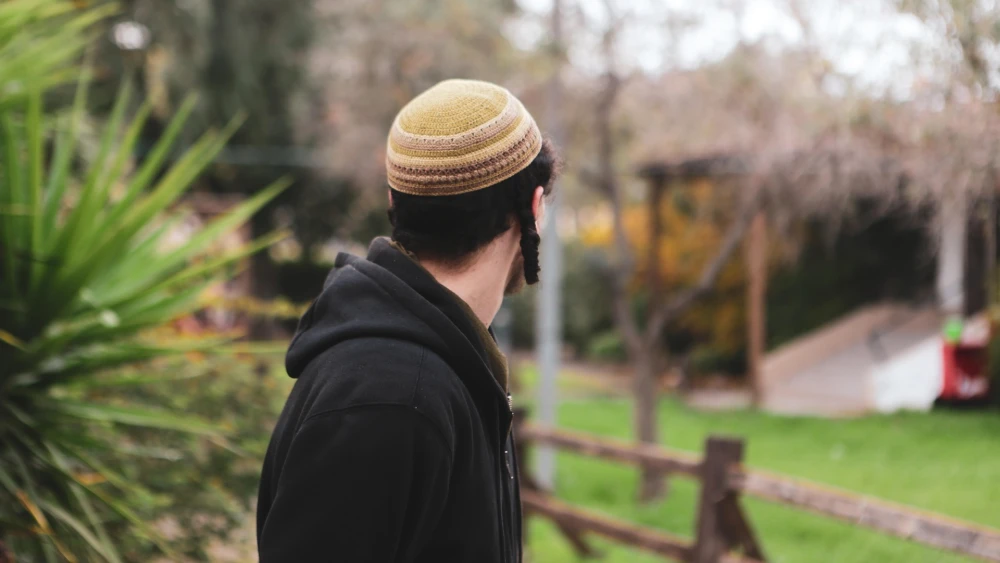

The people who shouted “Heil Hitler” and “Death to the Jews!” at me didn’t ask what I thought about Israel’s government. They didn’t inquire about my politics. They saw a Jew walking home from synagogue and decided that was enough.
It happened one Friday night in Southfield, Mich. Six people on motorcycles rode past me, shouted their threats and continued on their way. In the weeks that followed, I learned that others had experienced similar harassment.
There was nothing ambiguous about the encounter. Yet much of the national conversation about antisemitism is devoted to making an increasingly straightforward problem seem impossibly complicated. Before addressing the intimidation of Jews, we are invited to debate geopolitics, interrogate the victims’ beliefs or consider whether objecting too forcefully might make matters worse.
Meanwhile, the practical advice offered to Jews is often easier to understand: Be careful. Avoid confrontation. Think twice about making yourself visible.
There is something profoundly wrong when the most immediate consequence of antisemitism is that Jews are expected to change their behavior.
A national survey conducted in 2025 found that 55% of American Jews had changed their behavior out of fear of antisemitism. These changes included avoiding certain places or events; concealing visible signs of Jewish identity; and/or refraining from posting content online that would identify them as Jewish or reveal their views on Jewish issues.
Consider what that means. A majority of the Jews surveyed were making decisions about ordinary life with antisemitism in mind. No law required them to conceal a necklace or reconsider attending an event. Intimidation was accomplishing what formal restrictions would otherwise have to impose.
The danger extends beyond harassment. On March 12, an attacker rammed a vehicle into Temple Israel in West Bloomfield, Mich., and exchanged gunfire with security guards while children and staff were inside. The FBI determined that the attack was an act of terrorism inspired by Hezbollah and documented the attacker’s consumption and circulation of its propaganda.
Following the attack, Dr. Abdul El-Sayed, a Democrat running for the U.S. Senate in Michigan, linked the assailant’s actions to an Israeli airstrike in Lebanon, saying, “Hurt people hurt people.”
Our message must be unequivocal: Regardless of what happens in the Middle East, we don’t hurt people. We help people. Turmoil in the Middle East can never excuse targeting Jews in America.
A national response to antisemitism must confront that danger before another synagogue becomes a crime scene.
The U.S. Department of Justice’s “American Tour Against Hate,” led by Leo Terrell, chair of its Task Force to Combat Antisemitism, is a national tour spanning several states, beginning on Oct. 14 in Southfield. The tour will bring federal officials and resources directly into communities confronting antisemitism and hate, giving them an opportunity to hear firsthand what those communities face and what actions are needed.
Jews should be able to walk home from synagogue and any other place without being told, afterward, how they might have made themselves less conspicuous.
Its importance lies in the opportunity to change who bears responsibility for confronting the problem. Jewish communities have become practiced at raising money for security, documenting incidents, advising worried parents and pressing institutions to respond. The people being targeted cannot be expected to carry this burden indefinitely while everyone else decides how concerned to be.
As executive director of ZOA-Michigan, which is organizing the tour’s opening event in coordination with the Justice Department, I want federal officials to hear directly from those living with the consequences of antisemitism.
Jews should never have to renounce their connection to Israel to establish that they deserve protection. A person’s right to participate in American life cannot depend on passing someone else’s foreign-policy test.
Free expression deserves serious protection. So does the ability of Jewish students to attend classes and of Jewish communities to gather openly. Retreating into general statements about the sensitivity of the subject accomplishes little for someone waiting for help.
The same clarity is needed in politics. Antisemitism must be confronted when doing so costs something—when the offender is an ally, a prominent donor, a popular activist or a figure with an audience a party wants to attract.
The Trump administration’s decision to bring this effort directly into communities deserves support. It creates an opportunity for federal officials to learn where existing responses have fallen short and to develop relationships that can produce sustained action. That opportunity should be used fully.
I want the next generation to inherit the confidence to live openly as Jews. That means preserving far more than physical safety. It means the freedom to participate, speak, worship and belong without constantly negotiating the terms.
The people on those motorcycles presumed that they could make a Jewish stranger feel unwelcome on an American street. The national response to antisemitism must make that presumption untenable.
Jews should be able to walk home from synagogue and any other place without being told, afterward, how they might have made themselves less conspicuous. America’s task is to confront the people doing the intimidating and the failures that allow them to succeed.
The “American Tour Against Hate” begins on Oct. 14 at Congregation Shaarey Zedek in Southfield, Mich. Admission is free; registration is required at: mizoa.org/events.