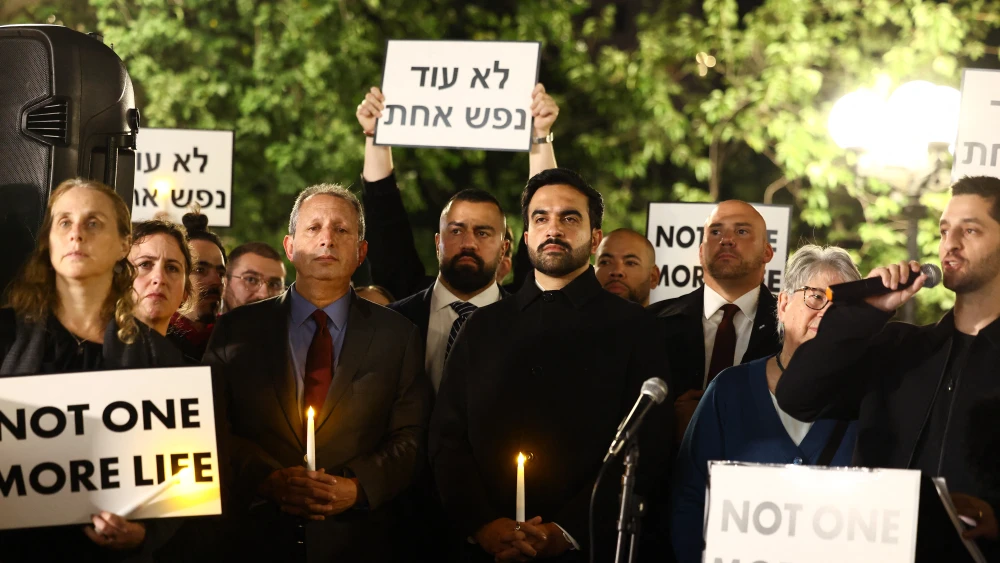
Hundreds of anti-Israel protesters accused New York City Mayor Zohran Mamdani of supporting “genocide” and of being a “traitor,” as he attended an Oct. 7 candlelight vigil put on by an “anti-occupation” group and hours after he released an Oct. 7 statement that Jewish leaders said endangers Jews.
In the Oct. 7 statement, Mamdani again accused Israel of “genocide,” which drew Rabbi Rick Jacobs, president of the Union for Reform Judaism, to say that the anti-Israel mayor was “callous toward Jewish pain” on a day of mourning and failing “to show basic humanity toward us in our grief.” Turning the third anniversary of the deadliest days for Jews since the Holocaust “into an indictment of the Jewish state is not only hurtful and deeply offensive, but it also makes Jewish New Yorkers less safe,” Jacobs stated.
In Manhattan’s Union Square on Wednesday, Mamani, who campaigned on having the Israeli prime minister arrested, attended the vigil organized by a group called “Israelis for Peace,” which describes itself as “Israeli anti-occupation activists in New York City mobilizing for an equal and safe future for both peoples.”
Mamdani’s frequent criticism of Israel wasn’t enough for the protesters, who nearly overran the candlelight vigil, at which Mamdani stood quietly for about an hour. (JNS cought comment from City Hall.)
“On a day of profound pain for so many New Yorkers, disrupting a vigil for the victims of Oct. 7 while waving the flags of terrorist organizations is absolutely despicable,” stated New York Gov. Kathy Hochul, a Democrat. “Jewish New Yorkers deserve to mourn in peace, free from hatred and intimidation. There is no excuse for this. None.”
Deborah Lipstadt, a historian and former U.S. special envoy for monitoring and combating antisemitism in the Biden administration, stated that Mamdani faced “the orthodoxy of the pro-Palestinian cause: no bemoaning Jewish pain even if you also speak of genocide.”
“Only unequivocal condemnations of Israel allowed,” she added.
Even Mehdi Hasan, the anti-Israel founder of the site Zeteo, stated that “if you’re protesting and blaming *checks notes* Zohran Mamdani for the Gaza genocide you may, you just may, need to check yourself into a mental health facility.” (Within minutes just before and just after his post, Hasan accused Israel of “genocide.”)
The mayor stood at the event surrounded by rabbis, including Rabbi Jill Jacobs of T’ruah: The Rabbinic Call for Human Rights, Rabbi Sharon Kleinbaum of the New York Jewish Agenda and Rabbi Ellen Lippmann, who retired from the Park Slope independent congregation Kolot Chayeinu. All three have been aligned with the mayor since he campaigned last year.
Mamdani also stood beside Brad Lander, a former city comptroller and the Democratic nominee for Congress in a seat expected to be safe for Democrats. Lander, who has accused Israel of “genocide,” has been an ally of the mayor’s since Mamdani beat him in the primary election for mayor. Mamdani endorsed Lander for Congress.
The protesters booed and jeered the mayor, trying to drown out speakers at the candlelight vigil.
Some wrapped their heads and faces in keffiyahs, and some pushed down metal police barriers, as uniformed members of the New York City Police Department appeared to struggle to contain the tense scene, according to footage that the New York Post and others shared.
“Zohran Mamdani you can’t hide, we charge you with genocide,” some yelled. Others shouted “traitor.” Others yelled “we love Hamas,” as the normally smiling mayor stood stoically.
His security team surrounded him as he returned to his car, as anti-Israel protesters shouting at him.
Earlier on Oct. 7, mainstream Jewish leaders criticized Mamdani for his Oct. 7 statement, which appeared to reduce the number of Israelis murdered on Oct. 7 by 100 and in which he wrote that “three years later, we must refuse to accept a world in which occupation and apartheid continue, where war crimes are met with impunity and our federal government continues its complicity with every arms shipment.”
After leaving Union Square, the mayor and his entourage went to the Upper West Side to dine at the area’s only Palestinian restaurant, Ayat. The restaurant appeared to be closed to everyone but the mayor and his small group, as many people looked in through glass walls from the sidewalk.
In the restaurant, Mamdani appeared to be smiling and animated—far more comfortable than he was in Union Square.
The mayor’s office described the event as a meeting “with Palestinian New Yorkers.”