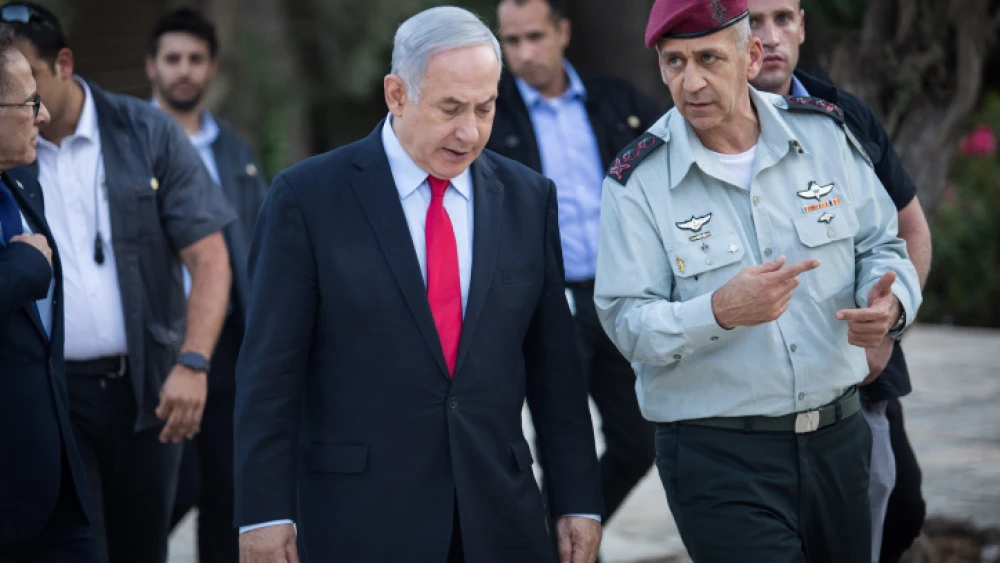
Israeli Prime Minister Benjamin Netanyahu and Israel Defense Forces’ Chief of Staff Lt. Gen. Aviv Kochavi have recently made it clear that the threats Israel faces require an urgent response. Some castigated them for sparking unnecessary anxiety, and while it is true that none of the threats in question are new, they are all directed by Iran, making for a particularly volatile mix.
Unfortunately, a scenario in which Israel faces war on its northern and southern borders simultaneously is not far-fetched.
Waning American dominance in the Middle East has many implications for the regional reality. Wars can erupt faster and—in the absence of a world power to restrain the parties involved—last longer. This change is not just the result of a shift in White House policy. It also reflects the change in the nature of the battlefield.
The introduction of advanced weapons to the Persian Gulf and the Middle East, in general, has undermined American military superiority in the region. Recent publications by the U.S. Department of Defense show that the Americans have realized how fast military technology and advanced weapons systems can become available on the private market and certainly to the Iranians.
For example, Iran’s strike on oil facilities in Saudi Arabia in September involved cruise missiles and drones, guided by advanced intelligence processing technologies that enabled them to defeat Saudi radars.
The Houthis, Iran’s proxy in Yemen, have long been operating drones and cruise missiles. This is, in fact, a new balance of power that intensifies Iranian influence in Iraq, Syria, Yemen and Lebanon. This trend also threatens Jordan’s stability.
Another component of this systemic change lies in the military buildup in Hezbollah in Lebanon and Hamas in the Gaza Strip.
While still defined as terrorist groups, in reality, these are military organizations. Kochavi calls them “terrorist armies,” and indeed, they are organized into battalions and brigades. They are well-funded by their Iranian patrons, too, who supply them with increasingly advanced offensive capabilities.
Should war break out, this strategic change will manifest in the challenge of defending the civilian home front. The head of the IDF Homefront Command, Maj. Gen. Tamir Yadai, recently detailed the components of this new challenge, stating that “although the evolving threat to the home front is known to the IDF, the cumulative change in the threat has not been defined.”
One of the biggest challenges, he said, transcends the threat to civilian lives and strategic infrastructure and involves the fact that Hezbollah and Hamas are trying to move the fighting to Israeli soil.
The accumulation of threats and the fact that they can now be coordinated means at least part of the threat has evolved from quantitative to qualitative. Meeting this challenge requires proper organization on Israel’s part with respect to the IDF’s force buildup, as currently, it will struggle to address a multi-sector war.
This challenge mandates that the IDF develop new operational concepts, and the home front, too, must also prepare to deal with these new and very real threats.
Maj. Gen. (res.) Gershon Hacohen is a senior research fellow at the Begin-Sadat Center for Strategic Studies. He served in the IDF for 42 years, commanding troops in battles with Egypt and Syria. He was formerly a corps commander and commander of the IDF Military Colleges.
This article first appeared in Israel Hayom.