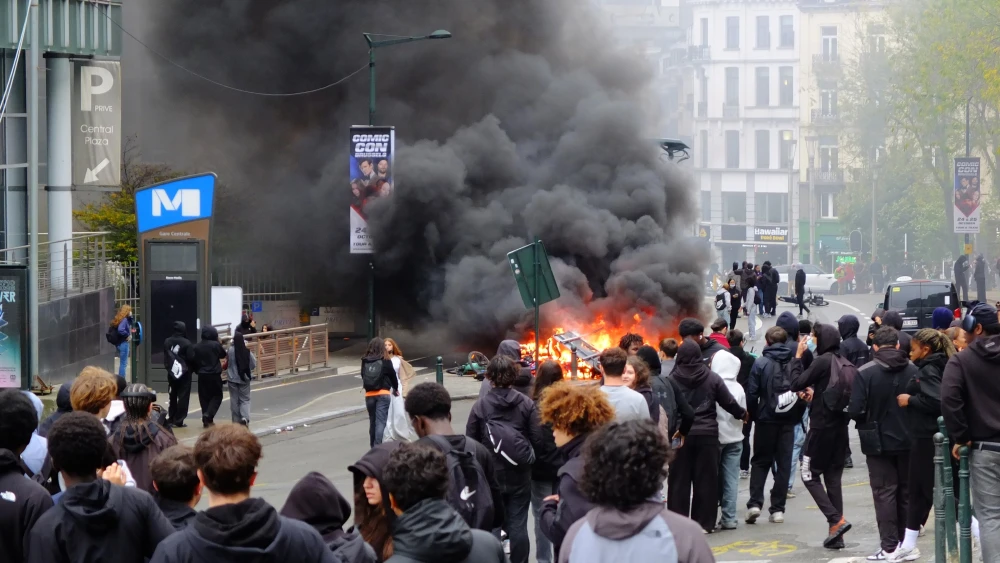

French students protesting inadequate schools have legitimate grievances. But what grievance against an educational system is expressed by chanting threats against Jews?
On Oct. 1, municipal authorities in Carpentras, in southeastern France, reported chants outside Victor-Hugo high school that included “We burned Israel!” and “Who are the Jews? We trample them!”
The reported incident does not define the entire student movement. But the words demand an explanation that complaints about missing teachers cannot provide.
The warning signs predated the unrest. In June 2024, French daily Le Monde reported that a 7-year-old Jewish girl drew an Israeli flag during a classroom exercise. A classmate responded with a beheading gesture. The girl’s mother said she avoided calling her children by their names in public for fear of identifying them as Jewish.
Oct. 7 did not create the prejudice described in that reporting. It exposed existing hostility and was followed, according to those interviewed, by more frequent and less inhibited expressions of antisemitism.
Israel did not exist when the Nazis persecuted and murdered Jews. Antisemitism plainly required no Israeli government, policy or military campaign. The historical contexts and scale are profoundly different, but the attribution of collective guilt remains recognizable. A French Jewish child does and should not have to answer for the Israeli government.
The current protests require distinctions of their own. Demonstrations over schools and the cost of living have brought large numbers of peaceful demonstrators onto French streets. Authorities attributed arson, looting and attacks on public buildings to far-left groups and opportunistic criminals. Islamist direction of the disturbances has not been established.
Across Europe, education protests, housing campaigns and opposition to military spending have intersected with Palestinian solidarity. These associations are not inherently illegitimate. A Palestinian flag alone establishes neither extremism nor antisemitism.
The question is how Israel becomes the connecting explanation for grievances originating elsewhere and when opposition to the one Jewish state on the planet becomes permission to target Jews everywhere.
For certain movements, the Palestinian cause supplies a common language of opposition to capitalism, colonialism and Western institutions. In this worldview, Israel is reduced to a colonial oppressor, obscuring the Jewish people’s historical connection to the land and Zionism’s character as a movement for national self-determination.
A coalition’s manifesto for a European student strike to take place on Nov. 20 illustrates this convergence. It connects demands for investment in education and housing with opposition to capitalism and militarization. It also calls for NATO’s dissolution and severing ties with Israel, which it labels “genocidal.”
There is no policy dispute between a 7-year-old Jewish student in a French classroom and a classmate threatening her.
Those positions do not establish that this coalition directed the French riots. They demonstrate that linking domestic grievances to an international ideological agenda is a declared political strategy, not merely an interpretation imposed by critics.
Law-enforcement authorities must investigate threats, incitement and violence, identify those responsible and establish whether any organizations planned, financed or facilitated criminal acts, including antisemitic intimidation.
Beyond the streets, the unrest has revived a familiar conspiracy narrative: Jews are responsible. As JNS has reported, the Combat Antisemitism Movement documented online claims blaming Jews, Israel and the Mossad for the French disturbances, alongside explicit calls for violence.
These findings reveal how even a crisis involving French classrooms and household expenses can be recast as a Jewish conspiracy.
This is why the problem cannot be reduced to disagreement over Israeli policy. There is no policy dispute between a 7-year-old in a French classroom and a classmate threatening her. Nor does a shortage of teachers explain a chant about trampling Jews.
The consequences extend beyond France. In June, Canadian Prime Minister Mark Carney acknowledged that Canada was failing its Jewish community, citing attacks on schools and synagogues. Jewish institutions were being threatened in a country thousands of miles from the conflict invoked against them.
Brazil offers another warning. In an Oct. 14 analysis for the Washington Institute for Near East Policy, Brazilian federal prosecutor Lucas Gualtieri described how a Hezbollah-linked network recruited financially vulnerable men with criminal records, sent them to Lebanon for training, and returned them to scout Jewish and Israeli targets. Prior ideological commitment was not required.
According to the analysis, one recruit, Lucas Passos Lima, filmed and geolocated three synagogues, a Jewish cemetery, the Israeli embassy, and a rabbi in and around Brasília.
On Sept. 15, Brazil’s Superior Court of Justice reinstated Lima’s conviction for preparatory acts of terrorism. A lower court had acquitted him of that offense because he acted for financial gain rather than ideological commitment. The higher court rejected that reasoning. It ruled that preparing a terrorist attack can constitute terrorism even when the participant is paid rather than ideologically committed.
These cases have different perpetrators and circumstances. They do not establish a single organization directing events across continents. They show why Jewish communities cannot be expected to treat threats as political theater until someone acts on them.
Students have every right to demand better schools. Citizens have every right to advocate for Palestinians or criticize Israel. Those freedoms do not include threatening Jewish children or attacking synagogues.
In such cases, Israel serves as the pretext. Jews become the target.
Antisemitism is often described as the canary in the coal mine: a warning that a society’s protections are failing. France’s looted shops and burned public buildings do not prove that antisemitism caused the wider unrest. They show that the safety of the broader public is already at stake.
A democracy cannot afford to dismiss threats against Jews as someone else’s problem.