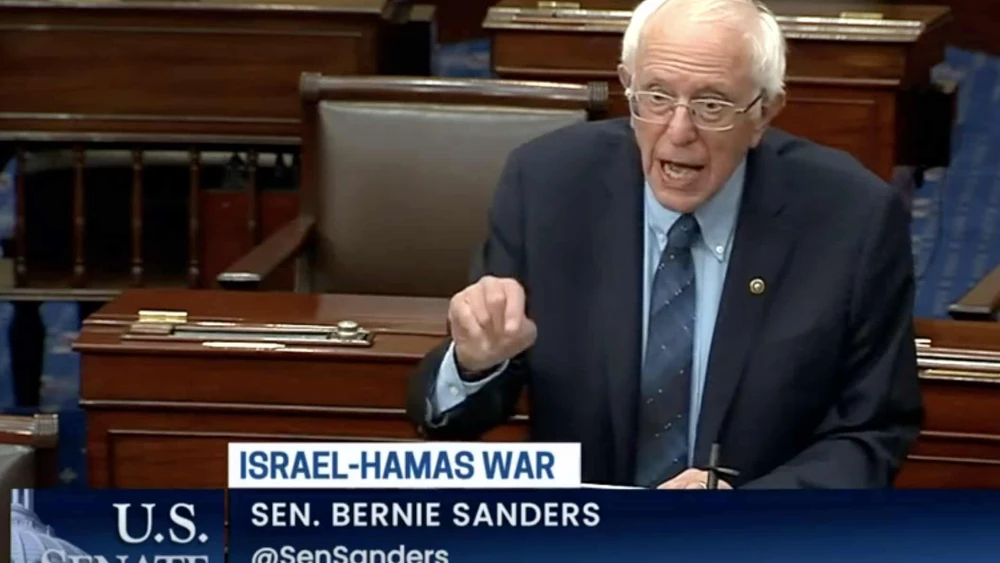
Sen. Bernie Sanders (I-Vt.) announced Thursday he will force up to eight Senate votes next week on joint resolutions of disapproval aimed at blocking $8.8 billion in U.S. arms sales to Israel, citing concerns over the humanitarian crisis in Gaza.
The resolutions, which target weapons sales approved by President Donald Trump’s administration, are expected to face significant opposition in the Republican-controlled Senate. However, Sanders’s effort marks the first major test for Senate Democrats on Israel policy in the new term, reported Jewish Insider.
Israeli Prime Minister Benjamin Netanyahu “has clearly violated U.S. and international law in this brutal war, and we must end our complicity in the carnage,” Sanders said in a statement. He pointed to Israel’s suspension of aid deliveries to Gaza and the destruction of parts of the Strip.
“The latest Trump sales provide almost $8.8 billion more in U.S. bombs and other munitions, including more than 35,000 massive 2,000-pound bombs. The United States must not continue to supply endless amounts of military aid and weaponry to the Netanyahu government,” Sanders said.
According to the Hamas-run Gaza Health Ministry, more than 50,000 Palestinians have been killed since Oct. 7, 2023. However, this figure is inflated to include those who died of natural causes, and despite Hamas claims, the losses include a very high proportion of Palestinian terrorists, unprecedented in urban warfare. The war began when Hamas-led terrorists attacked southern Israel on Oct. 7, killing some 1,200 people and taking 251 hostages.
The resolutions are unlikely to pass, given the long-standing bipartisan support for Israel in Congress. However, proponents hope the debate will increase pressure on the U.S. and Israeli governments to address civilian casualties and humanitarian concerns.
The Senate overwhelmingly rejected similar measures Sanders introduced in November, when Democrats controlled the chamber. At the time, 19 Democrats supported at least one of the resolutions, while no Republicans backed them. Most of those Democrats remain in office, and their votes next week could indicate shifting dynamics on U.S.-Israel policy.
Under U.S. law, Congress can block foreign arms sales through resolutions of disapproval, though none has ever passed both chambers and survived a presidential veto. The law guarantees a Senate vote on such resolutions, often sparking contentious debates.
Trump has reversed efforts by his predecessor, Joe Biden, to impose restrictions on arms transfers to Israel. The upcoming votes will test how the Democratic Party, now in the Senate minority, navigates U.S. policy toward Israel under the Trump administration.