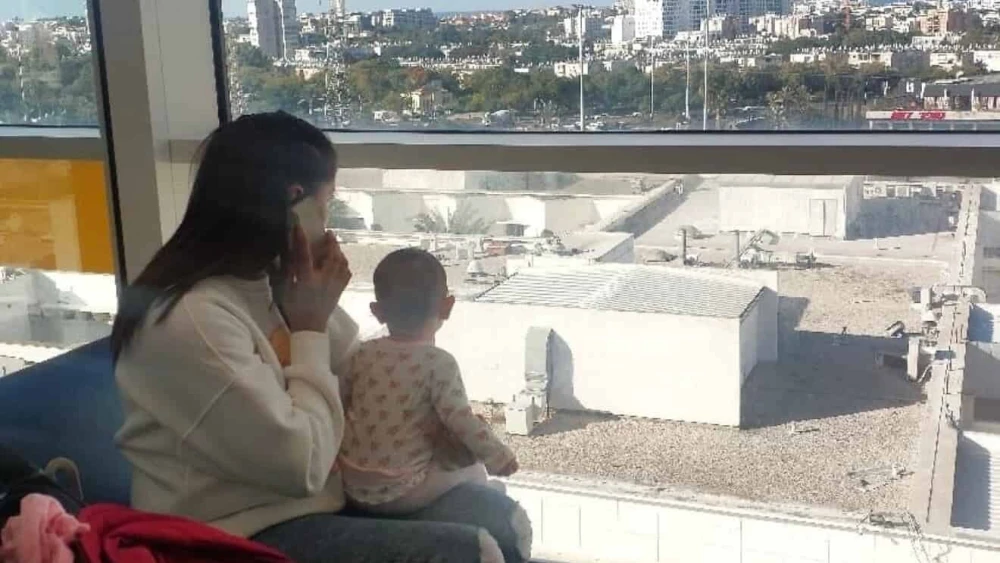
“When she was born, we realized immediately that something was wrong with her heart and that she needed treatment,” said Nadia (not her real name), a Druze woman from a war-affected village in Syria, speaking about her toddler in an interview with JNS.
Nadia arrived in Israel earlier this month with her daughter, in a transfer coordinated by the Israel Defense Forces and Save a Child’s Heart, the nonprofit through which her child received life-saving care.
Save a Child’s Heart treats children with congenital and rheumatic heart disease who have limited access to medical care in their home countries. Roughly eight in every 1,000 children are born with a heart defect, and half of them need treatment within their first year.
Since 1995, the organization has treated more than 8,000 children from 75 countries in collaboration with the Sylvan Adams Children’s Hospital at Wolfson Medical Center in Holon, south of Tel Aviv, and conducted 140 clinics and medical missions.
Nadia said she encountered deeply compassionate staff in Israel, including Dr. Sagi Assa, senior pediatric cardiologist and head of the Interventional Pediatric Cardiology Unit at Save a Child’s Heart, who performed a heart catheterization procedure on her daughter.
“He was very human and made me feel safe before and after my baby underwent catheterization,” said Nadia, who lost her home and her entire village to sectarian fighting in Syria. She traveled to Wolfson Medical Center carrying many of her belongings, fearing to leave anything behind.
The Druze, an Arabic-speaking ethnoreligious community distinct from Islam, number about 150,000 in Israel. Significant Druze populations also live in Syria and Lebanon, with families often split across borders.
In July, clashes erupted in Syria between local Druze, Sunni Bedouin tribes and regime forces. Reports of mass killings, public executions and abuses against Druze civilians prompted IDF strikes.
Also in July, Israel’s Ministry of Foreign Affairs said it delivered some two million shekels ($450,000) worth of humanitarian aid to the embattled Druze population of Sweida in southern Syria.
Where she lives, Nadia said, she had no access to care comparable to what her baby received at Wolfson. She said she was surprised to be treated by a team that included Jews and Arabs, something she had never seen, or heard of before.
“I hope it will be the same for us, that there will be peace among us, the way there is peace here. I hope that either we will have peace or become one day a part of Israel so that we too can live as safely as people live here,” she said.
Nadia said she cannot forgive those who burned her home and destroyed her village. She expressed fear and uncertainty about returning to the place where she now lives, but also relief that her child was treated before any permanent damage occurred.
“For me, it was very exciting to treat someone from Syria, especially since I was brought up as a young child by a Jewish Syrian lady. It felt like meeting a culture I was already familiar with and very close to,” Dr. Assa told JNS.
“Having the opportunity to communicate with and help these people filled my heart with happiness. I felt privileged to be able to do so,” he added. The cost of the treatment was covered by Save a Child’s Heart.
Dr. Assa explained that Nadia’s baby was born with a stenotic valve—a heart valve that was narrow and unable to open properly.
“Restricted blood flow forced the heart to work much harder and caused the right side of the heart to enlarge. What she needed was a repaired valve leading to the pulmonary artery, and we were able to do that through a catheterization procedure using balloon dilation of the valve leaflet,” he said.