Newsletter
Newsletter Support JNS

Spring brings swarm of locusts to southern Israel

Farmers fear for their crops, but migratory birds are enjoying nature’s “protein bars.”

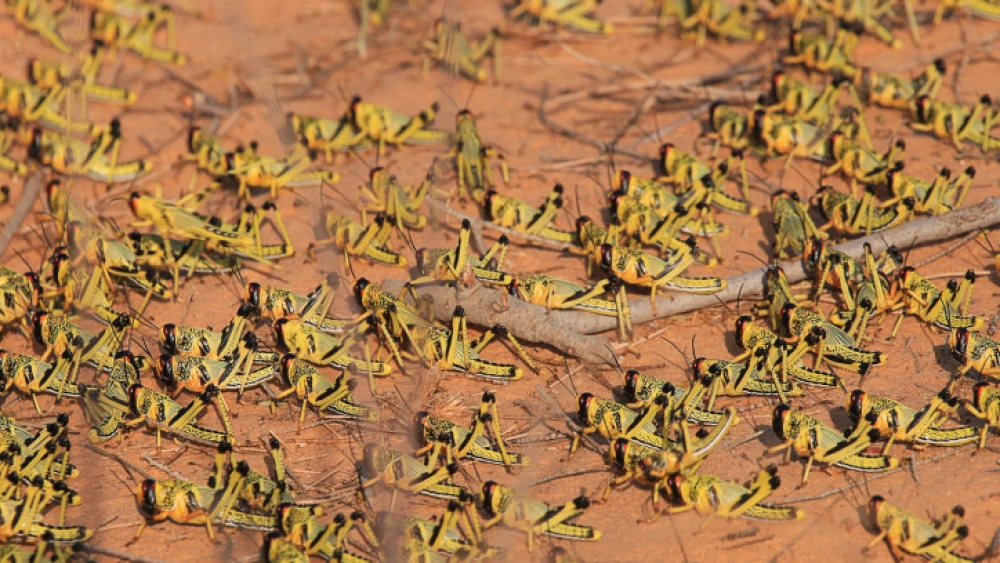
Thousands of locusts descend on southern Israel, May 15, 2013. Photo by Dror Garti/Flash90.

Residents of Israel’s southern city of Eilat and Arava region have woken up for the past few mornings to enormous swarms of locusts in their gardens, fields and elsewhere.

Farmers on Kibbutz Samar and Kibbutz Elipaz are worried about their crops, although residents of Moshav Hatzeva managed to catch some of the locusts using net traps set up in their fields.

In Eilat, the swarm settled at an agricultural school near the bay, although individual locusts were spotted throughout the city.

People’s bane can be a bonus for wildlife, however. Amir Balaban, who handles the urban nature depart at the Society for the Protection of Nature in Israel, said that hundreds of bee-eaters had been spotted at Kibbutz Lotan on their way north from Africa to Europe.

“They fly over fences and fill their beaks with the locusts landing in the area,” he said.

Balaban called the locust event a “festival of protein” for Israel’s wildlife. “Much like the [way in which] a lot of migratory birds feed off the locusts on their way north.”

This article first appeared in Israel Hayom.

Anthony Albanese downplayed the hecklers’ reception, saying the overall atmosphere was “incredibly positive.”
Two divisions continue to dismantle the Iranian-backed group’s infrastructure in Southern Lebanon, as another division prepares to join the fight.
Meanwhile, Washington has issued a short-term authorization permitting the sale of Iranian oil currently stranded at sea.
“This is a war crime, but it is not surprising because the Iranian regime is a terrorist regime,” Defense Minister Israel Katz says at a damaged kindergarten.
The U.S. military has thus far struck over 8,000 targets across the Islamic Republic, including 130 enemy vessels, according to CENTCOM chief Adm. Brad Cooper.
Cairo has taken on the role of mediator, but local media is clearly leaning toward Tehran.