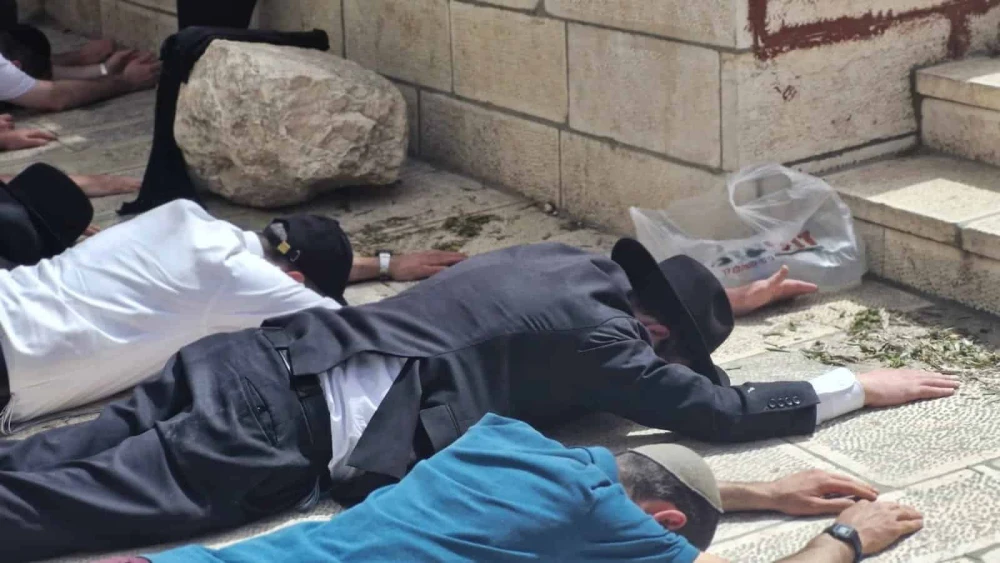
One morning in July, on a pathway atop Jerusalem’s Temple Mount, eight barefoot men lay spread-eagled, faces pressed to the ground, as four police officers stood by and watched.
Just two years ago, this act—part of a mitzvah, a religious commandment known as Hishtachavaya—would have led to immediate ejection. For decades, authorities restricted Jewish prayer at the site, which houses the Al-Aqsa mosque and the remains of the Second Temple, making it one of the most sensitive and contested religious spaces on earth.
Often described as a powder keg, the Temple Mount is the holiest site in Judaism—the location of the two ancient Jewish Temples, the last of which was destroyed by the Romans in 70 CE. That destruction is mourned annually on Tisha B’Av (the 9th of Av), a day of fasting and lamentation, which this year begins on Saturday night, Aug. 2.
Under Israel’s current government, Jewish prayer on the Mount has been liberalized in scope and frequency like never before. Visits by Jews have surged. Supporters of this shift cite its spiritual and ideological significance for future generations. Critics, however, argue it provokes Muslims, contravenes religious law and escalates tensions.
Among the critics are leading rabbinic authorities, including Israel’s chief rabbis and the official Rabbinate. They prohibit Jewish visits to the Mount over concerns of ritual impurity. Since the exact location of the Holy of Holies—the Temple’s innermost sanctum—is unknown, many fear that stepping there inadvertently would violate halachah (Jewish law).
Those rabbis instruct Jews to avoid the Mount entirely. Others, however, permit visits, believing that the restricted areas are sufficiently identifiable to navigate around.
Beyond religious debates, some legal scholars and officials oppose Jewish worship on political grounds. In a December 2024 essay for Tel Aviv University’s Institute for National Security Studies, jurist Shmuel Berkovitch warned, “Israel would be in great danger if Jews were allowed to pray on the Temple Mount,” citing the potential for violent Palestinian backlash.
Despite such warnings, Jewish participation has soared. In the current Hebrew calendar year of 5775 (2024-25), which began on the evening of Oct. 2, the Temple Mount has already recorded 56,079 Jewish visits, according to Beyadenu, a nonprofit promoting Jewish presence at the site. This exceeds by 22 visits the grand total of Jewish visits during the whole of 5774 (2023-24), which was a 13-month Hebrew leap year.
Much of the credit is given to National Security Minister Itamar Ben-Gvir, a staunch advocate of Jewish prayer on the Mount. But Beyadenu’s data show that visitation has been steadily rising since 2018, when Jewish prayer was first allowed (initially in a hidden corner, and at very limited times.)
In 2022, before Ben-Gvir assumed office, the Mount saw 51,483 Jewish visits. The years prior—marked by COVID restrictions—saw lower numbers: 34,779 in 2021 and 19,814 in 2020. In 2019, the number reached 30,416, a historic milestone.
“Arabs can pray wherever they want, so Jews should be able to pray wherever they want,” Ben-Gvir said in a 2023 Army Radio interview. He also expressed support for building a synagogue on the Mount—a remark widely seen as endorsing long-term desires to rebuild a Jewish Temple there.
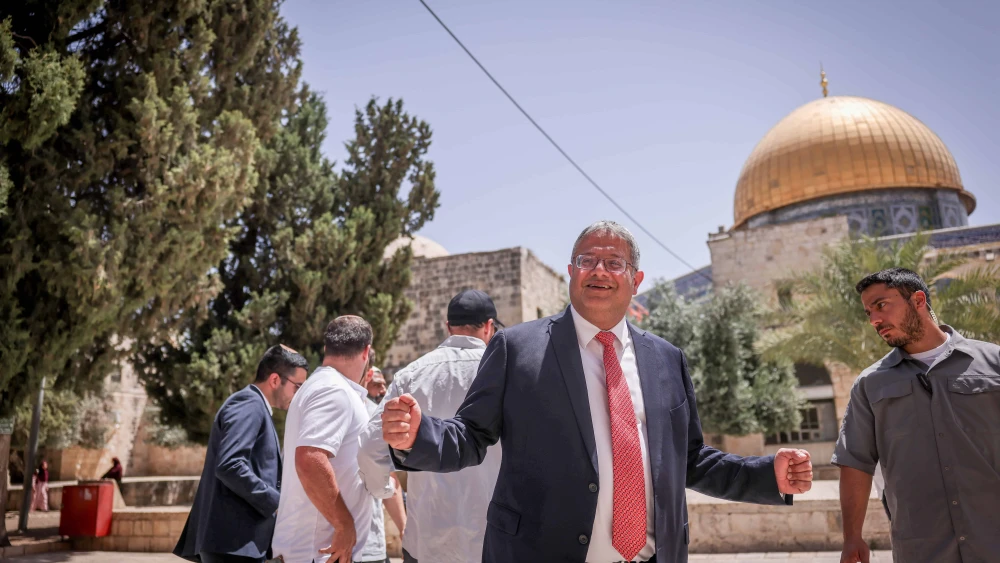
Ben-Gvir announced in May that he had officially changed the rules to allow Jews to lie prostrate in prayer—though the practice had been quietly tolerated since at least February. In April, Police allowed groups of over 100 Jewish visitors, sometimes as many as 180, to visit at one time—a departure from the previous limit of 30 Jews at a time.
“The numbers already had been climbing before Ben-Gvir, but the reality shifted dramatically since he took office,” said Arnon Segal, a Temple Mount activist, speaking to JNS. He noted that Jews still need to come at allotted times, and would be turned away outside those times whereas Muslims may enter whenever access is permitted.
For decades, the site’s management has been under the Jordanian Waqf, a religious trust overseeing Muslim holy places with Israel’s consent. Enforced by the Israel Police, the Waqf’s restrictions on Jewish prayer were, for many Jews, deeply painful—seen as both discriminatory and a sign of Israeli weakness.
“There are still restrictions,” Segal said, “and prayer isn’t allowed anywhere at any time—but it’s a totally different reality.” He recalled a time when Jews would mutter prayers in conversation to avoid detection. Hundreds have been expelled from the Mount over the years for praying—or merely appearing to.
Yet even this strict enforcement failed to prevent Muslim riots. Major clashes erupted in 2017 after the installation of metal detectors, and again in 2021 and 2023.
The Waqf’s grip began loosening after a 2017 terror attack in which three Arab-Israeli gunmen killed four Israeli security personnel on or near the Mount, Segal noted.
“It was painful, sad, and unjust that the Temple Mount was the one place we couldn’t pray,” said Rafi Sandler, a 37-year-old musician and father of three from Ra’anana who visited the site for the first time this week.
Sandler ascended with members of his Kippalive choir. They performed several songs a cappella, observing the Jewish ban on instruments during the Nine Days leading up to Tisha B’Av.
It may have been the first time in modern history that a Jewish choir sang on the Mount, he said, adding, “It feels like we’re living in biblical times.”
Sandler sees the easing of restrictions as part of a historic continuum leading to the construction of the Third Temple.
“A hundred years ago, the State of Israel was unimaginable. Then the Western Wall was out of reach. A decade ago, praying on the Mount seemed impossible. Now it’s happening,” he said. “The next step? People say we’ll never see a Temple again. They call us ‘messianic’ or ‘extreme,’ but this is who Jews have been for millennia.”
Although observant Jews widely agree that the Jewish Temple’s reconstruction is a desired goal, they vary in how they think would come about. Some believe it should be built immediately, whereas many others believe it should be built only after the coming of the Messiah.
Before visiting, Sandler followed his rabbi’s instruction to immerse in a mikvah—a ritual bath required to enter the sacred site in a state of purity.
The visit changed his connection to Tisha B’Av. “It’s hard to mourn something you’ve never seen or experienced,” he said. “But after being there, I could close my eyes and really imagine the Temple. You open your eyes—and you hope to see it.”