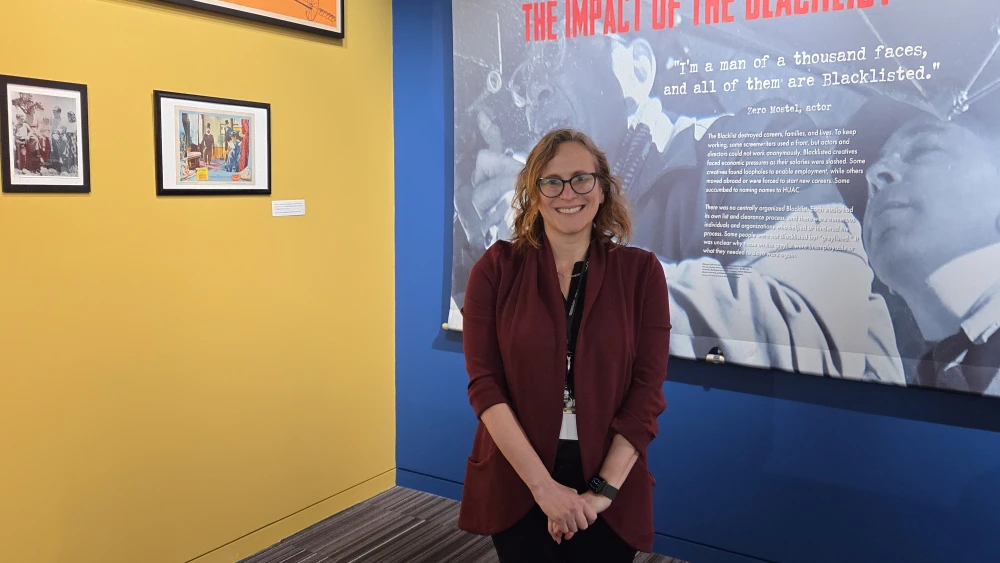
As visitors engage with the Capital Jewish Museum’s new exhibit “Blacklisted: An American Story,” Beatrice Gurwitz, the Washington museum’s executive director, figures that they will draw connections to the present moment.
“I think it’s always helpful to look at moments when antisemitism has surged, why it’s happened, how it’s connected to the broader political moments and, also, how those surges come to a close,” she told JNS on a preview of the show, which opens on Friday and runs through Labor Day.
After World War II ended, so did the wartime alliance between the United States and the Soviet Union, and Communism gained a foothold in eastern Europe, China and Southeast Asia. The USSR built its own atom bomb.
The exhibit in Washington addresses the Red Scare, the period from the end of World War II until the end of the 1950s, during which many Americans feared that Communism was on the march and that they needed to stand up against it, the congressional Un-American Committees held hearings and Jews were accused of being an unpatriotic “fifth column.”
Aided by private industry, U.S. officials imposed loyalty tests, purging or blacklisting those suspected of Communist sympathies. The House and Senate Un-American Committees held hearings to badger witnesses about Communist affiliations and to name names of others who expressed sympathetic views. Many refused to answer, citing their First Amendment rights, and paid the price.
Through film, pictures, artifacts and interactive displays, the exhibition recounts the time when the rights of Americans were trampled, when people were encouraged to spy on colleagues and when Wisconsin Republican senator Joseph McCarthy claimed that the federal government was riddled with Communists.
Some of the leading lights of Hollywood were blacklisted for refusing to answer the question: “Are you now, or have you ever been, a member of the Communist Party?”
Throughout this all, Jewish Americans occupied center stage, as the exhibit explains.
Jews had been active in progressive movements, labor unions, the New Deal and the motion picture industry. Some actually were Communists or Socialists, expressing beliefs protected under the U.S. Constitution. All came under attack.
The top Democrat on the House Un-American Activities Committee, John Rankin, of Mississippi, was a known antisemite, who would refer to Hollywood actors by their given Jewish names. In fact, according to the museum, “Jewish” often served as a stand-in for “Communist.”
Julius and Ethel Rosenberg, members of the Communist Party, were convicted and executed for passing information about the atom bomb to the Soviet Union.
Six members of the Hollywood 10—producers, directors and screenwriters who were blacklisted by the movie studios after being held in contempt of Congress for refusing to answer questions about whether they had any Communist affiliations—were Jewish.
They claimed that such questions violated their First Amendment rights. The U.S. Supreme Court upheld their contempt convictions.
There were plenty of Jews on the other side as well. Many of the studio owners who blacklisted the actors, writers and producers were Jewish. So was lawyer Roy Cohn, chief counsel to McCarthy and later a mentor to future U.S. President Donald Trump.
Some of the blacklisted created and acted in an off-Broadway play, “The World of Sholom Aleichem,” which proved to be such a success that it led to the musical “Fiddler on the Roof,” starring another blacklisted actor, Zero Mostel.
For some observers, there are parallels to how movie studios gave into government pressure and blacklisted those refusing to disavow any Communist sympathies in the 1950s, to current day pressures that law firms and media companies have experienced under the current administration in Washington.
“These themes recur over and over again,” Gurwitz told JNS. “The number of parallels is tremendous and different people will walk in and find their own echoes of the past in the contemporary moment.”
When the exhibit moved to Washington, the Capital Jewish Museum added a section on the Red Scare in the nation’s capital.
This was where the House and Senate held hearings on possible Communist infiltration, and where more than 4.7 million federal employees underwent background checks, 26,000 faced FBI investigations, more than 6,800 people quit or withdrew their applications and 560 lost their jobs.
“The number of federal employees, who were required to take loyalty oaths and were investigated, who lost their jobs” and who had to testify before the House Un-American Activities Committee, “is very significant,” Gurwitz told JNS.
“This is a city of the federal government. So when you think of those numbers, and you think about the impact, not just on the workers, but on their families and their communities, it’s really an important component of the story,” she said.
“The Hollywood component gets more attention, but numberswise, the story about the impact on the federal government is much bigger,” she said.
One of the stories the museum tells is about Abraham Chasanow, who was suspended from his federal job over allegations from an informant that he was part of several left-wing groups. Chasanow had 97 witnesses testify on his behalf and was restored to his position.
Time magazine reported that the office in which Chasanow worked had 13 employees who lived in Greenbelt, Md., as he did. Five were suspended because of concerns they were security risks. All five were Jewish. The other eight were not.
Another story involves famed Washington Post reporter Carl Bernstein’s mother, part of a community of liberal Jews in the Washington area, who was called to testify before the House Un-American Activities Committee. She refused to answer questions from the committee and was ostracized by her neighbors.
Visitors are welcome to sit behind a desk in front of a backdrop of the Capitol, a microphone in front of them as if they were appearing before members of Congress, and read through actual testimony from witnesses. They can also thumb through a list of questions asked by committee members.
On a wall, they can write and post thoughts about the First Amendment.
By the mid-1950s, the mood of the country had changed. Besides McCarthy’s takedown by Edward R. Murrow of CBS News, the U.S. Supreme Court, in 1957, overturned the conviction of a union leader for refusing to name names in testimony before the House Un-American Activities Committee.
The Hollywood blacklist ended in 1960, as one of the Hollywood 10, Dalton Trumbo, received credit for writing the movies “Spartacus” and “Exodus.”
President John F. Kennedy even crossed picket lines set up by the American Legion to watch the former.
“I think people look back at the Red Scare as a dark moment in our history, but it’s not the only moment that questions of government overreach or tensions between national security and First Amendment rights have emerged,” Gurwitz told JNS.
“This show gives people the opportunity to grapple with big questions and to enter into conversations about contemporary resonance,” she said.