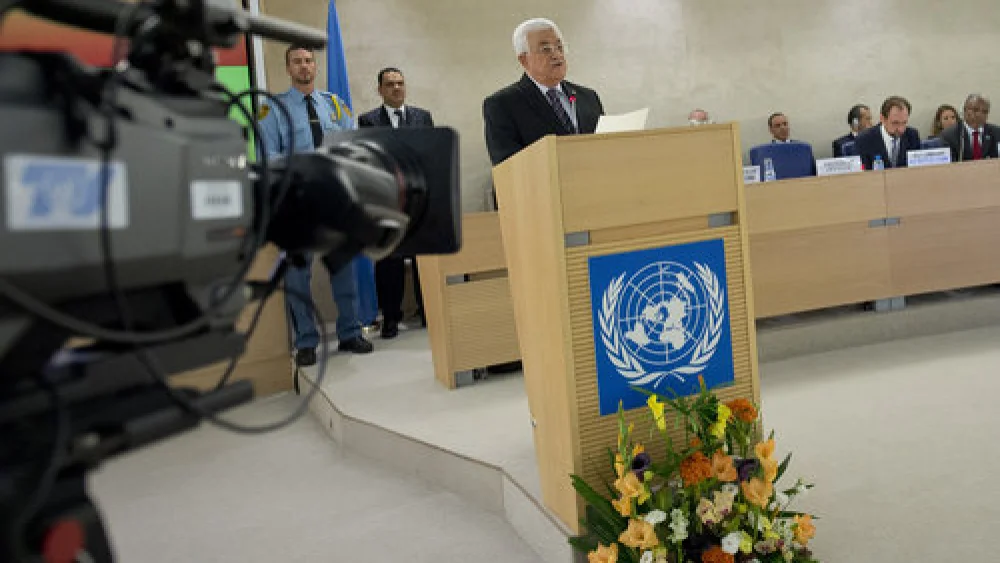
The United Nations Human Rights Council passed five anti-Israel resolutions at the end of its 37th session in Geneva, under the “Agenda Item 7,” a UNHRC mandate that a discussion of Israeli human rights abuses against Palestinians must be part of every council session.
U.S. Ambassador to the United Nations Nikki Haley expressed America’s outrage at the UNHRC’s treatment of Israel and warned that the U.S. would reconsider its membership in the body.
“When the Human Rights Council treats Israel worse than North Korea, Iran, and Syria, it is the Council itself that is foolish and unworthy of its name,” said Haley.
“The United States continues to evaluate our membership in the Human Rights Council. Our patience is not unlimited,” she added. “Today’s actions make clear that the organization lacks the credibility needed to be a true advocate for human rights.”
One resolution passed, called on Israel to give the Golan Heights to civil war-torn Syria, with 25 votes in favor, 14 against and 7 abstentions. Another, “ensuring accountability and justice for all violations of international law in the Occupied Palestinian Territory, including east Jerusalem,” called upon member states not to sell any military armaments to the Jewish state. It passed by a vote of 27 to 4 with 15 abstentions.
Three additional resolutions included one calling for Palestinian self-determination and Israeli withdrawal to the 1948 border lines, a resolution calling on Israel to cease building homes for Jews in Judea and Samaria, commonly referred to as the West Bank, and a resolution condemning Israel for committing human rights abuses against Palestinians. All the resolutions, which were authored by the Organization of Islamic Cooperation, were approved.
In addition to the United States, Australia, and the United Kingdom spoke out against UNHRC’s “Agenda Item 7,” requesting that the UNHRC move debates on Israeli violations to “Agenda Item 4,” where human rights abuses of all other member states excluding Israel are currently discussed. The U.K. still supported two of the “Agenda Item 7" resolutions.
Palestinian Authority Ambassador to the U.N. in Geneva Ibrahim Khraishi said if Israel wanted to abolish Agenda Item 7, it should withdraw to 1948 borders and “end the occupation.”
Israeli Defense Minister Avigdor Lieberman said in a tweet that Israel “has no business being in the UN’s Human Rights Council.” He stated that its “presence there gives legitimacy to… anti-Semitic resolutions, and the farce must end.”