


By Eli Mandelbaum
In the aftermath of Oct. 7, 2023, Israel has faced not only a war on its borders, but also a quiet, prolonged battle at home—the battle to help tens of thousands of wounded soldiers heal. Since the beginning of the war, more than 10,000 Israel Defense Forces soldiers have been injured, many of them sustaining complex physical wounds alongside deep psychological trauma.
While Israel’s health-care system and Ministry of Defense have provided crucial emergency response and rehabilitation, the sheer scale and intensity of the war have created cracks in the system. Into this void has stepped Belev Echad, a nonprofit organization that is working in close cooperation with the Defense Ministry to help fill the space where public care often ends and personal healing must begin.
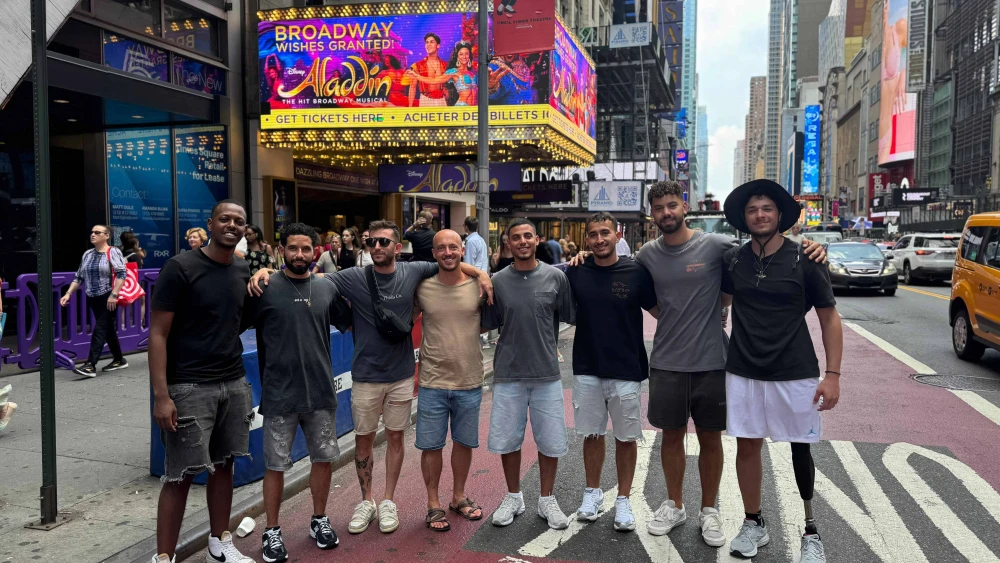
Founded in 2009, Belev Echad has developed a dual-phase model for rehabilitation that combines long-term physical and psychological treatment in Israel with a transformative recovery journey abroad, most recently, a two-week delegation to New York. This model provides wounded soldiers not only with routine care and emotional support, but also with a once-in-a-lifetime opportunity to reconnect with joy, identity and community, far from the trauma zones of home.
Guy Beniso, 24, from Netanya, served in the Givati Brigade and was called up for reserve duty after the Hamas-led terror attacks on Oct. 7. On Nov. 3, 2023, during operations in the central Gaza Strip, he was shot—a bullet and shrapnel struck his pelvis and thigh.
“I was airlifted to Hadassah Ein Kerem,” he recalls. “After five days in the hospital, I was sent home with metal in my body and no real idea what came next.”
Beniso was connected to Belev Echad through a friend. He soon began attending physiotherapy sessions at their Kiryat Ono center three times a week, where he also found a sense of belonging.
“I come all the way from Netanya just to be there,” he says. “After each session, I eat lunch with the other guys. It became a routine, something to hold on to.”
But it was the rehabilitation delegation to New York that gave him the emotional reset he didn’t know he needed.
“It’s my first time in the United States. Every day here is a new high, shows, meals with Jewish families, community events. We laugh, we feel alive. I didn’t realize how much I needed this until I was here. For the first time in months, I feel like myself again.”
Yechiam Barali, 30, from Jerusalem, was in South America on Oct. 7. As soon as he heard what had happened, he booked a flight home and rejoined his reserve unit—an armored infantry support company.
Two weeks later, while maneuvering through a narrow alleyway inside Gaza, his unit was ambushed.
“A grenade was thrown at me, followed by heavy gunfire. I was injured in my limbs. One of my arms was fractured, and several arteries were torn,” he recounts. “I was evacuated for emergency surgery. I honestly didn’t think I’d make it out.”
Barali is still in rehabilitation. He continues physiotherapy at Belev Echad’s center, but says the emotional impact of the New York trip was just as powerful.
“There, we were treated like heroes, like family. It’s not just a break from therapy; it’s part of the therapy. It reminded me that there’s more to life than pain. It gave me air to breathe.”
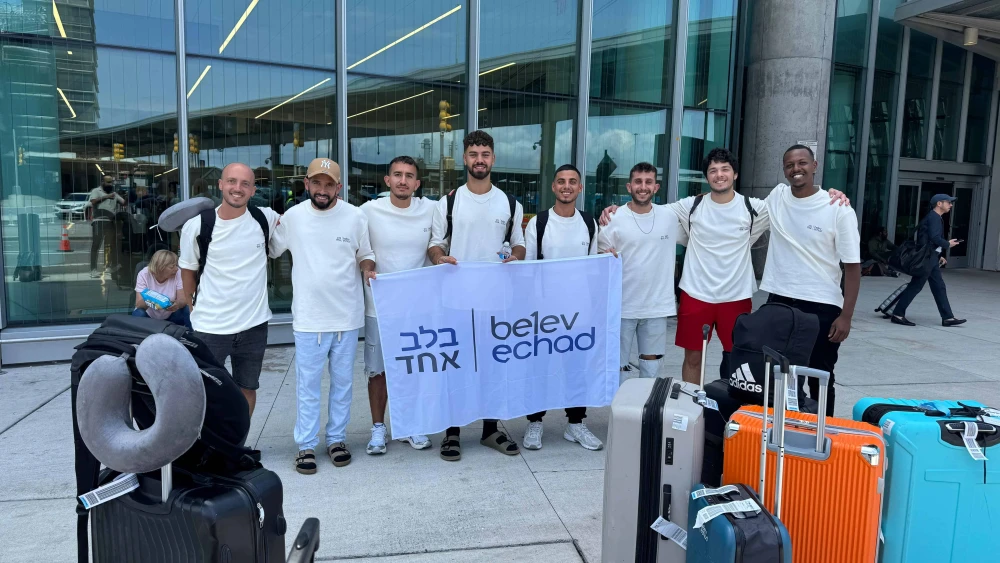
The Belev Echad model is built on a deep understanding that healing is not only physical. The trauma of war affects the body, as well as the mind, relationships, identity and future.
The organization’s center in Kiryat Ono offers physiotherapy, trauma care and community support in a welcoming, family-like atmosphere. But it’s the contrast of the journey to New York, the emotional shift, that turns routine recovery into true transformation.
“We created this model because we saw the gap,” says Rabbi Uriel Vigler, co-founder of Belev Echad. “Soldiers were returning from war with physical wounds, but also with deep emotional scars that weren’t being addressed fully. We wanted to give them more than therapy. We wanted to give them life again.”
His wife and co-founder, Shevy Vigler, adds, “In Israel, they fight to stand again. In New York, they remember how to live again. They dance, they laugh, they cry, and they realize they’re not alone. That’s the moment the healing truly begins.”
Throughout the last 15 years, Belev Echad has accompanied hundreds of wounded IDF veterans. Its model—grounded in compassion, community and continuity—is increasingly seen as a necessary complement to the state’s official rehabilitation efforts.
As Israel continues to absorb the psychological and societal shocks of Oct. 7, it is clear that the recovery of its wounded soldiers will be a generational challenge. The physical injuries are severe. But the invisible wounds—fear, survivor’s guilt, trauma—often run deeper.
Organizations like Belev Echad are not replacing the state’s role, they are extending it, reaching the places that medicine alone cannot reach. They are building relationships, creating safe spaces and offering wounded heroes a reminder that their lives still matter, deeply.
“This isn’t just a trip,” says Beniso. “It’s a turning point. It reminded me that I’m not just a soldier with a scar. I’m a person. I have a future.”
For Beniso, Barali and thousands of others, that future is beginning to take shape, one step at a time.



