Newsletter
Newsletter Support JNS

With arms embargo lifted, Iran races to update its military arsenal

Tehran is also in talks to sell several domestically produced weapons systems, says Iranian Defense Minister Gen. Amir Hatami.

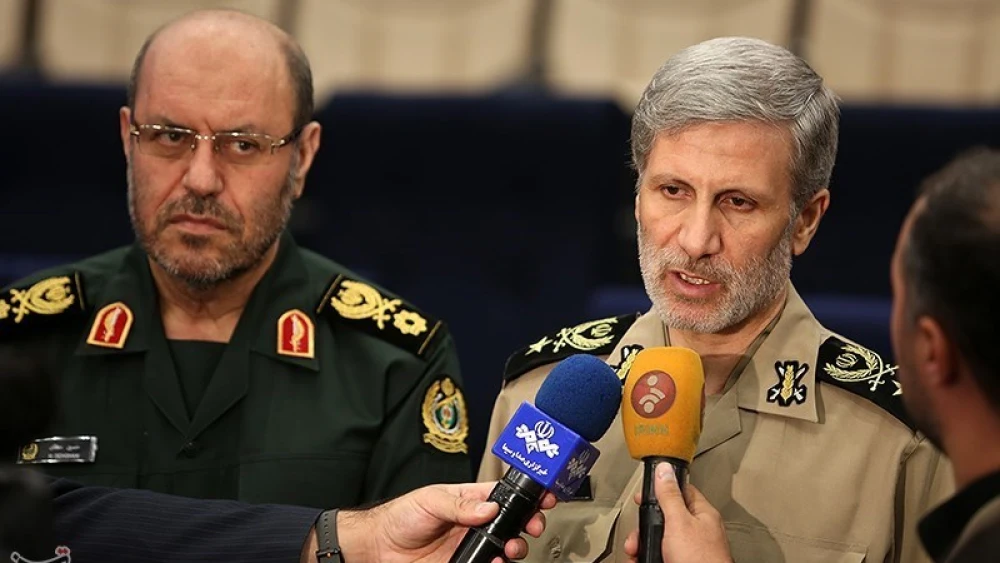
Iranian Defense Minister Gen. Amir Hatami (right) and his predecessor Gen. Hossein Dehghan, at a presentation ceremony in Tehran, Aug. 22, 2017. Credit: Tasnim News Agency via Wikimedia Commons.

With an international arms embargo lifted, Iran plans on buying advanced military systems, including armed drones, air-defense systems, fighter jets and tanks, Iranian Defense Minister Gen. Amir Hatami told local media on Wednesday.

The Islamic Republic has previously shown interest in Russia’s Su-30 and Yak-130 jets, T-90 tank and S-400 air-defense system. It has also expressed interest in several Chinese defense systems, including the J-10 and J-20 fighter jet, but was prevented from purchasing such items under the 2015 nuclear deal.

Hatami noted that Iran entered negotiations “with several countries” even before the arms embargo was lifted earlier this year, adding that the talks were now in their “advanced stages.”

Tehran is also in talks to sell several domestically produced weapons systems, including anti-tank missile systems, he said.

Earlier on Wednesday, Iranian Supreme Leader Ayatollah Ali Khamenei warned that his country had yet to “fully retaliate” over the Jan. 3 killing of Islamic Revolutionary Guard Corps’ Quds Force Gen. Qassem Soleimani in a U.S. drone strike in Iraq.

This article first appeared in Israel Hayom.

The United States is “shutting down the financial infrastructure that allows the regime to continue its threats to U.S. national security and global shipping,” the U.S. treasury secretary said.
“The American people are crying out for an end to U.S. tax dollars subsidizing Israel’s military,” Rep. Greg Casar, chair of the Congressional Progressive Caucus, told colleagues.
A U.S. Department of Homeland Security spokesman told JNS that the administration “acted well within its statutory and constitutional authority” in Khalil’s case, “as it does with any alien who advocates for violence, glorifies and supports terrorists, harasses Jews and damages property.”
“The Strait of Hormuz is open to all ship traffic except for Iran,” the U.S. president wrote.
The amendment “would restrict our country’s ability to confront Hamas, Hezbollah and other terrorist organizations in the region who are sworn enemies of both the United States and Israel,” the House minority leader said.
“We are prepared for any scenario,” the prime minister assured.
