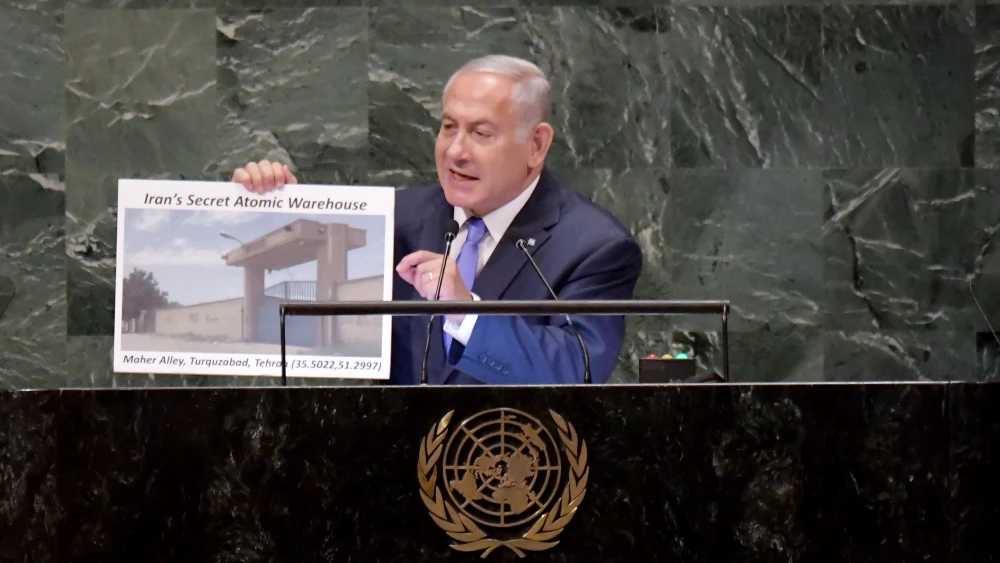
The documents recovered by Israeli intelligence from Iran’s hidden nuclear archive show “that Iran conducted far more high explosive tests at the site than previously understood,” according to a paper published on Tuesday by the Institute for Science and International Security.
Among the authors of the paper are Ollie Heinonen, former deputy director general of the International Atomic Energy Agency (IAEA); Frank Pabian, a former U.N. Nuclear Chief Inspector in Iraq for the IAEA; and David Albright, the president of the institute and a former weapons’ inspector.
With the new knowledge provided by the Iranian documents that were captured by Israel, the paper argued that the Parchin site “was a key part of” Iran’s “nuclear-weapons research and development effort.” The new information “necessitates calling for more action by the IAEA and the Joint Commission, which administers the Joint Comprehensive Plan of Action (JCPOA).”
The Iranian nuclear archives, the paper explained, confirm that Iran was testing “a specialized, difficult to develop, neutron initiator,” which is used “to start the chain reaction in a nuclear explosion.”
This showed, the paper continued, “that Iran conducted far more high explosive tests at the site than previously understood.” This also means that Iran may have stored this equipment for later use, instead of surrendering it prior to implementation of the deal.
The authors of the paper also question why the IAEA, which was informed about the archives by Israel, did not demand further clarifications from Iran about the scope of its nuclear weapons work on the basis of the new information. They noted that in 2002—when the opposition group, the National Council of Resistance of Iran, alleged that Iran had a secret nuclear site at Natanz—the IAEA “quickly” followed up with Iran.
They explained further that “maintaining such documents, material and equipment” seen in the archives, “is not compatible with the spirit and obligations of Iran under the NPT, its safeguards agreement, including the Additional Protocol, and the JCPOA.” It was, furthermore, up to the Joint Commission to ensure that Iran complied with all aspects of the JCPOA, and the information in the archives “raises profound questions about whether Iran is complying with the fundamental goal of the JCPOA, namely that ‘under no circumstances will Iran ever seek, develop or acquire any nuclear weapons.’ ”
The advanced work revealed in the archive shows that Iran “appears to have involved more than what the IAEA called feasibility and scientific studies,” as the IAEA concluded in its December 2015 assessment of Iran’s nuclear-weapons development.
In its concluding section, the paper observed: “there is no proof that Iran has abandoned its goal of building nuclear weapons, only that it has accepted that its projects and plans are put on the shelf.” Regarding Parchin, it held the IAEA’s Board of Governors responsible for “lack of adequate inspection of this site and the failure to fold new information into the IAEA’s broader challenge of ensuring that Iran’s nuclear program is actually peaceful.”
Practically, the paper suggests that the United States and EU3 (United Kingdom, France and Germany) should “urge the IAEA to substantially enhance its inspections in Iran.” This would involve actual inspections of Parchin, as well as using “the information in the seized archives to expand inspections and monitoring in Iran and build a stronger public characterization of Iran’s past nuclear weapons work.”
In an op-ed published earlier this month in The Hill, Josh Block, president and CEO of the Israel Project, noted that the IAEA had failed to follow through on the recent Israeli revelations and the implications of those failures on the agency’s overall knowledge of Iran’s nuclear weapons work.
Block argued that “the gaps in the IAEA’s knowledge—of Iran’s past nuclear work, of its military sites, of items mentioned in Section T of the nuclear deal and of the nuclear sites discovered by Israeli intelligence—raise questions about the full extent of Iran’s nuclear program.”